
Last updated: November 7, 2026 – By Diane Holcomb
November 2026 update: reconfirmed gasket-vs-manifold pricing and the cold-start tick point.
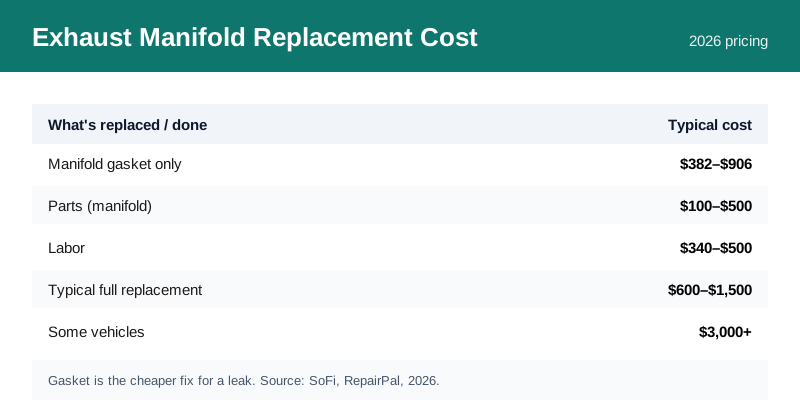
Exhaust manifold repair splits into two jobs with very different prices. A manifold gasket replacement – the fix for a leak at the joint – runs about $382 to $906. A full exhaust manifold replacement, needed when the manifold itself is cracked, runs roughly $600 to $1,500, with SoFi putting the average near $1,329 to $1,534 including parts and labor; some vehicles (performance and European) exceed $3,000. Parts are about $100 to $500 and labor $340 to $500 for typical cars. The exhaust manifold is the metal part bolted to the cylinder head that collects exhaust gases from each cylinder and funnels them into the exhaust system. When it leaks or cracks, you’ll usually hear a ticking or tapping that’s loudest on a cold start and quiets as the engine warms, sometimes with a burning smell and a check engine light. A gasket leak is the cheaper repair; a cracked manifold means replacement.
That cold-start tick is the signature of this problem, and catching which repair you need keeps the cost down. Let me break it down.
What you’ll actually pay
Here’s the split. These are estimates that vary a lot by vehicle and shop.
| Repair | Cost | Notes |
|---|---|---|
| Manifold gasket | $382–$906 | Leak at joint |
| Full manifold replacement | $600–$1,500 | Cracked manifold |
| Average (SoFi) | $1,329–$1,534 | Parts + labor |
| Performance / European | $3,000+ | More involved |
A manifold leak can mimic or accompany other exhaust issues; our muffler repair guide and exhaust system guide cover the rest of the exhaust.
Shop Talk
That ticking that’s loud on a cold start and fades as the engine warms up is the classic exhaust manifold leak – and there’s a reason for the cold-start part. The manifold and its gasket expand as they heat up, so a small crack or leaking gasket seals up tighter once the metal is hot, which is why the tick quiets down after a few minutes. Don’t let “it goes away when warm” fool you into thinking it’s fixed itself; it’s a real leak. The big cost swing is gasket versus manifold: if the leak is at the gasket between the manifold and the head, a gasket job is the cheaper fix. If the manifold itself has cracked (common on older vehicles and trucks, from years of heat cycling), it needs replacement. The two things that run up the bill are broken manifold bolts/studs – they rust and snap off, and extracting them adds real labor – and vehicles where the manifold is buried (tight engine bays, or a rear manifold on a V6/V8). Worth knowing: an exhaust leak at the manifold isn’t just noise. It can let exhaust fumes near the cabin and can throw off the oxygen sensor readings, so it’s worth fixing rather than living with.
Where Drivers Overpay
The overpay risk runs both directions here. Paying for a full manifold replacement when only the gasket is leaking is money wasted – so the repair should start with finding where the leak actually is. Conversely, repeatedly “resealing” a cracked manifold that really needs replacing just delays the inevitable and stacks up labor.
The hidden cost is broken bolts: rusted manifold studs snap during the job and add extraction labor, which a good shop will flag upfront on a high-mileage vehicle. The pattern: diagnose gasket-versus-crack first, fix the right one, and ask the shop to account for the possibility of seized bolts so the quote reflects reality.
The Real Number
A manifold gasket is $382 to $906; a full exhaust manifold replacement is $600 to $1,500 (average near $1,329 to $1,534), and $3,000+ on some performance and European cars. A tick that’s loud on a cold start and fades when warm is the telltale leak. The repair hinges on whether it’s the gasket or a cracked manifold, so diagnose that first – and expect a shop to flag rusted, breakable bolts on an older vehicle, since those drive the labor.
Frequently Asked Questions
How much does it cost to repair an exhaust manifold?
It depends on whether you need a gasket or the whole manifold. A manifold gasket replacement – the fix for a leak at the joint between the manifold and cylinder head – runs about $382 to $906. A full exhaust manifold replacement, needed when the manifold itself is cracked, runs roughly $600 to $1,500, with SoFi putting the average near $1,329 to $1,534 including parts and labor; some performance and European vehicles exceed $3,000. Parts are about $100 to $500 and labor $340 to $500 for typical cars. These are estimates that vary widely by vehicle and shop. Broken, rusted manifold bolts can add labor. A proper diagnosis of whether it’s the gasket or a crack determines which price applies.
What does the exhaust manifold do?
The exhaust manifold is the metal (cast iron or steel, sometimes with the catalytic converter integrated) part bolted directly to the cylinder head. It collects the hot exhaust gases as they leave each cylinder and funnels them together into the exhaust pipe, sending them downstream to the catalytic converter and muffler. Because it’s bolted right to the head and takes the full heat of combustion exhaust, it goes through intense heat cycling every time you drive – hot when running, cool when parked – which over years can crack it or fatigue its gasket. On many engines there’s one manifold per cylinder bank, so a V6 or V8 has two. A leak here is both a noise and an emissions concern, since it sits upstream of the oxygen sensors.
What are the symptoms of an exhaust manifold leak?
The hallmark is a ticking or tapping noise that’s loudest when the engine is cold and quiets as it warms up – because the metal expands and partly seals the leak when hot. You might also notice a burning smell (exhaust heat near plastic or the engine bay), a check engine light (a leak upstream can skew oxygen sensor readings), reduced power or fuel economy, and sometimes exhaust fumes you can smell. On a cracked manifold the tick may be more pronounced. Because the cold-start tick fades when warm, people sometimes dismiss it, but it’s a real leak that should be diagnosed. A shop can confirm whether it’s the gasket or a crack and whether any bolts have failed.
Is it a gasket leak or a cracked manifold?
That distinction drives the cost, and it takes an inspection to tell. A gasket leak is a failure of the seal between the manifold and the cylinder head – the manifold is fine, just the gasket (and sometimes loose or broken bolts) needs attention, which is the cheaper repair. A cracked manifold means the metal itself has fractured from years of heat cycling, common on older vehicles and trucks, and requires replacing the manifold. A technician identifies the leak’s source visually and by listening (sometimes with the engine cold when the leak is loudest). The repair then targets the real problem. Paying for a full manifold when only the gasket leaks, or vice versa, is the avoidable expense, so this diagnosis matters.
Is it safe to drive with an exhaust manifold leak?
It’s usually drivable in the short term, but it’s not something to ignore for long. An exhaust manifold leak can let exhaust gases escape before the catalytic converter, which means fumes (including carbon monoxide) could potentially reach the cabin – a real safety concern, especially on an enclosed or older vehicle. It can also skew the oxygen sensor readings and hurt fuel economy and performance, and a worsening crack gets louder and can damage nearby components with heat. So while a small leak won’t strand you immediately, it’s worth fixing before it grows or lets fumes in. If you smell exhaust inside the car, treat it as more urgent and get it checked promptly.
Why does the ticking noise go away when the engine warms up?
Because metal expands as it heats. The exhaust manifold and its gasket are cold when you first start the car, so a small crack or gap in the gasket is at its widest, and exhaust pulses escape through it – that’s the ticking. As the engine runs and the manifold heats up, the metal expands and the crack or gap tightens, partly sealing the leak, so the tick fades. This is why an exhaust manifold leak is often described as a cold-start tick. It’s a useful diagnostic clue, but it’s also why the problem is easy to underestimate: the noise seeming to fix itself doesn’t mean the leak is gone. It’s still leaking when cold every time, and the underlying crack or gasket failure only worsens over time.
Why do broken bolts make this repair cost more?
Exhaust manifold bolts and studs live in one of the harshest spots on the engine – constant extreme heat combined with road moisture and salt – so over years they rust and seize. When a shop removes the manifold, these aged bolts frequently snap off rather than backing out cleanly. Extracting a broken bolt or stud (drilling it out, using an extractor, or sometimes removing more parts to reach it) adds real labor, and occasionally a damaged thread needs repair. That’s why a quote on a high-mileage vehicle may include a note about possible broken bolts, and why the final bill can climb above the base estimate. A good shop will warn you of this risk upfront rather than surprising you, especially on an older truck where seized manifold bolts are common.
Sources
Price ranges verified against 2026 exhaust manifold pricing in November 2026. Dollar amounts are estimates that vary by vehicle and shop.
- SoFi – exhaust manifold replacement cost
- RepairPal – exhaust manifold gasket replacement cost
- ASE – National Institute for Automotive Service Excellence
Related Guides
- Muffler Repair Cost
- Exhaust System Replacement Cost
- Catalytic Converter Replacement Cost
- O2 Sensor Replacement Cost
- Car Repair Cost Estimator

Diane Holcomb spent seven years as a service advisor at multi-brand dealerships in Charlotte, NC, where the honest exhaust-manifold quote always included a line about rusted bolts that might snap – because on an older truck, they usually did. She drives a 2019 Honda CR-V and a hand-me-down 2007 Toyota Camry, and takes no referral fees or advertising money from any shop or chain.