
Last updated: November 9, 2026 – By Diane Holcomb
November 2026 update: reconfirmed pricing, the upstream/downstream distinction, and the use-direct-fit-sensors point.
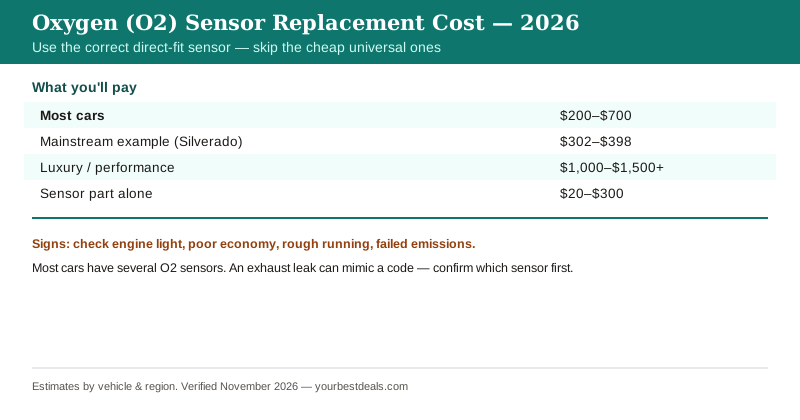
An oxygen (O2) sensor replacement runs about $200 to $700 for most cars, parts and labor – a Chevrolet Silverado 2500 lands around $302 to $398 and a Kia Cadenza around $590 to $686, while luxury and performance cars can run $1,000 to $1,500 or more. The sensor part alone is roughly $20 to $300, so DIY is cheaper where the sensor is accessible. The thing that drives this repair’s cost is which sensor and how many: most cars have several O2 sensors – upstream (before the catalytic converter) and downstream (after) – so the specific code tells you which one. A failing O2 sensor causes a check engine light, poor fuel economy, rough running, and a failed emissions test. Two tips: avoid cheap “universal” sensors on 1996-and-newer cars (use the correct direct-fit sensor), and confirm the code points to the sensor and not an exhaust leak before replacing.
O2 sensor is a common check-engine-light cause, but “which one” and “is it really the sensor” are where the money decisions are. Let me cover the cost, upstream vs. downstream, and the direct-fit rule.
What you’ll actually pay
Here’s the price picture. These are estimated ranges that vary by vehicle and shop.
| Item | Cost | Notes |
|---|---|---|
| Most cars (per sensor) | $200–$700 | Parts + labor |
| Mainstream example (Silverado) | $302–$398 | Model-specific |
| Luxury / performance | $1,000–$1,500+ | Pricier, more sensors |
| Sensor part alone | $20–$300 | Direct-fit |
Cars have multiple O2 sensors, so a “bad O2 sensor” could be any one of them, and a rusted-in sensor can be harder to remove. Our check engine light guide and catalytic converter guide cover the codes and the related emissions part.
Shop Talk
Three things keep an O2 sensor from being more expensive or more frustrating than it needs to be. First, pin down which sensor. Modern cars have at least two (an upstream sensor that helps control the fuel mixture and a downstream one that monitors the catalytic converter), and V-engines and bigger vehicles can have four or more. The trouble code names the bank and position, so you (or the shop) replace the right one instead of guessing. Second, don’t confuse an O2 code with the catalytic converter. A downstream sensor reading “low catalyst efficiency” might be a bad converter, not a bad sensor – and conversely, a lazy upstream sensor can make the computer think the cat is bad. A good diagnosis sorts that out before you spend on the wrong (expensive) part. Third, use the correct direct-fit sensor, not a cheap universal splice-in type, on any 1996-or-newer car – the universal ones can cause running and emissions problems. One more practical note: O2 sensors live in the hot exhaust and can seize in place, so a rusted sensor sometimes takes extra labor (or penetrating oil and heat) to remove without damaging the bung, which can nudge the cost up. And a faulty O2 sensor that makes the engine run rich can, over time, harm the catalytic converter – so it’s worth fixing rather than ignoring.
Where Drivers Overpay
The first overpay is replacing the wrong sensor by guessing – the code names the specific sensor (bank and upstream/downstream), so replacing that one rather than all of them avoids waste. The second, costlier one is confusing an O2 code with the catalytic converter: a downstream “low efficiency” reading can be a bad converter or a lazy sensor, so a proper diagnosis prevents spending on the pricey converter (or a sensor) unnecessarily.
Using a cheap universal sensor can cause running and emissions problems that lead to more diagnosis later – the direct-fit part is the right call. And an exhaust leak can throw O2 codes. The pattern: identify the specific sensor from the code, confirm it’s not the converter or an exhaust leak, and use the correct direct-fit sensor.
The Real Number
An O2 sensor is $200 to $700 per sensor (luxury $1,000 to $1,500+). Most cars have several (upstream and downstream), so the code tells you which one – replace that, not all of them. Don’t confuse a downstream O2 code with the catalytic converter; confirm the diagnosis before spending on the pricey cat. Use the correct direct-fit sensor on 1996-and-newer cars, not a cheap universal one, and fix a rich-running sensor before it harms the converter.
Frequently Asked Questions
How much does it cost to replace an oxygen sensor?
About $200 to $700 per sensor for most cars, parts and labor. Examples include a Chevrolet Silverado 2500 around $302 to $398 and a Kia Cadenza around $590 to $686; luxury and performance vehicles can run $1,000 to $1,500 or more, partly because they often have more sensors and pricier parts. The sensor part alone is roughly $20 to $300. These are estimates that vary by vehicle and shop. Because cars have multiple O2 sensors, the total depends on which one (and how many) you replace. A rusted-in sensor can add labor. For an accurate figure, identify the specific sensor from the trouble code and get a quote for your vehicle.
How many oxygen sensors does my car have?
Most modern cars have at least two – an upstream (pre-catalytic-converter) sensor that helps the computer control the fuel mixture, and a downstream (post-cat) sensor that monitors the catalytic converter’s efficiency. V-engines and larger vehicles often have four or more, with upstream and downstream sensors on each bank. So a “bad O2 sensor” could be any one of them, which is why the trouble code (identifying the bank and sensor position) matters for replacing the correct one. Knowing how many your car has, and which one the code points to, is key both to the diagnosis and to the cost, since you only need to replace the failed sensor, not all of them.
What are the signs of a bad O2 sensor?
Common signs are a check engine light (often with an O2-sensor or fuel-trim code), poor fuel economy, rough idle or running, hesitation, and a failed emissions test. A failing upstream sensor can make the engine run too rich or too lean, hurting economy and potentially harming the catalytic converter over time; a downstream sensor fault often shows up as a catalyst-efficiency code. Because these symptoms and codes overlap with a bad catalytic converter, an exhaust leak, or other issues, the specific code and testing confirm the O2 sensor. If you have a check engine light with worse fuel economy, an O2 sensor is a common and worthwhile suspect to diagnose.
Could an O2 code actually be the catalytic converter?
Yes, and it’s an important distinction because the converter is far more expensive. A downstream O2 sensor’s job is to monitor the catalytic converter, so a “catalyst efficiency below threshold” code can mean the converter has failed – but it can also be triggered by a lazy or faulty downstream sensor, or by an upstream sensor skewing the readings. Replacing an O2 sensor won’t help if the converter is really bad, and replacing a converter won’t help if the real issue is the sensor. A proper diagnosis – looking at the sensor data and testing the converter – sorts out which it is. Confirming this before spending prevents buying an expensive converter (or a sensor) you didn’t need.
Can I use a universal O2 sensor to save money?
It’s not recommended on 1996-and-newer vehicles. “Universal” O2 sensors that you splice into the wiring are cheaper, but they can cause running problems and emissions-system issues on modern OBD-II cars, and they’re generally discouraged. The correct approach is a direct-fit sensor made for your specific vehicle, which plugs in with the right connector and is calibrated correctly. The direct-fit part costs a bit more but avoids the headaches and potential check-engine-light or emissions problems a universal sensor can cause. Since an improper sensor can lead to more diagnosis and a repeat repair, the small savings on a universal sensor usually isn’t worth it. Use the right direct-fit part.
Is it safe to drive with a bad O2 sensor?
You can usually drive short-term, but it’s worth fixing. A failing O2 sensor often means the engine runs richer (or leaner) than ideal, hurting fuel economy and increasing emissions, and a rich condition over time can damage the catalytic converter – a far more expensive part. You’ll also have the check engine light on (masking other codes and failing emissions tests) and possibly rough running. So while a bad O2 sensor isn’t an immediate breakdown risk, leaving it can cost you in fuel and risk the converter. It’s worth diagnosing and replacing reasonably promptly, especially since catching it protects the pricier catalytic converter from damage caused by a sustained rich mixture.
Is replacing an O2 sensor a DIY job?
Often yes, when the sensor is accessible – it threads into the exhaust and unplugs from the wiring, and a special O2-sensor socket makes removal easier. The keys are confirming which sensor the code points to, using the correct direct-fit sensor, and dealing with a possibly seized sensor (the hot exhaust can rust it in place, so penetrating oil, heat, and care not to damage the threads may be needed). Some sensors are easy to reach; others are buried and awkward. For an accessible sensor with a confirmed diagnosis, DIY saves the labor. If the sensor is seized or hard to reach, or you can’t confirm which one is bad, a shop is the safer route.
Sources
Price ranges verified against 2026 oxygen sensor pricing in November 2026. Dollar amounts are estimates that vary by vehicle and shop.
- RepairPal – oxygen sensor replacement estimates
- ConsumerAffairs – oxygen sensor replacement cost
- ASE – National Institute for Automotive Service Excellence
Related Guides
- Check Engine Light Guide
- Catalytic Converter Replacement Cost
- Mass Air Flow Sensor Replacement Cost
- Spark Plug Replacement Cost
- Car Repair Cost Estimator

Diane Holcomb spent seven years as a service advisor at multi-brand dealerships in Charlotte, NC, where an O2 code got sorted – which sensor, and was it really the sensor and not the catalytic converter – before anyone bought a part. She drives a 2019 Honda CR-V and a hand-me-down 2007 Toyota Camry, and takes no referral fees or advertising money from any shop or chain.