
Last updated: November 10, 2026 – By Diane Holcomb
November 2026 update: reconfirmed Honda tune-up pricing and the maintenance-minder point.
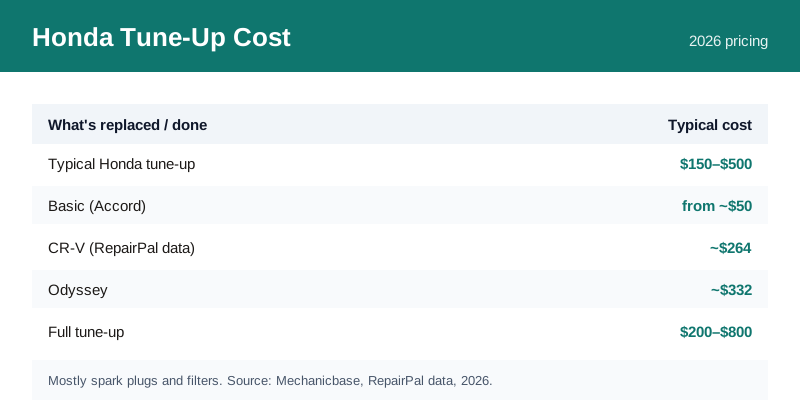
A Honda tune-up runs about $150 to $500 typically – from around $50 for a basic Accord service to over $500 for a larger vehicle like the Odyssey. By model, a CR-V tune-up is around $264 and an Odyssey around $332, and a full “full tune-up” runs $200 to $800. Dealers typically charge more than independent shops. Here’s what matters: a modern Honda “tune-up” isn’t the old points-and-carburetor service of decades past. On today’s Hondas it mainly means replacing the spark plugs and the air and fuel filters, inspecting the ignition and engine-control systems, and checking fluids and belts. And rather than a fixed-mileage schedule, newer Hondas use the Maintenance Minder system, which monitors your driving and tells you (via dash codes) what service is actually due – so “tune-up” really means doing the items the car and manual call for.
“Tune-up” means something different on a modern Honda than it used to, and the Maintenance Minder tells you what’s actually due. Let me break it down.
What you’ll actually pay
Here’s the picture. These are estimates that vary by model and shop.
| Service | Cost | Notes |
|---|---|---|
| Typical Honda tune-up | $150–$500 | By model |
| Basic (Accord) | from ~$50 | Minimal |
| CR-V / Odyssey | ~$264 / ~$332 | RepairPal data |
| Full tune-up | $200–$800 | Plugs + filters + inspection |
A tune-up bundles several services; our spark plugs guide, cabin air filter guide, and general tune-up guide cover the items.
Shop Talk
“Tune-up” is a loose term today, so the first thing to pin down is what’s actually included – because that’s what sets the price. On an old carbureted car, a tune-up meant points, condenser, carb adjustment, timing. On a modern Honda, there’s none of that; the “tune-up” is really scheduled maintenance: spark plugs (the big one – Honda’s are often long-life iridium plugs good for around 100,000 miles, so they’re not done every visit), the engine air filter, the cabin air filter, sometimes a fuel filter, plus inspecting the ignition coils, belts, fluids, and running a diagnostic check. So a $50 “tune-up” might be just an air filter and inspection, while a $400-plus one includes a full set of iridium plugs and multiple filters. Ask for the itemized list. Two Honda-specific tips. One, follow the Maintenance Minder, not a generic mileage. Newer Hondas display service codes (an “A” or “B” main code plus numbered sub-codes like 1 through 6) telling you exactly what’s due based on your actual driving – so you do what the car calls for instead of paying for a blanket “tune-up.” Two, the dealer isn’t your only option: independent shops do Honda maintenance for less, and you don’t void your warranty by using a reputable independent (keep your receipts). Don’t let a shop sell a big “tune-up” of items that aren’t due yet – match it to the Maintenance Minder and the manual.
Where Drivers Overpay
The overpay is paying for a big “tune-up” bundle of items that aren’t due yet. On a modern Honda the Maintenance Minder (and the manual) tells you exactly what the car needs now – long-life iridium plugs aren’t a every-visit item, for instance – so matching the service to what’s actually due beats a blanket tune-up.
The other is defaulting to the dealer: reputable independent shops do Honda maintenance for less without voiding the warranty (keep receipts). The pattern: read the Maintenance Minder code, get an itemized list, do only what’s due, and compare an independent shop against the dealer.
The Real Number
A Honda tune-up is $150 to $500 (a CR-V ~$264, an Odyssey ~$332, a full service up to $800). On a modern Honda it mainly means spark plugs (long-life iridium, not every visit) and air/fuel filters plus inspection – not the old points-and-carb job. Follow the Maintenance Minder and manual so you do only what’s actually due, get an itemized list, and a reputable independent shop costs less than the dealer without voiding the warranty.
Frequently Asked Questions
How much does a Honda tune-up cost?
About $150 to $500 typically, ranging from around $50 for a basic Accord service (an air filter and inspection) to over $500 for a larger vehicle like an Odyssey with a full set of plugs and filters. By model, a CR-V tune-up runs around $264 and an Odyssey around $332, while a full “full tune-up” is $200 to $800. Dealers generally charge more than independent shops. These are estimates that vary by model and shop. The wide range comes from what’s included: a minimal service (one filter, inspection) is cheap, while a full service with a set of iridium spark plugs and multiple filters costs more. So the price depends on exactly which items are done – which is why it’s worth getting an itemized list and matching it to what your Honda actually needs per the Maintenance Minder and manual.
What does a modern Honda tune-up include?
On a modern Honda, a “tune-up” is really scheduled maintenance, not the old carburetor-era service. It typically includes replacing the spark plugs (Honda often uses long-life iridium plugs good for roughly 100,000 miles, so they’re not replaced every visit), the engine air filter, the cabin air filter, and sometimes a fuel filter; plus inspecting the ignition coils, drive belt, and fluids, and often a diagnostic scan. Older or basic services may be just an air filter and inspection. What it does NOT include anymore (because modern cars don’t have them) are points, a condenser, carburetor adjustments, or manual ignition timing – those are gone. So a Honda tune-up is a bundle of maintenance items, and exactly which items depends on your mileage and what’s due. Ask the shop for the specific list of what they’ll do, since “tune-up” can mean a quick filter-and-inspect or a full plugs-and-filters service.
What is the Honda Maintenance Minder?
The Maintenance Minder is the service-reminder system in newer Hondas that tells you what maintenance is due based on your actual driving, rather than a fixed mileage schedule. The car monitors things like engine oil condition and driving patterns, and when service is due it displays a code on the dash: a main code – “A” (basic, oil change) or “B” (oil change plus inspections) – often combined with numbered sub-codes (1 through 6) that call for specific items like tire rotation, air and cabin filters, transmission fluid, spark plugs, coolant, or valve adjustment. So instead of guessing or paying for a blanket “tune-up,” you read the code and do exactly what the car is asking for. This is the Honda-specific way to know what’s actually due. A shop (or your owner’s manual) can translate the codes. Following the Maintenance Minder means you service the right items at the right time – not overpaying for things that aren’t due, and not missing things that are.
How often does a Honda need a tune-up?
There isn’t a single “tune-up interval” on a modern Honda – the items that make up a tune-up each have their own schedule, which the Maintenance Minder and owner’s manual specify. Spark plugs (long-life iridium) are often good for around 100,000 miles, so they’re a milestone service, not a frequent one. Air and cabin filters are replaced more often (commonly every 15,000 to 30,000 miles, sooner in dusty conditions). Oil changes and tire rotations come up frequently via the Maintenance Minder. So “how often” depends on which item you mean. The old advice of a tune-up every 30,000 miles roughly lines up with when a cluster of these items tends to come due, but the right approach is to follow the Maintenance Minder codes and the manual’s schedule for your specific model and driving, rather than a blanket interval. That ensures you do each item when it’s actually needed.
Do I have to go to a Honda dealer for a tune-up?
No – you can have Honda maintenance done at a reputable independent shop, and it typically costs less than the dealer. Using an independent mechanic does not void your Honda factory warranty, as long as the work is done correctly with appropriate parts and you keep records/receipts (under consumer protection rules, a manufacturer can’t require dealer-only service to keep the warranty valid). So for routine tune-up items – plugs, filters, inspections – a trusted independent shop is usually the value choice. The dealer may be preferable for warranty-covered work, recalls, or complex Honda-specific procedures, and some owners prefer the dealer for records. But for everyday maintenance, you have the choice, and independents are generally cheaper. Just use a reputable shop, insist on quality (ideally OEM or OEM-equivalent) parts for things like spark plugs, and keep your service receipts to document that maintenance was performed.
Will a tune-up fix my Honda’s problem?
It depends on the problem. A tune-up is maintenance, so it addresses wear items and can resolve issues caused by worn plugs or clogged filters – for example, a rough idle, hesitation, or reduced fuel economy from old spark plugs or a dirty air filter can improve after a tune-up. But a tune-up is not a diagnostic repair, so it won’t fix a specific fault like a failed sensor, a bad ignition coil, a check engine light with a particular code, or a mechanical problem – those need targeted diagnosis and repair. So if your Honda has a specific symptom or warning light, don’t assume a general “tune-up” will cure it; get it diagnosed, because you might pay for a tune-up and still have the problem. A tune-up is worthwhile as preventive maintenance and can smooth out wear-related drivability, but match the service to the issue: maintenance for maintenance, diagnosis-and-repair for a specific fault.
Why is spark plug replacement the big part of a Honda tune-up?
Because the spark plugs are usually the most significant (and sometimes priciest) item in a Honda tune-up, and they’re on a long interval, so they drive the cost of a “full” tune-up. Many Hondas use long-life iridium spark plugs rated for roughly 100,000 miles, meaning a full set replacement is a milestone service that comes up infrequently – which is exactly why a tune-up that includes new plugs costs much more than one that’s just a filter change. The labor to reach the plugs varies by engine (some are easy, some require removing the intake on V6s), affecting the price too. So when a Honda tune-up is quoted at the higher end ($300 to $500-plus), new spark plugs are usually why. If your plugs aren’t due yet (you’re well under their interval), a “tune-up” shouldn’t include them, and you’d pay less. This is a good example of why matching the service to what’s actually due – via the Maintenance Minder – keeps the cost right.
Sources
Price ranges verified against 2026 Honda tune-up pricing in November 2026. Dollar amounts are estimates that vary by model and shop.
- Jerry – Honda tune-up cost
- CarParts – Honda tune-up costs and maintenance
- ASE – National Institute for Automotive Service Excellence
Related Guides
- Tune-Up Cost
- Spark Plugs Replacement Cost
- Cabin Air Filter Replacement Cost
- BMW Oil Change Cost
- Car Repair Cost Estimator

Diane Holcomb spent seven years as a service advisor at multi-brand dealerships in Charlotte, NC, a lot of it on the Honda side, where she’d read the Maintenance Minder code with the customer so the “tune-up” was only what the car actually called for – not a blanket bundle. She drives a 2019 Honda CR-V and a hand-me-down 2007 Toyota Camry, and takes no referral fees or advertising money from any shop or chain.