
Last updated: November 8, 2026 – By Diane Holcomb
November 2026 update: reconfirmed gasket-vs-manifold pricing and the plastic-manifold point.
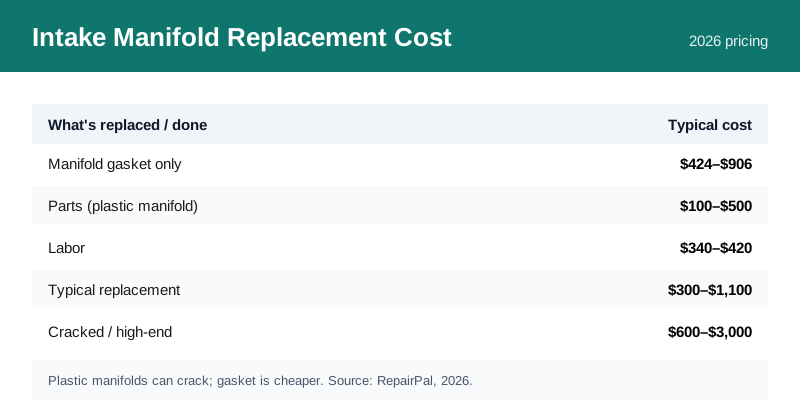
Intake manifold repair, like the exhaust side, splits into gasket versus full manifold. A manifold gasket replacement runs about $424 to $906. A full intake manifold replacement runs roughly $300 to $1,100 for most vehicles, and $600 to $3,000 when a plastic manifold cracks on a larger or higher-end engine. Parts are about $100 to $500 and labor $340 to $420 for typical cars. The intake manifold is the part that distributes incoming air (and on many engines, routes coolant passages) to each cylinder. A failing intake manifold gasket or a cracked plastic manifold causes a rough idle, a check engine light, a vacuum leak (which can cause high or surging idle), or – on engines with coolant running through the manifold – a coolant leak and overheating. Many modern manifolds are plastic, which saves weight but can crack and warp with age and heat. A gasket leak is the cheaper fix; a cracked manifold needs replacement.
The plastic-manifold era changed this repair, and the gasket-versus-crack question decides the price. Let me walk through it.
What you’ll actually pay
Here’s the split. These are estimates that vary a lot by vehicle and shop.
| Repair | Cost | Notes |
|---|---|---|
| Manifold gasket | $424–$906 | Leak at joint |
| Full manifold (most cars) | $300–$1,100 | Parts + labor |
| Cracked plastic / high-end | $600–$3,000 | Larger engines |
| Parts / labor | $100–$500 / $340–$420 | Typical |
An intake leak often shows up as a vacuum leak causing rough idle; our IAC valve guide and coolant leak guide cover the related symptoms.
Shop Talk
The thing that changed this repair is plastic. For weight and cost, a lot of engines from the last couple of decades use a plastic (composite) intake manifold, and plastic doesn’t love decades of heat cycling – it gets brittle, and the manifold itself or its coolant crossover can crack. On some well-known engines, a cracked plastic intake that leaks coolant is a known failure point. So the first thing to pin down is what’s leaking and where: a gasket leak (air or coolant escaping at the seal between the manifold and the heads) is the cheaper gasket job; a crack in the plastic manifold body means replacing the manifold. Two symptoms steer the diagnosis. If it’s a vacuum leak, you’ll get a rough, high, or surging idle and often a lean code, and you can sometimes hear a hiss. If it’s a coolant leak – on engines where coolant runs through the manifold – you’ll smell sweet coolant, see it weeping, or watch the coolant level drop, and in a bad case the engine overheats. Because the labor to get the manifold off is the bulk of the cost either way, it’s usually worth replacing the gaskets (and any cheap related parts under there) while it’s open, so you’re not paying that labor twice.
Where Drivers Overpay
The gasket-versus-crack call is where the money is. Paying for a full plastic manifold when only the gasket is leaking is a waste – but repeatedly resealing a cracked manifold that needs replacing just stacks labor. So the repair should start with finding where and what is leaking (air or coolant, gasket or body).
The offsetting save: since the labor to pull the manifold is the bulk of the bill, doing the gaskets and cheap related parts underneath while it’s open avoids paying that teardown twice. The pattern: diagnose gasket-versus-crack and air-versus-coolant first, fix the right thing, and bundle the under-manifold parts while access is open.
The Real Number
An intake manifold gasket is $424 to $906; a full manifold is $300 to $1,100 for most cars and $600 to $3,000 when a plastic one cracks on a larger engine. Rough or surging idle points to a vacuum leak; a sweet smell and dropping coolant point to a cracked plastic manifold on engines where coolant runs through it. Diagnose gasket-versus-crack first, and since the teardown labor is the bulk of the cost, do the gaskets and cheap under-manifold parts while it’s open.
Frequently Asked Questions
How much does it cost to repair an intake manifold?
It depends on gasket versus full manifold. An intake manifold gasket replacement runs about $424 to $906. A full intake manifold replacement runs roughly $300 to $1,100 for most vehicles, and $600 to $3,000 when a plastic manifold cracks on a larger or higher-end engine. Parts are about $100 to $500 and labor $340 to $420 for typical cars. These are estimates that vary widely by vehicle and shop. Because the labor to remove the manifold is the bulk of the cost either way, it’s usually worth replacing the gaskets while it’s open. A proper diagnosis of whether it’s the gasket or a cracked manifold, and whether the leak is air or coolant, determines which price applies.
What does the intake manifold do?
The intake manifold distributes the air (in a port-injection engine, the air-fuel mixture) coming into the engine evenly to each cylinder. It bolts to the cylinder head(s) over the intake ports and connects to the throttle body. On many engines it also routes coolant passages and mounts sensors and other components. Its job is to deliver a smooth, balanced flow of air to every cylinder so the engine runs evenly. Modern manifolds are often made of plastic (composite) to save weight. Because it handles intake air under vacuum and, on many engines, carries coolant, a leak in the manifold or its gasket causes either a vacuum leak (affecting idle) or a coolant leak, depending on where it fails.
What are the symptoms of an intake manifold leak?
It depends on whether air or coolant is leaking. A vacuum (air) leak at the intake manifold or gasket causes a rough, high, or surging idle, hesitation, a lean condition with a check engine light, and sometimes an audible hiss. A coolant leak – on engines where coolant runs through the manifold – shows up as a sweet smell, visible coolant weeping or puddling, a dropping coolant level, and in a bad case engine overheating. Some failures cause both. A cracked plastic manifold is a common source on certain engines. Because these symptoms overlap with other issues (a separate vacuum leak, a bad IAC valve, or another coolant leak), a shop diagnoses the exact source before repair. Pinpointing it avoids replacing the wrong part.
Why do plastic intake manifolds crack?
Plastic (composite) intake manifolds are used on many modern engines to save weight and cost, but plastic doesn’t handle decades of heat cycling as well as metal. Over years of heating up and cooling down, the plastic gets brittle and can crack – often at a coolant crossover passage, a thin section, or around a fitting. On some well-known engines, a cracked plastic intake that leaks coolant is a recognized failure point at higher mileage. Once the plastic body itself is cracked (as opposed to just the gasket leaking), the fix is to replace the manifold, since you can’t reliably repair a structural crack in it. This is why older vehicles with plastic manifolds sometimes need a full manifold rather than just a gasket – the material has simply aged out.
Is it safe to drive with an intake manifold leak?
It depends on the type of leak. A vacuum (air) leak usually leaves the car drivable but with a rough or high idle, possible stalling, and reduced efficiency – not an immediate emergency, but worth fixing before it worsens or strands you with stalling. A coolant leak from the manifold is more serious: losing coolant can lead to overheating, which can damage the engine (warped head, blown head gasket), so that type shouldn’t be driven on for long. If your temperature gauge climbs or you’re losing coolant, treat it as urgent. So a mild vacuum leak gives you some time, but a coolant leak from the manifold is a fix-it-soon situation. Have the leak diagnosed to know which type you have and how urgent it is.
Should the gaskets and other parts be replaced while the manifold is off?
Usually yes, and it’s good value. Removing the intake manifold is the labor-intensive part of this job, and once it’s off, a number of parts underneath become easily accessible – the intake gaskets (always replaced), and often things like certain hoses, the PCV valve, spark plugs on some engines, or a thermostat or coolant parts, depending on the engine. Doing those while the manifold is already removed means you don’t pay that same teardown labor again later when one of them fails. So a good shop will point out the cheap related parts worth doing at the same time. You don’t have to replace everything, but the gaskets are mandatory and bundling a few aging related parts under there is often smart. Ask the shop what’s accessible.
Is an intake manifold leak the same as a vacuum leak?
An intake manifold gasket leak is one type of vacuum leak, but not all vacuum leaks are at the manifold. The intake manifold operates under vacuum, so a leak at its gasket lets in unmetered air and causes the classic vacuum-leak symptoms: rough or high idle, surging, and a lean code. But vacuum leaks can also come from cracked vacuum hoses, a bad PCV valve, a torn intake boot, or a leaking brake booster – none of which are the manifold. So while a manifold gasket leak is a common cause of a vacuum leak, a shop should confirm the leak is actually at the manifold before replacing its gasket. A smoke test of the intake system finds exactly where the air is getting in, so you fix the right source rather than guessing.
Sources
Price ranges verified against 2026 intake manifold pricing in November 2026. Dollar amounts are estimates that vary by vehicle and shop.
- Samarins – intake manifold, problems and replacement cost
- RepairPal – repair cost estimator
- ASE – National Institute for Automotive Service Excellence
Related Guides
- Idle Air Control Valve Replacement Cost
- Coolant Leak Repair Cost
- Throttle Body Replacement Cost
- Exhaust Manifold Repair Cost
- Car Repair Cost Estimator

Diane Holcomb spent seven years as a service advisor at multi-brand dealerships in Charlotte, NC, where a cracked plastic intake leaking coolant was a familiar high-mileage story on certain engines – and where doing the gaskets while it was open saved customers a second teardown. She drives a 2019 Honda CR-V and a hand-me-down 2007 Toyota Camry, and takes no referral fees or advertising money from any shop or chain.