
Last updated: November 5, 2026 – By Diane Holcomb
November 2026 update: reconfirmed MAP pricing and the clean/confirm-first point.
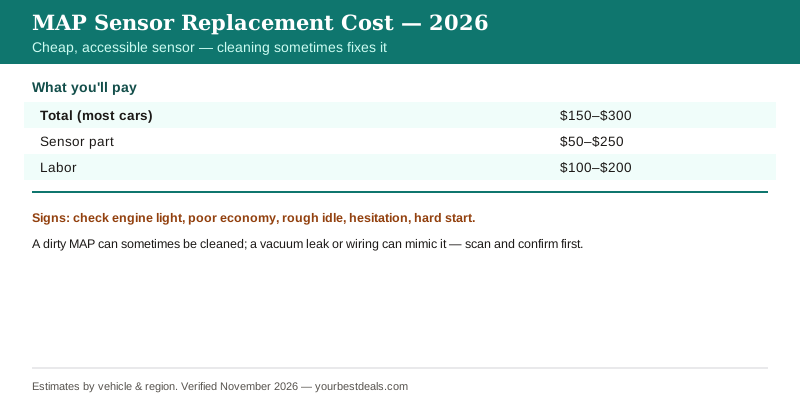
A manifold absolute pressure (MAP) sensor replacement runs about $150 to $300 total for most cars, with the sensor part roughly $50 to $250 and labor $100 to $200. It’s usually an easy, accessible part (on or near the intake manifold), so DIY is cheaper. The MAP sensor measures the pressure inside the intake manifold so the computer can calculate engine load and set the fuel mixture, so a fault causes a check engine light, poor fuel economy, rough idle, hesitation, and hard starting. Like the mass air flow sensor, a dirty MAP sensor can sometimes be cleaned rather than replaced, and a vacuum leak or wiring issue can mimic the same symptoms – so scan the codes and confirm the sensor before replacing it.
The MAP is a cheap, accessible sensor with the same “clean or confirm before you replace” logic as the MAF. Let me cover the cost, the cleaning option, and the look-alikes.
What you’ll actually pay
Here’s the price picture. These are estimated ranges that vary by vehicle and shop.
| Item | Cost | Notes |
|---|---|---|
| Total (most cars) | $150–$300 | Usually accessible |
| Sensor part | $50–$250 | Varies by vehicle |
| Labor | $100–$200 | Short job |
The MAP sensor is typically mounted on or near the intake manifold and held by a bolt and connector, so labor is modest. Our MAF sensor guide and check engine light guide cover the related airflow/pressure sensing and the codes.
Shop Talk
The MAP sensor does a job similar to a MAF – it tells the computer about engine load (by reading manifold pressure) so the fuel mixture is right – and it has the same money-saving angle: a dirty sensor can sometimes be cleaned instead of replaced. If the port or the sensor element is gummed up with oil or carbon, carefully cleaning it (with an appropriate electronics/MAF-type cleaner, not touching the element) can restore a correct reading. It’s also usually one of the easier, cheaper sensors to replace if it’s really failed, since it’s typically right on or near the intake manifold. The thing to rule out first is a vacuum leak: because the MAP reads manifold pressure, a vacuum leak throws off that reading and causes the same rough idle, hesitation, and lean codes a bad MAP would – and replacing the sensor won’t fix a leak. Wiring and connector faults can also mimic a MAP fault. So scan the codes, look at the MAP’s live reading (a shop can compare it to expected values at idle and under throttle), and check for vacuum leaks before buying a sensor. Done right, this is a cheap, quick fix; done by guessing, people sometimes replace a good MAP when the real problem was a cracked vacuum hose.
Where Drivers Overpay
The overpay is replacing a MAP that was only dirty, or replacing it when a vacuum leak was the real cause. A gummed-up MAP can sometimes be cleaned for almost nothing, and a vacuum leak throws off the manifold-pressure reading in a way that mimics a bad MAP – but a new sensor won’t fix a leak. Scanning the codes, checking the live MAP reading, and checking for vacuum leaks first prevents both.
Wiring and connector faults can also imitate a MAP failure. The pattern: scan the codes, try cleaning a dirty sensor, rule out a vacuum leak and wiring, and only replace the (cheap, accessible) sensor once it’s confirmed failed.
The Real Number
A MAP sensor is $150 to $300 – a cheap, usually accessible part. A dirty one can sometimes be cleaned instead of replaced, and a vacuum leak (or wiring fault) mimics a bad MAP but won’t be fixed by a new sensor. Scan the codes, check the live reading, and rule out a vacuum leak before replacing it.
Frequently Asked Questions
How much does it cost to replace a MAP sensor?
About $150 to $300 total for most cars, with the sensor part roughly $50 to $250 and labor $100 to $200. The MAP sensor is usually easy to reach (on or near the intake manifold), so labor is modest and DIY is cheaper. These are estimates that vary by vehicle and shop. Because the part is inexpensive and accessible, the cost is modest, and the main value is confirming the MAP is actually the problem – not just dirty, and not a vacuum leak or wiring fault – before replacing it. A quick scan and a look at the sensor’s live reading can save you from buying a sensor that wasn’t the cause.
What does the MAP sensor do?
The manifold absolute pressure (MAP) sensor measures the pressure (or vacuum) inside the intake manifold, which the engine computer uses to gauge engine load and help calculate the correct air-fuel mixture and ignition timing. On many engines it serves the role the mass air flow (MAF) sensor does on others – giving the computer the information it needs to fuel the engine properly across conditions. Because its reading directly affects the fuel mixture, a faulty MAP sensor causes the engine to run too rich or too lean, producing drivability and economy symptoms. It’s a small, inexpensive sensor, but its signal is central to engine management, which is why a bad one triggers a check engine light and running problems.
What are the signs of a bad MAP sensor?
Common signs include a check engine light (often with a MAP-related or fuel-trim code), poor fuel economy, rough or unstable idle, hesitation or stumbling, hard starting, and sometimes black smoke or a rich/lean running condition. Because the MAP reading sets the fuel mixture, a wrong value makes the engine run poorly. These symptoms overlap with a vacuum leak, a dirty throttle body, or other sensor issues, so the trouble codes and the MAP’s live data are used to confirm it. A dirty MAP can produce the same symptoms as a failed one, which is why cleaning is worth trying first. If you have these symptoms with a MAP code, the sensor is a cheap, worthwhile thing to check.
Can cleaning the MAP sensor fix it?
Sometimes, yes. If the MAP sensor’s port or sensing element is contaminated with oil, carbon, or debris, it can read inaccurately without being truly failed, and carefully cleaning it (with an appropriate electronics or MAF-type cleaner, without touching the delicate element) can restore a correct reading. So cleaning is a reasonable, cheap first step when contamination is suspected. If cleaning doesn’t resolve it and the sensor’s readings are still wrong, then replacement – which is inexpensive and usually easy on the MAP – is the next step. As with the MAF, many “bad sensor” complaints are really a dirty sensor or a related issue, so trying a cleaning before buying the part can save money.
Could it be a vacuum leak instead of the MAP sensor?
Yes, and it’s the key thing to rule out. The MAP sensor reads manifold pressure, so a vacuum leak – unmetered air or a change in manifold pressure from a cracked hose, bad gasket, or loose fitting – directly skews what the MAP reports and causes the same rough idle, hesitation, and lean-running symptoms a bad MAP would. Replacing the sensor won’t fix a vacuum leak. A proper diagnosis checks the MAP’s live reading against expected values and checks for vacuum leaks before concluding the sensor is bad. Wiring and connector faults can also mimic a MAP failure. Confirming the actual cause before buying a sensor prevents the common mistake of replacing a good MAP when the real problem was a cracked vacuum hose.
Can I drive with a bad MAP sensor?
You can usually drive short-term – a MAP fault typically causes drivability and economy issues plus a check engine light rather than a breakdown, and the computer may use a default strategy. But it’s not ideal: rough running, hesitation, poor fuel economy, and a possible rich mixture (which can foul plugs or stress the catalytic converter over time) make it worth fixing. The persistent light also masks other codes and fails emissions tests. Since the sensor is cheap and often cleanable, there’s little reason to keep driving with a MAP stumble for long. Confirm the cause (clean it, rule out a vacuum leak) and address it reasonably soon to restore smooth running and economy.
Is replacing a MAP sensor a DIY job?
Usually yes – it’s one of the easier sensor replacements. The MAP sensor is typically mounted on or near the intake manifold and held by a single bolt or screw and an electrical connector (and sometimes a vacuum port), so swapping it is quick once the fault is confirmed. Cleaning it yourself (the recommended first step) is even simpler. The keys are confirming the MAP is the issue – clean it first, rule out vacuum leaks and wiring – using the correct part, and handling the sensor carefully. For an accessible MAP with a confirmed diagnosis, DIY saves the labor. If you can’t confirm the cause or suspect a vacuum leak, a shop’s diagnosis is worthwhile before you replace anything.
Sources
Price ranges verified against 2026 MAP sensor pricing in November 2026. Dollar amounts are estimates that vary by vehicle and shop.
- Bumper – MAP/MAF sensor replacement cost
- RepairPal – MAP sensor estimates
- ASE – National Institute for Automotive Service Excellence
Related Guides
- Mass Air Flow Sensor Replacement Cost
- Check Engine Light Guide
- Oxygen Sensor Replacement Cost
- Throttle Body Replacement Cost
- Car Repair Cost Estimator

Diane Holcomb spent seven years as a service advisor at multi-brand dealerships in Charlotte, NC, where a MAP code got a cleaning and a vacuum-leak check first – more than once the “bad sensor” was a cracked hose. She drives a 2019 Honda CR-V and a hand-me-down 2007 Toyota Camry, and takes no referral fees or advertising money from any shop or chain.