
Last updated: November 5, 2026 – By Diane Holcomb
November 2026 update: reconfirmed the cost-by-source ranges and the diagnose-first point.
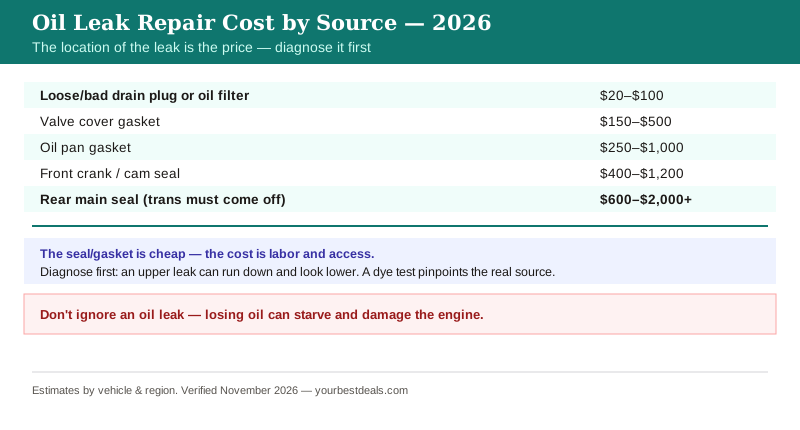
Oil leak repair costs anywhere from about $20 to $2,000 or more – the location of the leak is the price. A loose or bad drain plug or oil filter is the cheapest fix ($20 to $100); a valve cover gasket is $150 to $500; an oil pan gasket $250 to $1,000; a front crankshaft or camshaft seal $400 to $1,200; and a rear main seal is the priciest at $600 to $2,000 or more, because reaching it often requires removing the transmission (a 6-to-10-hour job). The seal or gasket itself is usually cheap – the cost is almost all labor and access. That huge range is exactly why the first step for any oil leak is a proper diagnosis to find where the oil is actually coming from, since an upper leak can run down and look like it’s lower.
Oil leaks are the repair where the same symptom – drips on the driveway – can mean a $30 fix or a $2,000 one, so diagnosis is everything. Let me lay out the cost by source and why finding the exact leak first saves money.
What each oil leak repair costs
Here’s the price picture by source. These are estimated ranges that vary by vehicle and shop.
| Leak source | Typical cost | Notes |
|---|---|---|
| Loose/bad drain plug or oil filter | $20–$100 | Cheapest; often from a sloppy oil change |
| Valve cover gasket | $150–$500 | Common, top of engine |
| Oil pan gasket | $250–$1,000 | Access varies |
| Front crank / cam seal | $400–$1,200 | Behind timing cover area |
| Rear main seal | $600–$2,000+ | Transmission usually must come off |
The pattern: the part (a gasket or seal) is cheap, but the labor to reach it ranges from trivial (a drain plug) to enormous (a rear main seal behind the transmission). That’s why the same amount of leaking oil can cost wildly different amounts to fix depending on where it originates. Our engine oil guide, valve cover gasket cost, and oil pan gasket cost guides cover the common sources in detail.
Shop Talk
Pay for the diagnosis first on an oil leak, because the whole bill depends on pinpointing the exact source – and oil is sneaky about hiding where it comes from. Oil runs downhill with airflow, so a leak at the top of the engine (say a valve cover gasket) can trickle down and coat the lower engine, making it look like an oil pan or even a rear main seal leak. Replace the pan gasket when the real leak was the valve cover and you’ve spent money and still have a leak. The right move is a proper diagnosis: the shop cleans the engine, often adds a UV dye to the oil, runs the car, and then uses a black light to trace the glowing dye back to the actual source. That’s cheap next to replacing the wrong gasket. A few money notes: first, check the easy stuff – a surprising number of “leaks” right after an oil change are just a loose drain plug, a double-gasketed filter, or an overfill, which are near-free fixes. Second, know that a rear main seal is the expensive one because the transmission usually has to come out, so if you’re told it’s the rear main, get a second opinion and confirm the diagnosis before authorizing that big job. And don’t ignore an oil leak hoping it’ll stay small – losing oil can run the engine low and cause serious damage, far more than the leak repair.
Where Drivers Overpay
The biggest overpay is replacing the wrong gasket because the leak wasn’t properly traced. Oil from an upper leak runs down and mimics a lower one, so without a dye trace a shop can replace a pan gasket when the valve cover was the real source – money spent, leak still there. A proper diagnosis (clean, dye, black-light trace) is cheap insurance against fixing the wrong thing, especially before any big job. The second overpay is authorizing an expensive rear main seal without confirming it – since that job means pulling the transmission, a wrong diagnosis there is very costly.
The flip side is checking the cheap causes first: a leak right after an oil change is often a loose drain plug, a doubled-up filter gasket, or an overfill – near-free to fix, not a gasket job. And don’t ignore a confirmed leak to save money now, because running low on oil can cause engine damage that dwarfs the repair. The pattern: diagnose and trace the exact source, rule out the cheap oil-change-related causes, confirm before any big-labor seal job, and don’t neglect a real leak. Our low oil pressure guide covers the risk of running low.
The Real Number
Oil leak repair runs $20 to $2,000+ depending on the source: drain plug/filter $20-$100, valve cover gasket $150-$500, oil pan gasket $250-$1,000, front seal $400-$1,200, rear main seal $600-$2,000+ (transmission comes off). The part is cheap; labor and access set the price. Pay for a dye-trace diagnosis first – an upper leak runs down and looks lower, so tracing it prevents replacing the wrong gasket. Rule out a loose drain plug after an oil change, and confirm before any rear-main job.
Frequently Asked Questions
How much does it cost to fix an oil leak?
Anywhere from about $20 to $2,000 or more, because the cost depends entirely on where the leak is. A loose drain plug or filter is $20 to $100, a valve cover gasket $150 to $500, an oil pan gasket $250 to $1,000, a front crank or cam seal $400 to $1,200, and a rear main seal $600 to $2,000 or more (the transmission usually has to come off). The seal or gasket is cheap – the cost is labor and access. These are estimates that vary by vehicle. A proper diagnosis to find the exact source is the essential first step.
Why do oil leak repair costs vary so much?
Because the part is cheap but the labor to reach it varies enormously. A gasket or seal itself costs little, but accessing it ranges from trivial (tightening a drain plug) to a major job (a rear main seal behind the transmission, which requires removing the transmission – 6 to 10 hours). So the same amount of leaking oil can cost $30 or $2,000 to fix depending purely on where it originates. That’s why identifying the exact source is so important: it determines whether you’re facing a quick cheap fix or a big labor bill.
Why is a rear main seal so expensive to replace?
Because of where it sits. The rear main seal seals the back of the crankshaft where it exits the engine to meet the transmission, so reaching it usually requires removing the transmission (and sometimes more), a labor-intensive job that can book 6 to 10 hours. The seal itself is inexpensive, but that heavy labor pushes the total to $600 to $2,000 or more. Because it’s such a big job, it’s worth confirming the rear main seal is really the leak source – not an upper leak running down – before authorizing it, and getting a second opinion is reasonable.
How do mechanics find where an oil leak is coming from?
The reliable method is a dye trace. The shop cleans the engine, adds a UV (fluorescent) dye to the oil, runs the car so the oil circulates and leaks, then uses a black light to spot where the glowing dye is escaping – pinpointing the exact source. This matters because oil runs downhill and with airflow, so an upper leak (like a valve cover) can coat the lower engine and look like a pan or rear main leak. The dye trace prevents replacing the wrong gasket. It’s an inexpensive diagnostic step relative to the cost of fixing the wrong thing.
My car is leaking oil right after an oil change – what’s wrong?
Often it’s something cheap and oil-change-related rather than a failed gasket. Common culprits are a loose or over-tightened drain plug, a drain plug with a bad or missing washer, an oil filter that wasn’t sealed properly (or got “double-gasketed” when the old filter’s gasket stuck), or simply an overfill. These are near-free to fix – tighten or reseat the plug or filter, or correct the level. So if the leak appeared right after service, check (or have the shop check) those first before assuming an expensive gasket repair. A reputable shop will correct their own installation error at no charge.
Is it safe to drive with an oil leak?
It depends on the severity, but you shouldn’t ignore one. A small seep may be fine to monitor short-term, but any oil leak means you’re losing oil, and if the engine runs low on oil it can suffer serious, expensive damage – far more than the leak repair. A larger leak can drop the level quickly. Oil on a hot exhaust can also smoke or, rarely, start a fire. So check your oil level frequently if you have a known leak, top up as needed, and get it diagnosed and fixed promptly rather than letting it run the engine low.
Can I use a stop-leak additive instead of repairing the leak?
Oil stop-leak additives can sometimes slow or temporarily reduce a small seep by softening and swelling aging rubber seals, and they’re cheap to try on an old, minor leak. But they’re not a reliable permanent fix, won’t address a significant leak or a hard-part failure, and can’t substitute for repairing a major source like a rear main seal. Think of them as a stopgap on a minor seep, especially on an older car where a big repair isn’t worth it – not a cure. For a real leak, proper diagnosis and repair is the dependable solution.
Sources
Price ranges verified against 2026 repair pricing in November 2026. Dollar amounts are estimates that vary widely by leak source, vehicle, and shop.
- Synchrony – cost to repair car oil leaks
- RepairPal – oil leak repair estimates
- ASE – National Institute for Automotive Service Excellence
Related Guides
- Valve Cover Gasket Cost
- Oil Pan Gasket Cost
- What Does the Low Oil Pressure Light Mean?
- Engine Oil Guide
- Car Repair Cost Estimator

Diane Holcomb spent seven years as a service advisor at multi-brand dealerships in Charlotte, NC, where an oil-leak ticket always started with a dye trace so the customer didn’t pay to replace the wrong gasket. She drives a 2019 Honda CR-V and a hand-me-down 2007 Toyota Camry, and takes no referral fees or advertising money from any shop or chain.