
Last updated: November 1, 2026 – By Eddie Brennan
November 2026 update: refreshed valve cover gasket parts and labor ranges against 2026 reporting and reconfirmed the four-cylinder versus V6 labor gap.
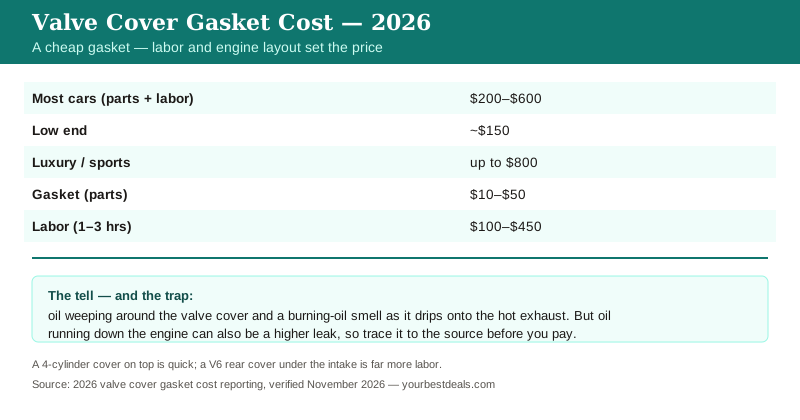
Valve cover gasket replacement in 2026 runs $200 to $600 for most cars, with the low end near $150 and luxury or sports cars up to $800. Here’s the pattern you’ll recognize from other engine jobs: the gasket itself is dirt cheap at $10 to $50, so the entire price is labor and how hard your valve cover is to reach. A four-cylinder with the cover sitting on top is a quick, cheap job; a V6 with a rear cover buried under the intake manifold is far more work.
The valve cover seals the top of the engine, and when its gasket hardens and leaks you get oil weeping down the engine and a burning smell as that oil hits the hot exhaust. I did a lot of these, and two things matter: knowing that engine layout, not the part, sets the price, and making sure the leak is actually the valve cover and not oil running down from somewhere higher. This guide covers both.
Valve cover gasket cost breakdown
These are parts-and-labor figures. Engine layout is the deciding factor, far more than the gasket.
| Item | Cost | Notes |
|---|---|---|
| Most cars (parts + labor) | $200–$600 | By engine layout |
| Low end (easy 4-cylinder) | ~$150 | Cover on top |
| Luxury / sports | up to $800 | Tight access, pricier parts |
| Gasket (parts) | $10–$50 | Cheap; labor is the rest |
| Labor (1–3 hrs) | $100–$450 | By access |
On a four-cylinder, the valve cover is usually right on top and the job is quick, landing near the low end. On many V6 engines there are two valve covers, and the rear one sits under the intake manifold, so reaching it means more teardown and more labor. That’s why the same repair can be $150 on one car and $600 on another, and it’s worth asking the shop which layout yours has.
What gets misdiagnosed
A valve cover gasket leak is usually easy to spot – oil weeping around the top edge of the valve cover, often baked onto the cover and the surrounding area, with a burning-oil smell as it drips onto the hot exhaust manifold. But the trap is that oil runs downhill. Oil you see lower on the engine, or a burning smell, can come from a leak higher up that’s running down, and the valve cover is only sometimes the source. A leaking cam or crank seal, an intake gasket, or a higher engine seal can all leave oil below where they actually originate.
A good tech cleans the area, runs the engine, and watches where the oil actually comes from, sometimes with UV dye, rather than assuming the top-most oily spot is the leak. On a valve cover gasket specifically, the oil originates right at the cover’s sealing edge. Getting the source right matters because a valve cover gasket is cheap while some of the leaks it gets confused with are pricier – so confirm the valve cover is the origin before paying to reseal it.
Straight From the Invoice: oil-leak jobs
These are jobs I either did myself or watched come through the bay – an easy four-cylinder, a buried V6, and a leak that came from higher up.
Invoice #1 – 2016 Honda Civic, valve cover gasket, independent, Ohio
Oil weeping around the top of the cover with a burning smell. Cover on top, gasket swapped in about an hour, $180. Textbook easy job. Lesson: on a four-cylinder with the cover on top, a valve cover gasket is a cheap $150-to-$250 repair – the gasket is a few dollars, the rest is a little labor.
Invoice #2 – 2014 Toyota Camry V6, rear valve cover, Charlotte NC
Leak from the rear valve cover, which sat under the intake plenum. Removing the intake to reach it turned a cheap gasket into $520 of labor. Lesson: a V6 rear valve cover is expensive because of access, not the gasket – the labor to reach it is real, not padding.
Invoice #3 – 2013 Ford Escape, leak that came from higher up, Texas
Oil low on the engine, owner assumed the valve cover. Cleaning and dye showed the oil was running down from a cam seal above it – a different repair. Lesson: oil runs downhill; the lowest oily spot isn’t always the source, so trace the leak before resealing the valve cover.
Is it worth fixing a valve cover leak?
Small weep vs active leak
A minor valve cover gasket weep that isn’t dropping oil on the ground or the exhaust can sometimes be monitored rather than fixed immediately, especially on an older car where the labor is high. But once it’s leaking enough to smell burning, smoke, or drip onto the exhaust, it’s worth doing – burning oil is a nuisance and, at worst, a fire risk in extreme cases, and oil dripping onto components isn’t good for them. On a car where the cover is easy to reach, the fix is cheap enough that there’s little reason to live with the leak.
Watch the oil level
Whether you fix it now or monitor it, keep an eye on your oil level with any valve cover leak. A slow weep uses little oil, but a worsening leak can drop your level over time, and low oil is far more damaging than the leak itself. If you’re deferring the repair on a high-labor engine, check the dipstick regularly and top up as needed. The gasket is cheap; a low-oil engine is not, so don’t let a known leak quietly run the oil down.
Shop Talk
Before you pay to reseal a valve cover, have the shop clean the area and confirm the oil is actually coming from the cover’s sealing edge and not running down from a higher leak – the lowest oily spot lies about where oil originates. And ask which valve cover it is: on a four-cylinder it’s a quick job on top, but a V6 rear cover under the intake is hours of labor for the same few-dollar gasket. Knowing the layout tells you whether to expect a $180 repair or a $520 one before you’re surprised at the counter.
What actually drives the price
Engine layout, plain and simple. The gasket is $10 to $50 on nearly any car, so the whole cost is how hard the valve cover is to reach. A four-cylinder cover on top is a $150-to-$250 job; a V6 rear cover under the intake is $400 to $600 for the identical few-dollar part, purely because of the teardown to get to it. Luxury and sports cars push higher on both access and parts. Knowing which layout you have tells you the price before you call.
The avoidable cost is paying to reseal a valve cover when the oil was actually running down from a higher leak. Because oil moves downhill, the lowest oily area isn’t always the source, and confirming the origin with a cleanup and dye keeps you from fixing the wrong seal. Get the source right, know your engine’s layout, and this is either a cheap job or a fair one – but not a surprise.
The Real Number
Budget $200 to $600, with an easy four-cylinder near $150 and a buried V6 rear cover toward the top – the gasket is only $10 to $50, so it’s all labor and access. Ask which valve cover it is so the price doesn’t surprise you. Before paying, have the shop confirm the oil is coming from the cover itself and not running down from a higher leak. And whether you fix it now or monitor a small weep on a high-labor engine, keep an eye on your oil level, because low oil does far more damage than the leak.
Frequently Asked Questions
How much does valve cover gasket replacement cost in 2026?
Most cars run $200 to $600, with an easy four-cylinder near $150 and luxury or sports cars up to $800. The gasket itself is only $10 to $50, so the entire price is labor of $100 to $450 for a one-to-three-hour job. Engine layout is the deciding factor: a four-cylinder cover on top is quick and cheap, while a V6 rear cover under the intake manifold takes far more teardown and labor. Ask the shop which layout your engine has to know whether to expect a low or high number.
Why is a valve cover gasket so cheap but the job expensive?
Because the gasket is a simple, inexpensive part at $10 to $50, but reaching the valve cover can take real labor on some engines. On a four-cylinder the cover sits on top and the job is quick. On many V6 engines the rear valve cover is buried under the intake manifold, so getting to it means removing parts, turning a few-dollar gasket into hours of labor. The cost is almost entirely about access, which is why the same repair ranges from $150 to $600 across different engines.
What are the symptoms of a leaking valve cover gasket?
Oil weeping or baked around the top edge of the valve cover, a burning-oil smell as leaking oil drips onto the hot exhaust manifold, visible oil on the engine, light smoke from the engine bay, and sometimes oil pooling in the spark plug wells on certain engines. A gradually dropping oil level can accompany a worse leak. The catch is that oil runs downhill, so oil you see lower on the engine can come from a higher leak, and the valve cover is only sometimes the source. Confirm the origin before assuming it’s the cover.
Is it safe to drive with a valve cover gasket leak?
A small weep is usually not an emergency, but don’t ignore a worsening leak. Oil dripping onto the hot exhaust causes a burning smell and, in extreme cases, a fire risk, and it isn’t good for surrounding components. More importantly, a significant leak can lower your oil level over time, and low oil damages the engine far more than the gasket ever would. If you’re deferring the repair, especially on a high-labor engine, check your oil level regularly and top up. Fix it once it’s actively dripping or smelling.
Can a valve cover leak cause a misfire?
On some engines, yes. If the valve cover gasket also seals the spark plug tubes, a failed gasket can let oil pool in the spark plug wells and reach the coils or plugs, causing a misfire. In that case the fix is the same gasket, but you may also need to clean or replace oil-fouled coils. This is one reason not to ignore a valve cover leak on engines with plugs down in the cover: what starts as a cheap gasket leak can turn into a misfire and coil replacement if oil gets where it shouldn’t.
How do I know the leak is the valve cover and not something else?
Have the shop clean the area, run the engine, and watch where the oil actually originates, sometimes using UV dye. A valve cover gasket leak starts right at the cover’s sealing edge along the top of the engine. Because oil runs downhill, oil you see lower can come from a higher leak like a cam or crank seal or an intake gasket, so the lowest oily spot isn’t always the source. Confirming the origin matters because a valve cover gasket is cheap while some leaks it’s confused with cost more to fix.
Is a valve cover gasket leak worth fixing?
Once it’s actively dripping, smelling of burning oil, or dropping your oil level, yes. A minor weep on a high-labor engine can sometimes be monitored, but a real leak is worth fixing because burning oil is a nuisance and mild fire risk, and losing oil is what actually damages the engine. On a car where the cover is easy to reach, the repair is cheap enough that there’s little reason to live with it. Either way, keep an eye on the oil level so a known leak never quietly runs the engine low.
Sources
Valve cover gasket cost ranges verified against 2026 parts-and-labor reporting on November 1, 2026. Ranges vary by engine layout and region; confirm your exact price locally.
- RepairPal – valve cover gasket replacement cost estimate
- CarParts.com – cost to replace a valve cover gasket
- The Cost Guys – valve cover gasket replacement, 2026
Related Guides
- Oil pan gasket replacement cost
- Car repair cost estimator hub
- Spark plug replacement cost
- About Eddie Brennan – ASE Master technician

Eddie Brennan is an ASE Master Certified technician who spent 11 years at an independent shop in Columbus, OH, cleaning engines and chasing oil leaks to their actual source before selling a gasket. He writes the repair and diagnostic guides on Your Best Deals and takes no referral fees. He drives a 250,000-mile 2015 Subaru Outback and a 2020 Ford F-150.