
Last updated: November 7, 2026 – By Diane Holcomb
November 2026 update: reconfirmed remote starter pricing and the professional-install point.
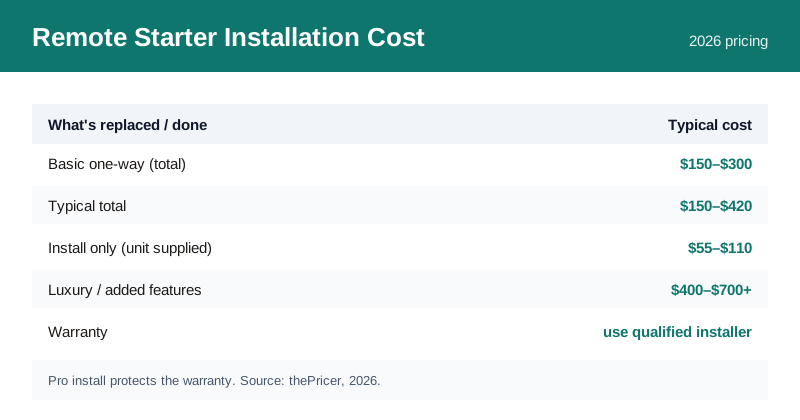
A remote starter installation runs about $150 to $300 for a basic one-way system including the unit and labor, $150 to $420 typically, and $400 to $700 or more for luxury vehicles or added features (two-way confirmation, longer range, phone-app control, security integration). If you supply the unit, install-only labor is about $55 to $110. A remote starter lets you start the engine from a distance with a key fob or phone app – to warm the car up in winter or cool it in summer before you get in. The price depends on three things: the unit’s features, the vehicle’s complexity (modern push-button-start and anti-theft/immobilizer systems need a bypass module to work with a remote starter, adding cost), and who installs it (dealers charge more than independent car-audio/electronics shops). This is a job worth having done professionally – a bad install can cause electrical gremlins or affect your warranty.
This is an add-on, not a repair, and the price swings with your car’s complexity and features. Let me break it down.
What you’ll actually pay
Here’s the picture. These are estimates that vary by vehicle, unit, and installer.
| Option | Cost | Notes |
|---|---|---|
| Basic one-way (total) | $150–$300 | Unit + labor |
| Typical total | $150–$420 | Varies |
| Luxury / added features | $400–$700+ | Bypass, two-way |
| Install only (unit supplied) | $55–$110 | Labor |
This is an accessory install involving the starting/electrical system; our car stereo install guide, starter guide, and car battery guide cover related installs and parts.
Shop Talk
Two things drive the price: the unit and your car’s complexity. A basic one-way remote starter (you press the fob and hope it started) is cheap; a two-way unit that confirms the car started, has long range, or works through a phone app costs more. The bigger variable is the vehicle: modern cars with push-button start, chip keys, and anti-theft immobilizers need a bypass module so the remote starter can defeat the immobilizer legitimately to start the engine, and that module plus the extra labor raises the cost on newer cars versus an older vehicle with a simple key. So the same remote starter is a cheap install on a basic car and a pricier one on a loaded modern one. My advice: have it installed professionally by a reputable car-electronics shop. A remote starter taps into ignition, starter, and security wiring, and a sloppy install is a classic cause of electrical gremlins, drained batteries, and even no-starts down the road – plus a botched job near the immobilizer can be a headache. Many remote-starter makers also require professional installation to honor the warranty. A dealer will install one but usually charges the most; an established independent car-audio/security shop often does it for less and does a lot of them. If you buy your own unit, make sure it’s compatible with your specific vehicle (year, make, model, and key type) before paying for install-only labor.
Where Drivers Overpay
The dealer is usually the priciest place to get this done; a reputable independent car-electronics/security shop often installs the same quality unit for less and does many of them. For an out-of-warranty everyday car, getting an independent quote is the main save.
But this is one job where going too cheap backfires: a sloppy install taps ignition and security wiring and can cause electrical gremlins, battery drain, or no-starts, and a bad job can void the unit’s warranty. The pattern: use a reputable professional installer (not the cheapest corner), match the unit to your vehicle’s key/immobilizer type, and weigh features you’ll actually use against the price.
The Real Number
A remote starter install is $150 to $300 for a basic system, up to $400 to $700+ on luxury cars or with push-button start and immobilizers (which need a bypass module); install-only labor is $55 to $110. A reputable independent car-electronics shop usually beats the dealer’s price. Don’t cheap out on the installer, though – a sloppy install taps ignition and security wiring and causes gremlins, and a bad job can void the warranty.
Frequently Asked Questions
How much does remote starter installation cost?
About $150 to $300 for a basic one-way system including the unit and labor, and $150 to $420 typically. Luxury vehicles or installs with added features (two-way confirmation, long range, phone-app control, security integration) run $400 to $700 or more. If you supply your own unit, install-only labor is about $55 to $110. These are estimates that vary by vehicle, unit, and installer. The main cost drivers are the unit’s features and your vehicle’s complexity – modern cars with push-button start and anti-theft immobilizers need a bypass module and more labor, raising the price versus an older car with a simple key. Where you have it done matters too: dealers typically charge the most, while reputable independent car-electronics shops often cost less. Confirming the unit is compatible with your specific vehicle is important before buying.
What does a remote starter do?
A remote starter lets you start your car’s engine from a distance – without being in the car or using the ignition – using a key fob, a long-range remote, or a smartphone app. The main purpose is comfort: starting the car a few minutes before you get in so the heater can warm it up in winter (and defrost the windows) or the AC can cool it in summer. The engine runs and idles, but the car stays locked and can’t be driven until you get in with your key/fob (the system has safeguards so it shuts off if someone tries to drive it or opens the hood). Many systems add convenience and security features. On modern cars with immobilizers, a bypass module lets the remote starter start the engine while keeping the anti-theft protection intact. So it’s a convenience accessory, not a repair – it adds remote-start capability to a car that didn’t come with it.
Why does my car’s type affect the price?
Because modern vehicles are more complex to integrate with, which adds parts and labor. An older car with a simple metal key and basic electrical system is relatively simple to add a remote starter to. But newer cars with push-button start, transponder/chip keys, and anti-theft immobilizer systems require a bypass module – a device that allows the remote starter to legitimately start the engine while keeping the factory anti-theft system intact (since the immobilizer would otherwise prevent the engine from running without the key present). That module costs money and the integration takes more labor and know-how. Vehicles with extra electronics, CAN-bus data systems, or that need specific wiring interfaces add further cost. So the same remote starter unit can be a cheaper install on a basic car and a pricier one on a loaded modern vehicle. That’s why a quote depends heavily on your exact year, make, model, and key type.
Should I install a remote starter myself?
For most people, professional installation is the smart choice, even though DIY kits exist. A remote starter taps into critical wiring – ignition, starter, security/immobilizer, and more – and a mistake can cause electrical problems, battery drain, no-starts, or interfere with the anti-theft system. Modern cars with immobilizers especially need proper bypass integration that’s easy to get wrong. A sloppy DIY (or cheap) install is a classic source of intermittent electrical gremlins that are frustrating and costly to chase down later. Additionally, many remote-starter manufacturers require professional installation to honor the product warranty. So while a very experienced DIYer with the right kit and documentation can do it, for most owners the modest install labor is worth it to get a clean, reliable, warranty-valid installation. If you do go DIY, make certain the kit is fully compatible with your specific vehicle and key type.
Will a remote starter void my warranty or cause problems?
Installed properly by a qualified technician, a remote starter generally won’t void your vehicle warranty – under consumer protection rules, a dealer can’t void your whole warranty just for adding an accessory, though damage caused by a faulty install to a related system might not be covered. The real risk is a bad install: because the system wires into ignition, starting, and security circuits, a poor-quality installation can cause electrical issues, battery drain, or no-start problems, and troubleshooting those can be expensive. That’s exactly why professional installation matters. Using a reputable installer and a quality, vehicle-compatible unit keeps the risk low and the installation reliable. Also, the remote starter’s own warranty often requires professional installation. So the concern isn’t that a remote starter inherently voids warranties – it’s that a careless installation can create problems. Choose a good installer and a compatible unit, and it’s a safe, reliable addition.
Is a two-way remote starter worth the extra cost?
It depends on how you’ll use it. A basic one-way remote starter sends the start command but gives you no feedback – you press the button and assume it started. A two-way system sends confirmation back to the remote (or phone app) that the car actually started, and often shows status and offers longer range. The two-way/app features cost more. Whether they’re worth it comes down to convenience: if you often start the car from far away (inside a building, from an upstairs apartment) where you can’t see or hear it, the confirmation is truly useful, and phone-app control adds flexibility (start from anywhere with signal, plus features like lock/unlock). If you mostly start it from a window where you can see the car, a basic one-way unit may be plenty. So match the features to your real use rather than buying the most expensive option by default. The installer can explain the practical differences for your situation.
Where should I get a remote starter installed?
The main options are a dealership or an independent car-electronics/car-audio/security shop. Dealers will install one (sometimes a factory-branded system) but typically charge the most. An established independent shop that specializes in car electronics and security often does remote starters routinely, charges less, and may offer more unit choices – for most people, that’s the value pick, provided the shop is reputable and experienced. The key, wherever you go, is a skilled installer, since the quality of the wiring work matters a lot for reliability. Look for a shop with good reviews, experience with your vehicle type, and a warranty on the installation. Big-box electronics retailers also offer installation. Avoid the cheapest no-reputation option, because a bad install causes expensive headaches. So: reputable independent car-electronics shop for value, dealer if you want a factory system and don’t mind paying more – but prioritize installer quality over the lowest price.
Sources
Price ranges verified against 2026 remote starter installation pricing in November 2026. Dollar amounts are estimates that vary by vehicle, unit, and installer.
- thePricer – remote starter installation cost
- RepairPal – repair cost estimator
- ASE – National Institute for Automotive Service Excellence
Related Guides
- Car Stereo Installation Cost
- Starter Motor Replacement Cost
- Car Battery Replacement Cost
- Ignition Switch Replacement Cost
- Car Repair Cost Estimator

Diane Holcomb spent seven years as a service advisor at multi-brand dealerships in Charlotte, NC, where she’d steer customers to a reputable car-electronics shop for a remote starter – because a cheap, sloppy install into the ignition and security wiring causes gremlins for years. She drives a 2019 Honda CR-V and a hand-me-down 2007 Toyota Camry, and takes no referral fees or advertising money from any shop or chain.