
Last updated: November 7, 2026 – By Diane Holcomb
November 2026 update: reconfirmed speed sensor pricing and the diagnose-first point.
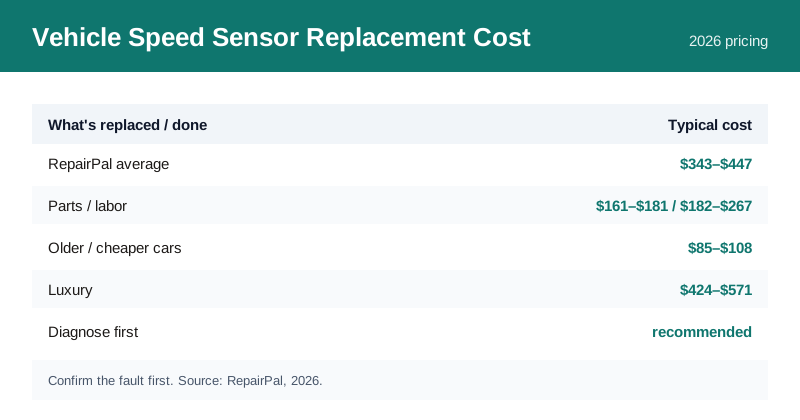
A vehicle speed sensor replacement averages about $343 to $447 (RepairPal), with parts at roughly $161 to $181 and labor $182 to $267. Older or cheaper vehicles can be much less – around $85 to $108 – while luxury models run $424 to $571. The vehicle speed sensor (VSS) measures how fast the car is moving (usually by reading a toothed ring on the transmission output or a wheel) and reports it to the speedometer, the transmission computer, cruise control, the ABS/stability system, and other functions. So when it fails, the effects fan out: a dead or erratic speedometer, harsh or erratic shifting (the transmission uses speed to decide shifts), cruise control that won’t engage, and a check engine light. Because a speedometer problem can come from things other than the sensor – wiring, the gauge cluster, or a related component – testing before replacing keeps you from a wasted repair.
One small sensor touches a lot of systems, which is why the symptoms look scattered. Let me cover the cost and why diagnosis matters.
What you’ll actually pay
Here’s the picture. These are estimates that vary by vehicle and shop.
| Item | Cost | Notes |
|---|---|---|
| RepairPal average | $343–$447 | Parts + labor |
| Parts / labor | $161–$181 / $182–$267 | Access varies |
| Older / cheaper cars | $85–$108 | Easy access |
| Luxury | $424–$571 | Pricier |
Speed-sensor symptoms overlap with transmission and ABS issues; our shift solenoid guide, ABS module guide, and crankshaft position sensor guide cover related sensors.
Shop Talk
The thing that surprises people about the speed sensor is how many systems it feeds. It’s not just the speedometer – the transmission computer uses vehicle speed to decide when to shift, so a failing speed sensor can cause harsh, erratic, or wrong-gear shifting that feels like a transmission problem. It also affects cruise control (which won’t hold or engage without a speed signal) and can trigger ABS or traction-control lights. So if you’ve got a dead speedometer plus weird shifting, one cheap sensor can be behind all of it – good news, because it’s far cheaper than a transmission repair. But here’s the caution: a speedometer or speed-related fault isn’t always the sensor. It can be the wiring or connector to the sensor (corrosion, a break), the toothed reluctor ring the sensor reads, the gauge cluster itself, or on some cars the signal comes from the ABS wheel speed sensors instead of a single VSS. So before buying a sensor, get the code read and the circuit tested – RepairPal itself notes you should test before replacing, because the fix might be a connector or the cluster, not the sensor. On many cars the VSS is on the transmission and reasonably accessible; on others it’s buried, which is why labor swings the price. If yours is easy to reach and confirmed bad, it’s a quick, worthwhile fix.
Where Drivers Overpay
The overpay is replacing the speed sensor for a speedometer or shift fault that was actually the wiring, the connector, the reluctor ring, or the gauge cluster. The symptoms point at the sensor, but the cause is sometimes elsewhere – so getting the code read and the circuit tested first is the save.
The reassuring flip side: when the sensor is the cause, it explains a scary-seeming mix of bad shifting plus dead speedometer for the price of one cheap part, not a transmission job. The pattern: scan and test the circuit, confirm the sensor (not wiring or cluster) is at fault, and then replace it.
The Real Number
A vehicle speed sensor is $343 to $447 (RepairPal), as low as $85 to $108 on older cars and up to $571 on luxury models. Because it feeds the speedometer, transmission, and cruise control, one cheap sensor can explain a dead speedometer plus erratic shifting – far cheaper than a transmission repair. But a speed fault can also be wiring, the connector, the reluctor ring, or the cluster, so test before replacing.
Frequently Asked Questions
How much does it cost to replace a vehicle speed sensor?
RepairPal puts the average at about $343 to $447, with parts at roughly $161 to $181 and labor $182 to $267. Older or less expensive vehicles with an accessible sensor can be much cheaper, around $85 to $108, while luxury models run higher, about $424 to $571. These are estimates that vary by vehicle and shop. Labor depends heavily on where the sensor is mounted – on many cars it’s on the transmission and reasonably reachable, while on others it’s buried. Before paying, it’s worth having the fault diagnosed, since a speedometer or speed-related problem isn’t always the sensor itself; it can be wiring, the connector, or the gauge cluster, which changes the repair.
What does the vehicle speed sensor do?
The vehicle speed sensor (VSS) measures how fast the vehicle is traveling and sends that signal to the car’s systems. It typically works by reading a rotating toothed ring (on the transmission output shaft or a wheel) and generating a signal proportional to speed. That speed signal is used by many systems: the speedometer and odometer, the transmission computer (which uses speed to decide shift points), cruise control, the ABS and traction/stability control, and sometimes power steering and other functions. Because so many systems rely on accurate speed data, a single VSS fault can cause widespread-seeming symptoms. Some vehicles use a dedicated VSS; others derive vehicle speed from the ABS wheel speed sensors. Either way, the role is the same – telling the car how fast it’s going so those systems can work correctly.
What are the symptoms of a bad speed sensor?
Because the speed signal feeds many systems, symptoms can include a speedometer that’s dead, erratic, or reads incorrectly; harsh, erratic, or improperly-timed shifting (the transmission relies on speed data); cruise control that won’t engage or hold a speed; an illuminated check engine light with a speed-sensor code; and sometimes ABS or traction-control warning lights. You might also notice the odometer not advancing. The combination of a speedometer problem plus shifting issues is a classic speed-sensor clue. However, because these symptoms can also stem from wiring, the gauge cluster, or the transmission itself, a bad speed sensor should be confirmed by diagnosis rather than assumed. The scattered nature of the symptoms is characteristic, but pinning it to the sensor specifically takes a scan and circuit test.
Why is a speedometer problem not always the speed sensor?
Because the speedometer relies on a whole chain, and the sensor is only one link. A dead or erratic speedometer can be caused by the speed sensor, but also by the wiring and connector between the sensor and the car’s computer (corrosion or a break interrupts the signal), the toothed reluctor ring the sensor reads (if damaged), the instrument cluster itself (a bad speedometer gauge or cluster), or the computer that processes the signal. On some vehicles the speed signal comes from the ABS wheel speed sensors, so a speedometer fault could trace back there. This is why simply replacing the VSS doesn’t always fix a speedometer problem – if the issue is wiring or the cluster, a new sensor changes nothing. A proper diagnosis traces the fault through the circuit to find the real cause, so you fix the right part.
Can a bad speed sensor cause transmission problems?
Yes – and this is the reassuring part cost-wise. The transmission computer uses vehicle speed to decide when and how to shift, so a failing speed sensor can cause harsh shifting, erratic or delayed shifts, the transmission holding gears too long or shifting at the wrong time, or even limp mode. These symptoms feel like a transmission problem and can be alarming, but when the cause is actually a bad speed sensor, the fix is a relatively cheap sensor rather than an expensive transmission repair. That’s why diagnosing shifting problems properly matters – a speed sensor (or its wiring) is one of the cheaper things that can cause them. So if you have both a speedometer issue and shifting trouble, the speed sensor is a prime, affordable suspect worth checking before assuming the transmission itself is failing.
Is it safe to drive with a bad speed sensor?
It depends on how the car is affected, but it’s best not to drive on it long. If the speedometer is dead or wrong, you can’t tell how fast you’re going, which is a safety and legal concern. If the transmission is shifting erratically or stuck in a gear from the lost speed signal, that affects drivability and can stress the transmission. Cruise control and some safety systems (ABS, traction control) may also be compromised. So while a bad speed sensor usually won’t leave you stranded, the loss of an accurate speedometer and proper shifting makes it something to fix promptly rather than ignore. Drive cautiously and get it diagnosed. The repair is relatively inexpensive, especially weighed against driving without a working speedometer or with a transmission shifting unpredictably.
Is there more than one speed sensor on a car?
Often, yes, and it matters for diagnosis. Many vehicles have a dedicated vehicle speed sensor (VSS) on the transmission, but modern cars also have individual wheel speed sensors as part of the ABS and traction/stability control systems – and on some vehicles, the computer derives overall vehicle speed from those wheel speed sensors rather than a single VSS. There can also be transmission input and output speed sensors used for shift control. So “the speed sensor” isn’t always one part. A speed-related fault could be a dedicated VSS, a wheel speed sensor, or a transmission input/output sensor, depending on the vehicle and the symptom. This is another reason a scan and proper diagnosis come first: identifying which speed sensor (and which circuit) is at fault ensures the right one gets replaced rather than guessing.
Sources
Price ranges verified against 2026 vehicle speed sensor pricing in November 2026. Dollar amounts are estimates that vary by vehicle and shop.
- RepairPal – vehicle speed sensor replacement cost
- J.D. Power – car repair shopping guides
- ASE – National Institute for Automotive Service Excellence
Related Guides
- Shift Solenoid Replacement Cost
- ABS Control Module Replacement Cost
- Crankshaft Position Sensor Replacement Cost
- Transmission Control Module Replacement Cost
- Car Repair Cost Estimator

Diane Holcomb spent seven years as a service advisor at multi-brand dealerships in Charlotte, NC, where a dead speedometer plus weird shifting often traced to one cheap speed sensor – a relief next to the transmission bill customers feared. She drives a 2019 Honda CR-V and a hand-me-down 2007 Toyota Camry, and takes no referral fees or advertising money from any shop or chain.