
Last updated: November 7, 2026 – By Diane Holcomb
November 2026 update: reconfirmed pricing, the stuck-closed vs. stuck-open behavior, and the confirm-first point.
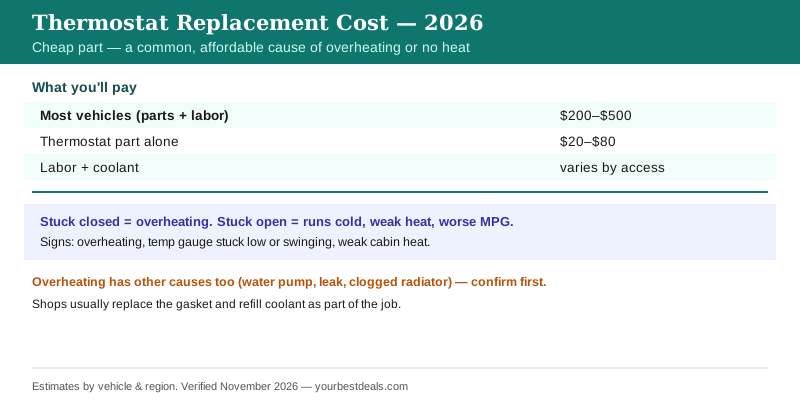
An engine thermostat replacement costs about $200 to $500 for most vehicles, parts and labor. The thermostat itself is cheap – often $20 to $80 – and the rest is labor plus fresh coolant, varying by how buried the thermostat housing is on your particular engine. The thermostat regulates engine temperature by opening and closing to control coolant flow as the engine warms up. The failure mode matters: stuck closed causes overheating (coolant can’t circulate), while stuck open makes the engine run too cold, giving poor cabin heat and worse fuel economy. Signs include overheating, a temperature gauge that stays low or swings erratically, and weak heat. It’s a common and relatively affordable cooling repair – and a frequent cause of overheating – but overheating has other causes too, so confirm the thermostat before assuming.
The thermostat is a cheap part that punches above its weight – a $40 part can cause overheating or no heat. Let me cover the cost, the two failure modes, and why confirming it matters.
What you’ll actually pay
Here’s the price picture. These are estimated ranges that vary by vehicle and shop.
| Item | Cost | Notes |
|---|---|---|
| Most vehicles (parts + labor) | $200–$500 | Varies by access |
| Thermostat part alone | $20–$80 | Cheap |
| Labor + coolant | the rest | Buried housings cost more |
The thermostat sits in a housing where coolant enters or leaves the engine. On many cars it’s reasonably accessible, making for an affordable job; on some engines the housing is buried or integrated, which raises labor. A proper job replaces the thermostat gasket (or housing seal) and refills/bleeds the coolant. Our coolant guide and overheating guide cover the cooling system and the other causes of overheating.
Shop Talk
The thermostat is cheap enough that it’s often worth replacing as a first step when the symptom fits – but know which symptom points at it. Stuck closed (the common failure that causes overheating): the thermostat won’t open, coolant can’t circulate to the radiator, and the engine overheats, often quickly and even in cold weather. Stuck open: the engine runs too cool, your temperature gauge never reaches normal or reads low, the heater blows lukewarm, and fuel economy drops because the engine never reaches efficient operating temperature. That “runs cold / weak heat” combo is almost a signature for a stuck-open thermostat, and it’s an easy, cheap fix. The caution: overheating has several possible causes – a failing water pump, a coolant leak, a clogged radiator, a bad cooling fan, or a blown head gasket – so don’t assume every overheating problem is the thermostat. Because the thermostat is cheap, a shop may reasonably try it first on an overheating or runs-cold complaint, but if overheating persists after a new thermostat, the cause is elsewhere and needs deeper diagnosis. And always use the correct-temperature thermostat for your engine (they’re rated for a specific opening temperature) and the right coolant when refilling.
Where Drivers Overpay
Because the thermostat is cheap, the risk isn’t overpaying for the part – it’s misdiagnosis in either direction. Replacing a thermostat for an overheating problem that was actually a water pump, leak, clogged radiator, or head gasket means the overheating continues and you’ve spent on the wrong fix. So while trying a cheap thermostat first can be reasonable, confirm it resolved the issue; if overheating persists, pursue the other causes rather than repeating parts.
The other consideration is the “runs cold / weak heat” complaint – that’s very often a stuck-open thermostat and a cheap, satisfying fix, so it’s worth checking before assuming a bigger heating-system problem. Use the correct opening-temperature thermostat and the right coolant. The pattern: match the symptom (overheating vs. runs-cold) to the thermostat, try the cheap part first where it fits, confirm it worked, and escalate to water pump, radiator, or head gasket diagnosis if overheating continues.
The Real Number
A thermostat is $200 to $500 – a cheap $20-to-$80 part plus labor and coolant. Stuck closed overheats the engine; stuck open makes it run cold with weak heat and worse economy. The “runs cold / weak heat” combo is a classic cheap thermostat fix. But overheating has other causes (water pump, leak, clogged radiator, head gasket), so if overheating continues after a new thermostat, the problem is elsewhere. Use the correct-temperature thermostat and right coolant.
Frequently Asked Questions
How much does it cost to replace a thermostat?
About $200 to $500 for most vehicles, parts and labor. The thermostat part itself is cheap at $20 to $80 – the rest is labor plus fresh coolant, and it varies mainly by how accessible the thermostat housing is on your engine (some are buried, raising labor). These are estimates that vary by vehicle and shop. A proper job also replaces the gasket or housing seal and refills and bleeds the coolant. Because the part is inexpensive, the thermostat is one of the more affordable cooling-system repairs when it’s the actual cause.
What happens when a thermostat fails?
It depends on how it fails. Stuck closed, the thermostat blocks coolant from circulating to the radiator, so the engine overheats – often quickly, and even in cold weather. Stuck open, coolant flows constantly and the engine runs too cool, so it never reaches proper operating temperature: the temperature gauge reads low, the heater blows lukewarm, and fuel economy drops. Both are problems, but stuck closed (overheating) is the more urgent because overheating can damage the engine. Matching your symptom – overheating versus running cold – to the failure mode helps confirm the thermostat is the cause.
Can a bad thermostat cause overheating?
Yes – a thermostat stuck closed is a common cause of overheating, because it prevents coolant from circulating to the radiator to shed heat. If your engine overheats, the thermostat is a prime and cheap suspect. However, overheating has several other causes too – a failing water pump, a coolant leak, a clogged radiator, a bad cooling fan, or a blown head gasket – so it’s not automatically the thermostat. Because the thermostat is inexpensive, a shop may try it first, but if overheating continues after a new one, the real cause is elsewhere and needs further diagnosis.
Why does my car run cold or have weak heat?
The most common cause is a thermostat stuck open. When the thermostat can’t close, coolant circulates constantly and the engine never reaches its proper operating temperature, so the temperature gauge stays low, the heater blows lukewarm (since cabin heat comes from engine coolant), and fuel economy drops because the engine runs inefficiently cold. It’s a cheap, satisfying fix. So if your gauge never warms up and your heat is weak, a stuck-open thermostat is the leading suspect – worth checking before assuming a bigger heating-system problem like a heater core.
Should I replace the thermostat first for an overheating problem?
It’s often a reasonable first step because the thermostat is cheap and a common overheating cause, but confirm it works. If the symptom fits (overheating with no obvious leak or other cause), trying a new thermostat is low-cost. But if overheating persists after replacement, the cause is something else – a water pump, a coolant leak, a clogged radiator, a cooling fan, or a head gasket – and you shouldn’t keep replacing parts hoping. So try the cheap thermostat where it fits, but if it doesn’t resolve the overheating, move to a proper diagnosis of the other cooling-system causes rather than guessing.
How long does a thermostat last?
There’s no fixed interval – a thermostat is a wear item that often lasts many years or 100,000-plus miles, but can fail sooner, especially with neglected or contaminated coolant (corrosion and debris can cause it to stick). It’s not a scheduled maintenance part; you replace it when it fails and causes overheating or a runs-cold/weak-heat symptom. Keeping your coolant fresh and the correct type helps the thermostat (and the whole cooling system) last. Some people replace the thermostat preventively when doing a coolant flush or other major cooling work, since it’s cheap and accessible then.
Can I replace a thermostat myself?
On many cars, yes – it’s a common DIY job if the thermostat housing is accessible. You drain some coolant, remove the housing, replace the thermostat and gasket (noting orientation), reinstall, and refill and bleed the cooling system. The cautions are working only on a cool engine (hot coolant is pressurized and causes burns), using the correct-temperature thermostat and the right coolant, and properly bleeding air out so the engine doesn’t overheat from an air pocket. On engines where the housing is buried or integrated, it’s more involved and a shop may be easier. For accessible designs, it’s a manageable, money-saving DIY.
Sources
Price ranges verified against 2026 cooling-system repair pricing in November 2026. Dollar amounts are estimates that vary by vehicle and shop.
- RepairPal – thermostat replacement estimates
- ASE – National Institute for Automotive Service Excellence
- AAA – auto repair resources
Related Guides
- 9 Reasons Your Engine Is Overheating
- Radiator Hose Replacement Cost
- Coolant Flush Cost
- Coolant & Cooling System Guide
- Car Repair Cost Estimator

Diane Holcomb spent seven years as a service advisor at multi-brand dealerships in Charlotte, NC, where a “runs cold, no heat” complaint was usually a cheap stuck-open thermostat, not a big heating repair. She drives a 2019 Honda CR-V and a hand-me-down 2007 Toyota Camry, and takes no referral fees or advertising money from any shop or chain.