
Last updated: November 5, 2026 – By Diane Holcomb
November 2026 update: reconfirmed per-wheel and retailer pricing and the check-pressure-first point.
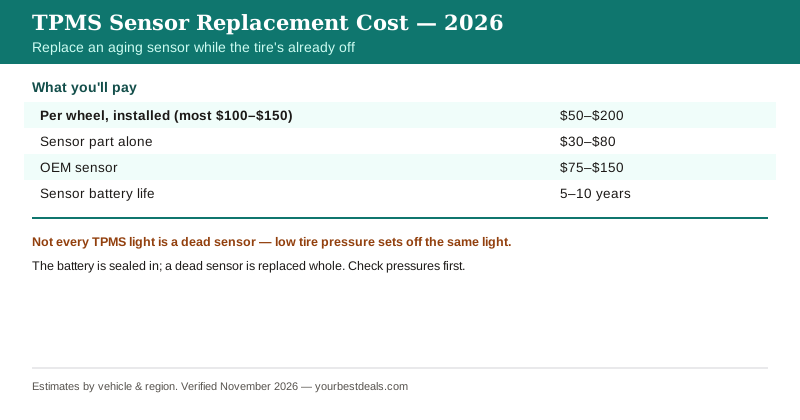
A TPMS (tire pressure monitoring system) sensor replacement runs about $50 to $200 per wheel installed, with most jobs around $100 to $150. That price includes the sensor, dismounting and remounting the tire, rebalancing the wheel, and programming the new sensor to the car. The sensor part alone runs about $30 to $80, and OEM sensors $75 to $150. Here’s the thing to understand: each sensor has a small sealed battery that lasts roughly five to ten years and can’t be replaced separately – so when a sensor dies, you replace the whole unit. And not every TPMS warning light means a dead sensor; low tire pressure sets off the same light, so the first step is always to check your actual tire pressures.
Two things save money here: knowing the light isn’t automatically a failed sensor, and timing a replacement for when the tire’s already off. Let me cover the cost, the sealed-battery issue, and the check-pressure-first rule.
What you’ll actually pay
Here’s the price picture. These are estimated ranges that vary by vehicle and shop.
| Item | Cost | Notes |
|---|---|---|
| Per wheel, installed | $50–$200 | Most $100–$150 |
| Sensor part alone | $30–$80 | Aftermarket |
| OEM sensor | $75–$150 | Dealer part |
| Sensor battery life | 5–10 years | Sealed, not replaceable |
The installed price reflects the tire work (dismount, mount, balance) plus programming, not just the part. Retailers vary – warehouse clubs and big-box tire shops often run at the lower end. Our tires guide covers related tire service.
Shop Talk
Before you pay to replace a sensor, check your tire pressures with a gauge, because the TPMS light comes on for low pressure just as readily as for a dead sensor – and a cold snap that drops pressure overnight is a classic false alarm. If the pressures are fine and the light’s still on (or a specific sensor reads nothing), then you’re likely looking at a failed sensor. Here’s the timing tip that saves real money: most of the TPMS replacement cost is the labor to dismount and remount the tire, not the sensor itself. So if one sensor has died because its battery wore out, the others are the same age and will follow within a year or two. If you’re already buying new tires – tire’s off the rim anyway – that’s the cheap moment to replace aging sensors, because you skip paying that dismount labor a second time. One more thing: you can often buy aftermarket sensors for less than dealer OEM, and a good tire shop can program them to your car; just make sure they confirm the sensors are communicating before you leave.
Where Drivers Overpay
The first overpay is replacing a sensor that was fine. Low tire pressure – very common after a cold snap – triggers the same TPMS light as a dead sensor, so checking pressures with a gauge first can turn a “repair” into a free top-off. The light is a prompt to check, not automatic proof of a failed sensor.
The second is timing. Since most of the cost is the tire dismount labor, replacing one dead sensor now and paying that labor again when the next same-age sensor dies soon after is wasteful – doing aging sensors while the tires are off for new tires skips the repeat labor. Aftermarket sensors also often cost less than dealer OEM. The pattern: check pressures first, use the tire-change window, and consider aftermarket sensors a good shop can program.
The Real Number
A TPMS sensor is $50 to $200 per wheel installed (most $100 to $150), and most of that is the tire dismount labor, not the $30-to-$80 part. The sealed battery lasts 5 to 10 years and isn’t separately replaceable, so a dead sensor is replaced whole. Check your tire pressures first – low pressure sets off the same light. And if you’re buying new tires, replace aging sensors then, while the tire’s already off.
Frequently Asked Questions
How much does it cost to replace a TPMS sensor?
About $50 to $200 per wheel installed, with most jobs around $100 to $150. That includes the sensor, dismounting and remounting the tire, rebalancing the wheel, and programming the new sensor to the car. The sensor part alone runs about $30 to $80, and OEM dealer sensors $75 to $150. These are estimates that vary by vehicle and shop. Most of the installed cost is the tire labor rather than the part, which is why replacing several aging sensors during a tire change – when the tires are off anyway – is more economical than doing them one at a time on separate visits.
Why can’t I just replace the TPMS sensor battery?
Because the battery is sealed inside the sensor and isn’t designed to be replaced on its own. TPMS sensors are built as sealed units with a small lithium battery that typically lasts five to ten years; when that battery is depleted, the sensor stops transmitting and the whole sensor is replaced. There’s no serviceable battery door. This is why a “dead” sensor means buying a new sensor rather than a cheap battery swap. The upside is that these sensors last a long time, often close to the life of several sets of tires, so replacement isn’t frequent – and the sealed design is also what makes them durable against road conditions.
Does a TPMS light always mean a bad sensor?
No – and this is the most useful thing to know. The TPMS warning light comes on for low tire pressure just as readily as for a failed sensor, and low pressure is far more common, especially after a cold snap (cold air lowers tire pressure overnight). So the first step is always to check your actual tire pressures with a gauge and inflate to the recommended level. If the light goes out after proper inflation, you had a pressure issue, not a sensor problem. If pressures are correct and the light stays on, or a specific wheel reads no pressure, then a failed sensor becomes the likely cause. Checking first can save an unnecessary repair.
Should I replace all TPMS sensors at once?
Often it makes sense, especially during a tire change. The sensors are all the same age, so when one battery dies, the others are usually close behind. Because most of the replacement cost is the labor to dismount and remount the tire, replacing just one now and paying that labor again when the next fails soon after is less efficient than doing them together. If your tires are already off for new tires, that’s the ideal, cheapest moment to replace aging sensors. On a newer car where one sensor failed early (a defect rather than age), replacing just the one is reasonable. It comes down to the age of the sensors.
Can I use aftermarket TPMS sensors instead of OEM?
Usually yes. Aftermarket and “universal” programmable TPMS sensors often cost less than dealer OEM sensors, and a tire shop with the right tool can program them to communicate with your vehicle. Quality aftermarket sensors work well for most cars. The key is that the shop programs them correctly to your vehicle and confirms they’re communicating before you leave. A few vehicles are pickier about sensor compatibility, so a good shop will use a sensor known to work with your make and model. For most drivers, a quality aftermarket sensor properly programmed is a sound, money-saving choice over OEM.
Can I drive with a TPMS warning light on?
You can, but you shouldn’t ignore what it’s telling you. If the light is on because a tire is low, driving on an underinflated tire is a real safety and tire-wear concern – low pressure causes heat buildup, poor handling, and can lead to a blowout, so check and inflate promptly. If the light is on because a sensor has failed (but your pressures are actually fine), the immediate safety risk is lower, but you’ve lost the monitoring system’s protection and should get it fixed so it can warn you of a genuine low tire later. Either way, treat the light as a prompt to check your pressures right away.
How long do TPMS sensors last?
Typically five to ten years, limited mainly by the sealed internal battery. In practice that often means a sensor lasts through two or more sets of tires before it needs replacing. Longevity varies with how much you drive (the sensors transmit more with use) and with climate. Because they’re sealed units, there’s no maintenance to extend their life; they simply run until the battery is depleted. When sensors reach that age, it’s common for them to start failing around the same time, which is why replacing them as a set during a tire change is a sensible plan once they’re near the end of their expected life.
Sources
Price ranges verified against 2026 TPMS sensor replacement pricing in November 2026. Dollar amounts are estimates that vary by vehicle and shop.
- J.D. Power – TPMS sensor replacement cost
- RepairPal – TPMS sensor estimates
- NHTSA – tire pressure monitoring information
Related Guides
- Tires Guide
- Tire Mount, Balance & Rim Change Cost
- Tire Rotation Cost
- Wheel Alignment Cost
- Car Repair Cost Estimator

Diane Holcomb spent seven years as a service advisor at multi-brand dealerships in Charlotte, NC, where the first cold morning of fall reliably filled the lanes with TPMS lights that just needed air, not sensors. She drives a 2019 Honda CR-V and a hand-me-down 2007 Toyota Camry, and takes no referral fees or advertising money from any shop or chain.