
Last updated: November 9, 2026 – By Diane Holcomb
November 2026 update: reconfirmed single-vs-pack pricing and the check-fluid-first point.
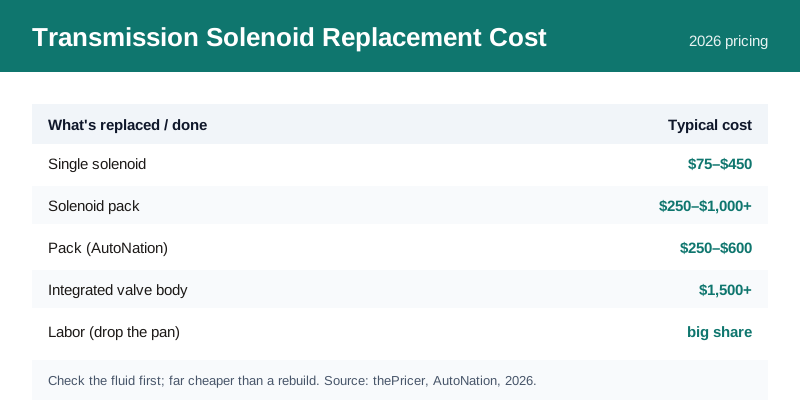
A transmission solenoid replacement runs about $75 to $450 for a single solenoid and $250 to $1,000 or more for a full solenoid pack (AutoNation puts a pack near $250 to $600). An integrated valve body, where the solenoids are built in, runs $1,500 or more. Labor to drop the transmission pan to reach them is a big share of the cost. Transmission solenoids are the small electrically controlled valves that direct transmission fluid to do the work: shift solenoids engage gears, a pressure control solenoid manages line pressure, and the TCC solenoid locks the torque converter. When one fails, you get harsh, erratic, delayed, or stuck shifting, slipping, limp mode, or a transmission trouble code. The important first step: because low or burnt transmission fluid causes the exact same symptoms, a good shop checks (and if needed services) the fluid first – it’s the cheapest possible fix.
This covers the transmission’s solenoids as a group – shift, pressure, and torque-converter – and the money-smart first move is the fluid. Let me break it down.
What you’ll actually pay
Here’s the picture. These are estimates that vary by vehicle and shop.
| Item | Cost | Notes |
|---|---|---|
| Single solenoid | $75–$450 | One valve |
| Solenoid pack | $250–$1,000+ | Multiple |
| Pack (AutoNation) | $250–$600 | Typical |
| Integrated valve body | $1,500+ | Before labor |
Specific solenoids have their own guides; our shift solenoid guide, TCC solenoid guide, and transmission fluid guide cover them.
Shop Talk
Before you pay for any solenoid, make sure it’s really a solenoid – because low, old, or burnt transmission fluid causes the exact same harsh, slipping, erratic shifting that a bad solenoid does, since the solenoids rely on clean fluid at the right pressure to work. I’ve seen a fluid-and-filter service fix shifting that was headed toward a solenoid-pack quote. So step one is checking the fluid level and condition. If it’s low, dark, or smells burnt, service that first and see if the symptoms clear. Step two is pulling the transmission codes: a specific solenoid code (P0750-series for shift solenoids, P0740 for the torque-converter clutch solenoid, P0745 for pressure control) points to a solenoid circuit, but codes can also be triggered by fluid and pressure problems, so they’re a starting point, not a guarantee. On the parts side: “transmission solenoid” can mean one individual solenoid ($75 to $450), a solenoid pack that houses several ($250 to $1,000), or solenoids integrated into a valve body ($1,500+) – your transmission’s design decides which, and that’s the biggest cost variable. Whatever it is, replacing a solenoid (even a pack) is a fraction of a transmission rebuild, so a solenoid code is good news relative to the alternative. And since the pan’s already off, do a fluid and filter service at the same time.
Where Drivers Overpay
The number-one overpay is skipping the fluid check and going straight to a solenoid pack. Low or burnt fluid mimics solenoid failure, and a fluid-and-filter service is far cheaper – so paying for the fluid first, when it’s the likely cause, can save the whole solenoid job.
The second is fear-driven overrepair: a shifting problem sounds like “transmission,” but a solenoid (even a pack) is a fraction of a rebuild. The pattern: check fluid first, pull the codes, replace the specific solenoid or pack that’s confirmed bad (not the whole valve body unless it’s integrated), and keep the repair well below a rebuild.
The Real Number
A single transmission solenoid is $75 to $450, a solenoid pack $250 to $1,000, and an integrated valve body $1,500+ before labor. Before paying, have the fluid checked – low or burnt fluid causes the same harsh, slipping, erratic shifting and a fluid-and-filter service may fix it. Pull the codes to confirm which solenoid, and remember any solenoid repair is far below a transmission rebuild, so a shift code is not a reason to replace the transmission.
Frequently Asked Questions
How much does it cost to replace a transmission solenoid?
A single transmission solenoid runs about $75 to $450, including labor. A full solenoid pack (several solenoids in one assembly) runs $250 to $1,000 or more, with AutoNation putting a typical pack near $250 to $600. If the solenoids are integrated into the valve body, that assembly can be $1,500 or more before labor. Labor to drop the transmission pan to reach the solenoids is a significant share of the cost, and a fluid-and-filter service is usually done at the same time. These are estimates that vary by vehicle, transmission design, and shop. The biggest variable is whether you need one solenoid, a pack, or a valve body – your transmission’s design determines that. Whatever the figure, a solenoid repair is far below a transmission rebuild. Checking the fluid first can sometimes avoid the repair entirely.
What do transmission solenoids do?
Transmission solenoids are small, electrically operated valves inside an automatic transmission that control the flow of transmission fluid to make the transmission work. Different solenoids have different jobs: shift solenoids direct fluid to engage the clutches and bands for each gear (so the transmission shifts up and down); a pressure control (or line pressure) solenoid regulates the fluid pressure the transmission runs on; and the torque converter clutch (TCC) solenoid locks the torque converter at cruising speed for efficiency. The transmission’s computer commands these solenoids based on speed, throttle, and load. Because they depend on clean fluid at the correct pressure to operate, the solenoids and the fluid system are closely linked – which is why fluid problems can mimic solenoid failures. When a solenoid sticks or fails electrically, it disrupts shifting or pressure, causing the characteristic symptoms and setting a code.
What are the symptoms of a bad transmission solenoid?
Common symptoms include harsh or jerky shifts, delayed engagement (a pause before the transmission goes into gear), erratic or unpredictable shifting, the transmission slipping or getting stuck in one gear (limp mode), skipped gears, or a torque-converter shudder (if the TCC solenoid). You’ll usually get a check engine light with a transmission solenoid code (such as a P0750-series shift code, P0740 for the TCC solenoid, or P0745 for pressure control). The tricky part is that low, old, or burnt transmission fluid causes these same symptoms, because the solenoids rely on proper fluid pressure. So while these signs point toward a solenoid, a good diagnosis checks the fluid level and condition first and pulls the codes before condemning a solenoid. That step – fluid first, then codes – can save you an unnecessary repair, since a cheap fluid service sometimes resolves what looked like a solenoid failure.
Can low transmission fluid mimic a bad solenoid?
Yes, and this is why the fluid check matters so much. Transmission solenoids work by directing pressurized transmission fluid, so they depend on the fluid being at the right level, clean, and at the correct pressure. When fluid is low, old, oxidized, or burnt, it can’t build or hold proper pressure, and the result looks exactly like a failing solenoid: harsh shifts, slipping, delayed or erratic engagement. A fluid and filter service is far cheaper than a solenoid or solenoid pack, so checking and, if needed, servicing the fluid first can sometimes fix the shifting without touching a solenoid. A good shop does this before quoting a solenoid replacement. It’s one of the cheapest things to rule out, and skipping it is how people pay for solenoids they didn’t need. So before any solenoid work, confirm the fluid is full, clean, and the right type – it may be the whole fix.
Is a solenoid cheaper than rebuilding the transmission?
Far cheaper – this is the reassuring part. A shifting problem sounds alarming because it’s “the transmission,” and a rebuild or replacement runs several thousand dollars. But replacing a solenoid ($75 to $450) or even a full solenoid pack ($250 to $1,000) is a fraction of that. So a transmission solenoid code is not, by itself, a reason to replace or rebuild the transmission. The right order is to check the fluid, confirm the specific failed solenoid with codes and testing, and replace just what’s needed. Only if there’s genuine internal mechanical damage (worn clutches, hard-part failure) does a rebuild come into the picture, and a solenoid code alone doesn’t prove that. So if you’re facing a shifting issue, the solenoid (and the fluid) are the affordable things to rule in first, before anyone talks about a rebuild. Don’t let “transmission trouble” rush you into the biggest repair.
What’s the difference between a single solenoid and a solenoid pack?
It comes down to how your transmission is built, and it drives the cost. Some transmissions have individual solenoids that can be replaced one at a time – so if only one shift solenoid or the TCC solenoid is bad, you replace just that one ($75 to $450). Other transmissions group several solenoids into a single assembly called a solenoid pack, which is replaced as a unit ($250 to $1,000) even if only one solenoid within it failed. And some have the solenoids integrated into the valve body, so a solenoid problem may mean replacing or rebuilding the valve body ($1,500+ before labor). Which design your transmission uses determines whether you can replace one cheap solenoid or must buy a pack or valve body. On a high-mileage transmission, some shops recommend doing the whole pack even when one solenoid can be changed alone, reasoning another will fail soon. Your shop can tell you your transmission’s design and the best approach.
Can you drive with a bad transmission solenoid?
Sometimes, but it’s not a good idea to put it off. Depending on which solenoid failed and how, the car may shift harshly, get stuck in a single gear (limp mode, often second or third, to protect the transmission), shift erratically, or shudder. Driving in limp mode or with slipping shifts puts extra heat and stress on the transmission, and heat is what damages clutches and fluid – so a cheap solenoid problem left alone can grow into a more expensive one. If the transmission is slipping, stuck, or shifting badly, it’s best to get it diagnosed promptly rather than keep driving on it. A quick fluid check and code scan early can keep a small, affordable repair from turning into a big one. So while a minor solenoid issue may let you limp to a shop, don’t ignore it – address it before the heat and stress cause real internal damage.
Sources
Price ranges verified against 2026 transmission solenoid pricing in November 2026. Dollar amounts are estimates that vary by vehicle and shop.
- thePricer – transmission solenoid repair cost
- AutoNation Mobile Service – transmission solenoid replacement cost
- ASE – National Institute for Automotive Service Excellence
Related Guides
- Shift Solenoid Replacement Cost
- Torque Converter Clutch Solenoid Replacement Cost
- Transmission Fluid Change Cost
- Transmission Replacement Cost
- Car Repair Cost Estimator

Diane Holcomb spent seven years as a service advisor at multi-brand dealerships in Charlotte, NC, where a shifting complaint got the fluid checked before anyone quoted a solenoid pack – and where she reassured customers that a solenoid, even a pack, is a fraction of a rebuild. She drives a 2019 Honda CR-V and a hand-me-down 2007 Toyota Camry, and takes no referral fees or advertising money from any shop or chain.