
Last updated: November 9, 2026 – By Eddie Brennan
November 2026 update: reconfirmed the symptom list, per-sensor cost range, and the P0420 crossover note.
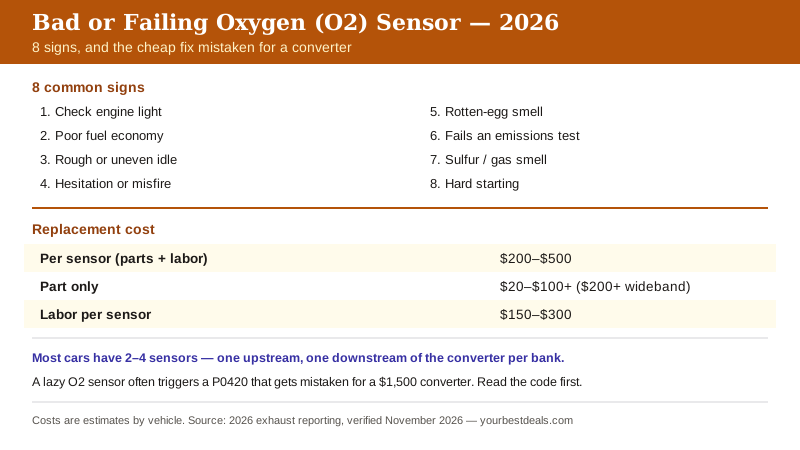
A bad oxygen sensor usually shows up as a check engine light plus worse fuel economy, a rough idle, or hesitation – and the fix is one of the cheaper emissions repairs at $200 to $500 per sensor. The oxygen sensor’s job is to measure oxygen in the exhaust so the computer can dial in the right fuel mixture, so when it fails, the engine runs too rich or too lean and everything from economy to smoothness suffers. The important twist: a lazy oxygen sensor often triggers the same P0420 code people associate with a catalytic converter, so a $250 sensor gets mistaken for a $1,500 converter. Reading the specific code is what saves you from that mistake. Here are the eight signs and what to do about them.
I chased a lot of oxygen-sensor codes in Columbus, and the satisfying ones were the P0420s that a good sensor fixed instead of a converter. Let me lay out the symptoms, what replacement really costs, and how to make sure you’re replacing the sensor, not needlessly buying the expensive part it sits next to.
The eight signs
These are the common symptoms of a failing oxygen sensor. Many stem from the same root: the computer is getting bad air-fuel data and mismanaging the mixture.
1. Check engine light. A failing or lazy oxygen sensor is one of the most common check-engine triggers, setting codes for the sensor circuit or for fuel-mixture trouble.
2. Poor fuel economy. A bad sensor can make the engine run rich, dumping in extra fuel and noticeably cutting your miles per gallon – often the first thing owners notice.
3. Rough or uneven idle. Wrong mixture data makes the idle hunt, shake, or feel uneven.
4. Hesitation or misfire. A poor mixture can cause the engine to stumble, hesitate on acceleration, or misfire.
5. Rotten-egg smell. A rich mixture from a bad sensor overworks the catalytic converter, which can produce a sulfur, rotten-egg smell.
6. Failing an emissions test. A bad sensor throws off the mixture and the readiness monitors, which can cause an emissions failure.
7. A sulfur or gas smell. Beyond rotten eggs, a rich-running engine may give a raw gas or sulfur odor, and can waste fuel visibly.
8. Hard starting. In some cases a bad sensor’s effect on the mixture makes the engine harder to start or run poorly when cold.
What replacement costs
An oxygen sensor replacement runs $200 to $500 per sensor including parts and labor. The part itself is usually $20 to $100, though wideband air-fuel sensors can be $200 or more, and labor adds roughly $150 to $300 per sensor depending on how buried it is. Most vehicles have two to four sensors – an upstream sensor before the catalytic converter and a downstream one after, on each engine bank – so which sensor failed affects both the part cost and the access.
A couple of practical notes. Oxygen sensors can seize in place from heat, making removal harder and occasionally requiring extra labor, and they often age together, so if one fails the others may not be far behind. Because a bad sensor can make the engine run rich and overwork the catalytic converter, replacing a failed sensor promptly is cheap protection for the far more expensive converter. See our exhaust guide for how the sensors and converter work together.
Shop Talk
There are upstream and downstream oxygen sensors, and the distinction matters for diagnosis. The upstream sensor (before the converter) controls the fuel mixture and is the one that usually causes running and economy problems. The downstream sensor (after the converter) mainly checks that the converter is working – and a lazy downstream sensor is a classic cause of a P0420 code that looks like a bad converter. So when you get a converter-efficiency code, having a tech compare the upstream and downstream sensor readings on a scan tool can reveal a $250 sensor fix instead of a $1,500 converter. Always match the code to the specific sensor and its location – the “bank 1 vs bank 2” and “sensor 1 vs sensor 2” in the code tells the tech exactly which one to check.
What Gets Misdiagnosed
The most valuable thing to know about oxygen sensors is how often they’re the cheap answer to a scary code. A lazy downstream sensor commonly sets a P0420 “catalyst efficiency” code – the same code that gets people quoted for a catalytic converter. Replace the sensor and the code clears; replace the converter and the sensor keeps lying, so the code returns. Before anyone sells you a converter on a P0420, the upstream and downstream sensors should be checked, because the sensor is a fraction of the converter’s price.
The mistake also runs the other way: assuming every fuel-economy or rough-idle complaint is the oxygen sensor when it’s actually a vacuum leak, a dirty mass-airflow sensor, or a misfire producing similar symptoms. The sensor gets the blame because it’s a common failure, but reading the specific code and checking fuel-trim data separates a genuine bad sensor from a mixture problem elsewhere. So the rule is the same as with the converter – match the exact code to the exact part, and confirm before replacing. That’s what keeps you from buying the wrong piece.
The Real Number
A failing oxygen sensor shows up as a check engine light, worse fuel economy, a rough idle, or hesitation, and it’s a cheap emissions fix at $200 to $500 per sensor. The key insight: a lazy downstream sensor often triggers the P0420 code that gets mistaken for a $1,500 catalytic converter, so read the specific code and check the sensor before buying the pricier part. Most cars have two to four sensors, and the code tells the tech exactly which one. Replace a failed sensor promptly – it’s cheap, and a rich-running engine from a bad sensor can overwork and shorten the life of the far more expensive converter.
Frequently Asked Questions
What are the symptoms of a bad oxygen sensor?
The common signs are a check engine light, poor fuel economy, a rough or uneven idle, and hesitation or misfire. You may also notice a rotten-egg or sulfur smell, fail an emissions test, smell raw gas, or have harder starting. These happen because the oxygen sensor tells the computer how to set the air-fuel mixture, so a bad sensor makes the engine run too rich or too lean and everything from smoothness to economy suffers. Because several of these overlap with other problems like vacuum leaks or a dirty airflow sensor, reading the specific diagnostic code is what confirms the oxygen sensor as the cause.
How much does it cost to replace an oxygen sensor?
Replacing an oxygen sensor runs $200 to $500 per sensor including parts and labor. The part is usually $20 to $100, though wideband air-fuel sensors can run $200 or more, and labor adds roughly $150 to $300 per sensor depending on how accessible it is. Most vehicles have two to four sensors – upstream and downstream of the catalytic converter on each bank – so the total depends on which one failed. These are estimated ranges that vary by vehicle. Because sensors age together and can seize from heat, some owners replace more than one at a time, but you only need to replace the one that’s actually bad.
Can a bad oxygen sensor cause a P0420 code?
Yes, and this is one of the most useful things to know. A P0420 is a “catalyst efficiency below threshold” code that people associate with the catalytic converter, but a lazy or failing downstream oxygen sensor is a very common cause of it – the sensor reports the converter’s performance, so a bad sensor produces a false converter reading. Replacing a $250 sensor often clears a P0420 that would otherwise be quoted as a $1,500 converter. That’s why, before buying a converter on a P0420, you should have the upstream and downstream sensors checked. Reading the specific code and comparing sensor data separates the two.
Is it safe to drive with a bad oxygen sensor?
You can usually drive with a bad oxygen sensor short-term, but it’s not ideal. The engine runs on a poor air-fuel mixture, which wastes fuel, can cause rough running or hesitation, and – importantly – a rich mixture can overwork and damage the catalytic converter over time, turning a cheap sensor fix into an expensive converter one. It will also fail an emissions test. So while a bad sensor rarely strands you, driving on it for long risks the far pricier converter and costs you fuel in the meantime. It’s a cheap repair worth doing promptly rather than putting off.
How long do oxygen sensors last?
Oxygen sensors typically last somewhere between 60,000 and 100,000 miles, though it varies by vehicle and sensor type, with older-style sensors often on the shorter end. They wear gradually, becoming “lazy” – slow to respond – before failing outright, which is why fuel economy can creep down before a code sets. Because they age together, when one fails the others may be close behind. There’s no need to replace them preventively before a symptom or code, but if you’re already replacing one on a high-mileage car and another is marginal, some owners do both. Follow your symptoms and codes rather than a fixed replacement schedule.
What’s the difference between upstream and downstream oxygen sensors?
The upstream sensor sits before the catalytic converter and measures the exhaust coming out of the engine, so it’s the one the computer uses to control the fuel mixture – a bad upstream sensor usually causes running and economy problems. The downstream sensor sits after the converter and mainly monitors whether the converter is cleaning the exhaust properly. A lazy downstream sensor is a classic cause of a P0420 code that looks like a converter problem. The diagnostic code identifies which sensor and which engine bank, so a tech knows exactly which one to check. Knowing the difference helps you understand why one sensor affects driving and another affects emissions codes.
Can I replace an oxygen sensor myself?
Often yes, if the sensor is accessible and you have an oxygen-sensor socket. The main challenges are that sensors seize in place from heat, sometimes requiring penetrating oil or heat to break loose, and that you have to identify the correct sensor from the code so you replace the right one. Disconnect the battery, let the exhaust cool, and use the proper socket to avoid damaging the wiring. That said, deeply buried sensors or seized ones can be a fight, and misdiagnosing which sensor is bad wastes a part. If the location is easy and the code is clear, it’s a reasonable DIY job that saves the labor portion.
Sources
Oxygen sensor symptoms and replacement cost verified against 2026 exhaust and emissions reporting on November 9, 2026. Costs are estimated ranges that vary by vehicle and sensor type; the diagnostic code identifies the specific sensor.
- Rohnert Park Transmission – oxygen sensor replacement cost, 2026
- Carsilks – cost of replacing oxygen sensors, 2026
- Blue Ridge Auto – O2 sensor replacement cost, 2026
Related Guides
- Exhaust and emissions system: parts and cost
- 9 signs of a bad catalytic converter
- What does a check engine light mean?
- Spark plug replacement cost (misfire)

Eddie Brennan spent 11 years as an ASE Master Certified technician at an independent shop in Columbus, OH, where his favorite fix was a P0420 solved with a $250 oxygen sensor instead of a converter. His A6 electrical/electronic certification covers this sensor diagnostics work directly. He takes no referral fees and drives a 250,000-mile 2015 Subaru Outback and a 2020 Ford F-150.