
Last updated: November 5, 2026 – By Diane Holcomb
November 2026 update: reconfirmed extended-warranty cost figures, the worth-it factors, and the solicitation warning.
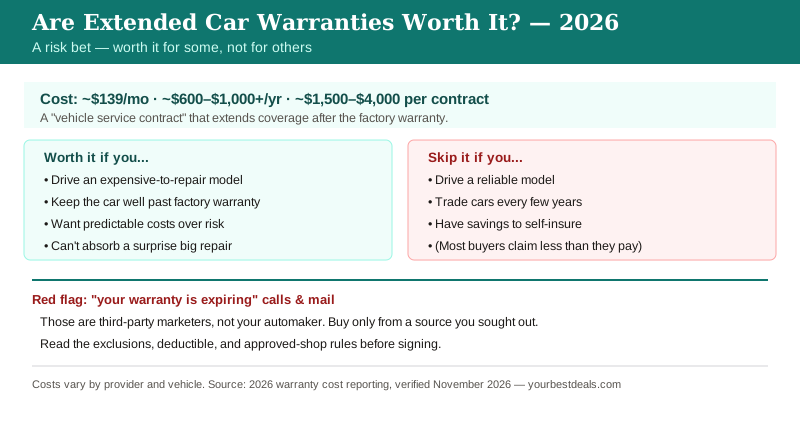
Whether an extended car warranty is worth it comes down to your specific situation, not a universal yes or no. These plans – technically vehicle service contracts – cost an average of about $139 a month, roughly $600 to $1,000 or more a year, or $1,500 to $4,000 for a multi-year contract. They can be worth it if you drive a model that’s expensive to repair, plan to keep the car well past the factory warranty, or simply can’t absorb a surprise four-figure repair. They’re often not worth it for reliable cars, frequent traders, or people with savings to self-insure – because most buyers pay more in premiums than they get back in claims. It’s fundamentally a risk-tolerance bet. Here’s how to decide, and the scams to dodge.
Extended warranties were something I watched customers agonize over at the dealership, usually pressured into a decision at the finance desk. The honest answer is that they’re neither a rip-off nor a must-have – they’re insurance, and whether insurance is “worth it” depends on your risk and your budget. Let me lay out who really benefits, who’s better off skipping, and how to avoid overpaying.
What they cost and how they work
An extended warranty extends mechanical coverage after your factory warranty ends. Pricing averages around $139 a month, but ranges widely – bare-bones plans from about $30 a month up to $250 for extensive coverage – landing most people at $600 to $1,000 or more per year, or $1,500 to $4,000 for a full multi-year contract. Like the factory warranty, it covers major component failures (engine, transmission, electrical) and excludes maintenance, wear items, and cosmetic damage. Most plans have a deductible per visit and restrict which shops you can use.
The economics are simple insurance math: the provider prices the plan to make a profit, which means on average buyers pay more in premiums than they receive in covered repairs. That doesn’t make it a bad deal – it’s the same as any insurance – but it means the value isn’t in “coming out ahead” on average; it’s in protection against a rare, expensive failure you couldn’t otherwise afford. Understanding that framing is the key to deciding, and it’s why the answer differs so much by person. See our car repair money guide for the bigger picture.
Who it’s worth it for – and who should skip it
It can be worth it if: you drive a model with a reputation for expensive repairs (many luxury and European brands qualify), you plan to keep the car for years past the factory warranty when failures become your cost, or you’d struggle to pay a surprise $3,000-to-$4,000 repair and value predictable, budgetable costs over risk. For these drivers, a single covered transmission or major electrical failure can exceed the plan’s total price, and the peace of mind has real value.
It’s often not worth it if: you drive a reliable, inexpensive-to-repair model with a strong track record, you tend to trade or sell cars every few years (often before the extended coverage would even start), or you have enough savings to self-insure – that is, to simply pay for the occasional repair yourself, which on average costs less than the premiums. For these drivers, the money is usually better kept in a repair fund than spent on a plan. Match your car, your holding period, and your finances to these buckets, and the decision usually becomes clear.
Shop Talk
Those “your car’s warranty is about to expire” phone calls and postcards are almost never from your manufacturer – they’re aggressive third-party marketers, and the plans they push are often overpriced with heavy exclusions and hard-to-use claims processes. Never buy from a cold call. If you want an extended warranty, you have real options: the manufacturer’s own plan (usually the most reliable, and negotiable at the dealer – don’t accept the first price), or a reputable independent provider you researched yourself. Also, you don’t have to buy it the day you buy the car; you can often add a manufacturer plan any time before the factory warranty expires, which gives you time to decide without finance-desk pressure. And always read the contract’s exclusions and deductible before signing.
Where Drivers Overpay
The clearest overpay is buying an overpriced third-party plan from a cold call or high-pressure finance desk. These often cost more and cover less than a manufacturer plan, with exclusions that get claims denied. If you want coverage, buy the manufacturer’s plan (negotiated, not at sticker) or a reputable provider you sought out yourself. The second overpay is buying a plan you don’t need – for a reliable car you’ll trade in a few years, the premiums usually exceed what you’d ever claim, so the money is better in a repair fund.
The third is not negotiating. Manufacturer extended warranties are frequently negotiable, and dealers mark them up, so the first price is rarely the best. And the fourth is paying for overlap – buying extended coverage that duplicates time still left on your factory warranty. So if you decide a plan is right for your situation, buy it from a trustworthy source, negotiate the price, avoid overlap with existing coverage, and read the exclusions. And if your car and finances point the other way, keeping the premium money as a repair fund is the cheaper path. This is a financial decision, so weigh it against your own budget and risk tolerance.
The Real Number
An extended warranty costs about $139 a month, roughly $600 to $1,000-plus a year, and is insurance, not a savings play – most buyers pay more in premiums than they claim. It’s worth it if you drive an expensive-to-repair model, keep the car well past the factory warranty, or couldn’t absorb a surprise big repair. Skip it if you drive something reliable, trade cars often, or can self-insure with savings. Never buy from a “your warranty is expiring” cold call; use the manufacturer’s plan (negotiate it) or a reputable provider, avoid overlap with existing coverage, and read the exclusions before signing.
Frequently Asked Questions
How much does an extended car warranty cost?
Extended car warranties cost an average of about $139 a month, though they range widely – from roughly $30 a month for bare-bones coverage up to $250 for extensive plans. Annually that’s commonly $600 to $1,000 or more, and a full multi-year contract often totals $1,500 to $4,000. Cost depends on the vehicle, coverage level, deductible, and provider. These are estimated ranges that vary. Because pricing varies so much and manufacturer plans are negotiable, it pays to shop around and not accept the first quote, especially at the dealer finance desk. Compare what’s covered and excluded, not just the monthly price, since a cheaper plan with heavy exclusions may not be the better value.
Is an extended warranty a good idea?
It’s a good idea for some drivers and a poor one for others, because it’s essentially insurance. It’s a good idea if you drive a model that’s expensive to repair, plan to keep the car well past the factory warranty, or couldn’t comfortably pay a surprise $3,000-to-$4,000 repair and want predictable costs. It’s a poor idea if you drive a reliable, cheap-to-repair car, trade vehicles every few years, or have savings to cover repairs yourself, since on average buyers pay more in premiums than they claim. So there’s no universal answer – match your specific car, how long you’ll keep it, and your finances to decide whether the protection is worth the cost for you.
What does an extended warranty not cover?
Like a factory warranty, an extended warranty covers major mechanical failures but not routine maintenance (oil changes, filters, fluids), wear items (brake pads, tires, wipers, belts, clutches), or cosmetic damage (scratches, dents, interior wear). Many plans also exclude damage from lack of maintenance, modifications, or misuse, and pre-existing conditions. Coverage varies a lot by plan tier – a powertrain plan covers less than a bumper-to-bumper-style plan – so the exclusions list matters as much as what’s covered. This is why reading the contract before buying is essential: a claim can be denied if the failed part is excluded or if you can’t show the required maintenance was done. Always know exactly what your specific plan does and doesn’t cover.
Are those extended warranty phone calls legitimate?
The “your car’s warranty is about to expire” calls and postcards are almost never from your manufacturer – they’re third-party marketing companies, and many are aggressive or misleading. The plans they sell are often overpriced with heavy exclusions and difficult claims processes, and some are outright scams. You should never buy an extended warranty from a cold call or unsolicited mail. If you want coverage, seek it out yourself from the vehicle manufacturer or a reputable, well-reviewed provider. Legitimate extended warranties don’t need to chase you with robocalls. Treat any unsolicited warranty pitch as a red flag, and hang up or discard it rather than engaging.
When is the best time to buy an extended warranty?
You generally don’t have to buy it the moment you buy the car, despite finance-desk pressure. With manufacturer plans, you can often add coverage any time before your factory warranty expires, which lets you decide without being rushed and see how the car holds up first. Buying too early means paying for coverage that overlaps your existing factory warranty, which is wasted money. So a reasonable approach is to note when your factory warranty ends and, if you’ve decided a plan makes sense for your situation, purchase before that deadline rather than on day one. This also gives you time to shop and negotiate rather than accepting the dealer’s first offer under pressure.
Can I negotiate the price of an extended warranty?
Yes, especially for manufacturer-backed plans sold through dealers, which are frequently marked up and negotiable. The price quoted at the finance desk is rarely the lowest the dealer will accept, so it’s worth countering or getting quotes from multiple dealers for the same manufacturer plan. Some buyers save hundreds by negotiating or buying the identical plan from a different dealer online. Third-party plans are also negotiable but come with the caveats about reputability. The key is not to treat the first price as fixed. Since these plans carry significant markup, negotiating is one of the simplest ways to reduce the cost if you’ve decided an extended warranty is right for you.
Should I just save the money for repairs instead?
For many drivers, yes – this is called self-insuring, and it often comes out ahead. Because providers price plans to profit, the average buyer pays more in premiums than they claim, so setting aside what you’d have spent on a plan into a dedicated repair fund frequently leaves you with money left over. Self-insuring works best if you drive a reliable car, have or can build a cushion of savings, and could handle a large repair from that fund. It works less well if a surprise big repair would really strain you, in which case the plan’s predictability has value. So weigh whether you’d rather guarantee a smaller known cost (the premium) or accept the risk and keep the money.
Sources
Extended warranty cost and value figures verified against 2026 cost reporting on November 5, 2026. Figures are estimated ranges that vary by provider and vehicle; read your specific contract terms.
- Insurify – average cost of extended auto warranties, 2026
- Car Talk – are extended car warranties worth it, 2026
- ConsumerAffairs – extended car warranty cost, 2026
Related Guides
- Car repair money: warranties and costs
- What is a bumper-to-bumper warranty?
- Transmission service and repair cost
- Car maintenance schedule and cost

Diane Holcomb spent seven years at Charlotte dealership service desks, where she watched customers get pressured into extended warranties at the finance desk – and learned that the honest answer is “it depends on your car and your savings,” not a hard sell. She writes the cost guides on Your Best Deals and takes no referral fees. She drives a 2019 Honda CR-V and a 2007 Toyota Camry.