
Last updated: November 4, 2026 – By Diane Holcomb
November 2026 update: reconfirmed intervals by oil type, the once-a-year rule, and severe-service triggers.
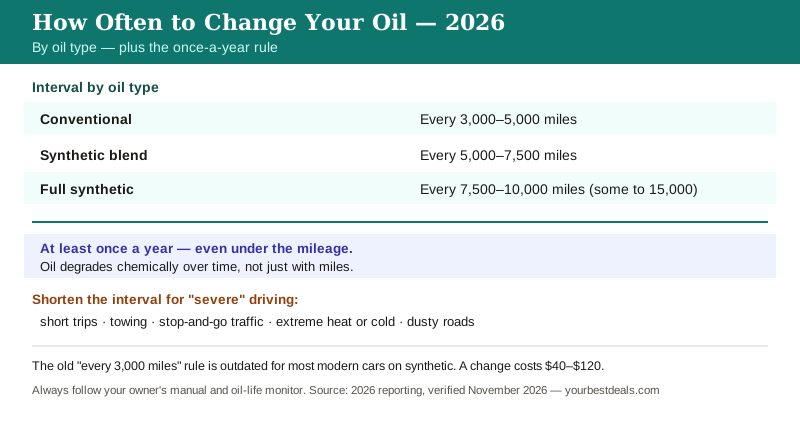
How often you change your oil depends mainly on the oil type: conventional oil every 3,000 to 5,000 miles, synthetic blend every 5,000 to 7,500, and full synthetic every 7,500 to 10,000 miles, with some vehicles going up to 15,000. On top of that, change it at least once a year even if you’re under the mileage, because oil degrades chemically over time, not just with use. The old “every 3,000 miles” rule is outdated for most modern cars running synthetic – but severe driving can pull any of these intervals shorter. Your owner’s manual and your car’s oil-life monitor are the final word, since they’re tuned to your specific engine.
This was the question I got most at the service desk, usually from someone who’d heard “3,000 miles” their whole life and was changing oil twice as often as their car needed. On modern synthetic that’s money down the drain. Let me lay out the real intervals, when to go shorter, and how to use the tools your car already gives you.
Interval by oil type
The oil in your engine determines how long it lasts, because synthetic oils are engineered to resist breakdown far longer than conventional. Conventional oil, the cheapest, needs changing every 3,000 to 5,000 miles. A synthetic blend stretches that to 5,000 to 7,500 miles. Full synthetic, which most newer cars now use or recommend, typically goes 7,500 to 10,000 miles, and some manufacturers spec intervals up to 15,000 miles on their full-synthetic requirement.
The important thing is to use the oil your manufacturer specifies and the interval that goes with it. Many modern engines are designed for full synthetic and a longer interval, so changing that oil every 3,000 miles wastes money without helping the engine. Conversely, using conventional oil and stretching it to a synthetic interval will damage the engine. Match the oil type to your manual, then use the matching interval. Our oil change cost guide covers what each type costs, and the engine oil guide explains the differences.
The once-a-year rule and severe driving
Mileage isn’t the only clock. Oil degrades chemically over months from exposure to heat, moisture, and combustion byproducts, so even a low-mileage car should have its oil changed at least once a year. If you drive so little that you never hit the mileage interval, the calendar is what triggers your change. This catches a lot of people with second cars or short commutes who assume low miles means they can skip it – the oil ages regardless.
Severe driving pulls every interval shorter. “Severe service,” which many manuals define, includes frequent short trips (where the engine never fully warms up), towing or hauling heavy loads, lots of stop-and-go traffic, extreme heat or cold, and dusty conditions. If that describes your driving – and it describes more people than realize it – you should lean toward the shorter end of your oil’s range or the severe-service interval in your manual. Short trips are the sneaky one: a lot of ordinary commuting actually qualifies as severe.
Shop Talk
Trust your car’s oil-life monitor if it has one – it’s smarter than a mileage sticker. Modern monitors track how the engine actually runs (temperatures, trip length, load) and tell you when the oil is really due, not just when an odometer number rolls over. Reset it after every change so it stays accurate. And ignore the sticker the quick-lube puts in your window that says “come back in 3,000 miles” – that’s their business, not your manufacturer’s recommendation. If your car specs synthetic at 7,500 miles, changing it at 3,000 doesn’t help the engine, it just sells more oil changes. Use the manual’s interval and the oil-life monitor, and change it once a year at minimum.
Where Drivers Overpay
The overpay here is changing oil far more often than your car needs, driven by the outdated 3,000-mile rule and quick-lube window stickers. If your engine takes full synthetic on a 7,500-mile interval and you’re changing at 3,000, you’re doing more than twice the oil changes required – money spent with no benefit to the engine. Modern oils and engines are built for the longer interval, so following the manufacturer’s number, not a shop’s sticker, is the direct saving.
The opposite overpay is stretching too far and risking the engine. Skipping oil changes to save money, or ignoring the once-a-year rule on a low-mileage car, can sludge and damage the engine – the single most expensive thing on the car. So the sweet spot is exactly what your manual says: not more often (wasting money), not less often (risking the engine). And the second saving is doing it at a fair-priced shop or DIY rather than a dealer premium. Match the manufacturer’s interval with the correct oil, and you spend neither too much nor too little. See our maintenance schedule for the full picture.
The Real Number
Change conventional oil every 3,000 to 5,000 miles, synthetic blend every 5,000 to 7,500, and full synthetic every 7,500 to 10,000 (some to 15,000) – and at least once a year regardless of mileage, since oil ages over time. Follow your owner’s manual and oil-life monitor, not the quick-lube’s 3,000-mile sticker, which for a modern synthetic car means paying for twice the oil changes you need. Go shorter for severe driving: short trips, towing, extreme temperatures, and stop-and-go. A change costs $40 to $120, and matching the manufacturer’s interval is where you avoid both overpaying and risking the engine.
Frequently Asked Questions
How often should I really change my oil?
It depends on your oil type: conventional every 3,000 to 5,000 miles, synthetic blend every 5,000 to 7,500, and full synthetic every 7,500 to 10,000 miles, with some manufacturers specifying up to 15,000 on full synthetic. Regardless of mileage, change it at least once a year because oil degrades over time. Your owner’s manual and your car’s oil-life monitor give the exact answer for your engine and should override any general rule. Severe driving – short trips, towing, extreme temperatures, dust – shortens all of these. The old 3,000-mile rule is outdated for most modern cars running synthetic oil.
Is the 3,000-mile oil change rule still true?
For most modern cars, no. The 3,000-mile rule dates from an era of conventional oil and older engines. Today’s engines are designed for synthetic or synthetic-blend oil that lasts much longer, so manufacturers commonly specify 5,000 to 10,000 miles, and some up to 15,000. Changing full-synthetic oil every 3,000 miles wastes money without benefiting the engine. The rule persists partly because quick-lube shops put 3,000-mile reminder stickers in windows. The reliable guide is your owner’s manual and oil-life monitor. That said, if your car specifically uses conventional oil, an interval closer to 3,000 to 5,000 miles may still apply, so check what your engine actually takes.
Does oil expire if I don’t drive much?
Yes. Oil degrades chemically over time from exposure to heat, moisture, and combustion byproducts, so it ages even in a car that isn’t driven much. That’s why manufacturers recommend changing the oil at least once a year regardless of mileage. If you drive so little that you never reach the mileage interval, the once-a-year rule is what triggers your change. Low-mileage second cars and short-commute drivers often overlook this and let old oil sit, which isn’t good for the engine. So don’t rely on mileage alone – the calendar matters too, and a yearly change is the minimum even for barely-driven cars.
What is severe service and does it apply to me?
Severe service is a driving pattern that stresses the oil more, and many manuals define it and give a shorter interval for it. It includes frequent short trips where the engine doesn’t fully warm up, towing or hauling heavy loads, lots of stop-and-go traffic, extreme heat or cold, and dusty or off-road conditions. It applies to more drivers than expect it – a short daily commute where the engine barely warms up qualifies. If your driving fits, lean toward the shorter end of your oil’s interval or follow the severe-service schedule in your manual. Read the definitions honestly rather than assuming your driving is “normal,” since the short-trip trigger is common.
Can I go by the oil-life monitor instead of mileage?
Yes, and on cars that have one, the oil-life monitor is generally more accurate than a fixed mileage number, because it factors in how the engine actually runs – trip length, temperatures, and load. When it indicates the oil is due, that’s a reliable signal to change it, and you should reset it after each change to keep it accurate. Just pair it with the once-a-year rule: if the monitor hasn’t triggered but it’s been a year, change the oil anyway. Also don’t confuse the oil-life monitor with a simple mileage-based maintenance reminder; a true oil-life monitor adapts to your driving, while a basic reminder just counts miles.
What happens if I change my oil too often?
Changing oil more often than your car needs doesn’t harm the engine, but it wastes money and resources. If your manufacturer specifies 7,500 miles on full synthetic and you change at 3,000, you’re paying for more than twice the oil changes required with no benefit – the oil still had plenty of life. This is a common way people overspend on maintenance, encouraged by the outdated 3,000-mile rule and quick-lube stickers. The engine doesn’t run better on needlessly fresh oil. The efficient approach is to follow the manufacturer’s interval and oil-life monitor, which gives the engine everything it needs without paying for changes it doesn’t.
What happens if I don’t change my oil on time?
Overdue oil is the more dangerous mistake. As oil ages it breaks down, loses its lubricating and cooling ability, and can turn to sludge, which starves engine parts of protection and causes wear or serious damage. Stretching oil changes well past the interval, or ignoring the once-a-year rule, risks the engine – the single most expensive component on the car. Warning signs include the oil warning light, a burnt smell, or dark, gritty oil on the dipstick. Because an engine repair or replacement dwarfs a $40-to-$120 oil change, staying on interval is cheap insurance. If you’ve gone well past due, change it as soon as possible.
Sources
Oil change intervals and costs verified against 2026 maintenance reporting on November 4, 2026. Intervals are estimated ranges; always follow your owner’s manual and oil-life monitor for your specific vehicle.
- Motorist Care – how often to change engine oil, 2026
- Rohnert Park Transmission – oil change intervals, 2026
- Replacement Guide – conventional vs synthetic oil intervals, 2026
Related Guides
- Car maintenance schedule and cost
- Oil change cost
- Engine oil guide: types and differences
- Oil change coupons and prices by chain

Diane Holcomb spent seven years at Charlotte dealership service desks, where “how often should I change my oil?” was the question she answered most – usually to tell someone they were changing it twice as often as their car needed. She writes the cost and maintenance guides on Your Best Deals and takes no referral fees. She drives a 2019 Honda CR-V and a 2007 Toyota Camry.