
Last updated: November 5, 2026 – By Eddie Brennan
November 2026 update: refreshed the strut-vs-shock explanation and the replace-in-pairs/alignment guidance.
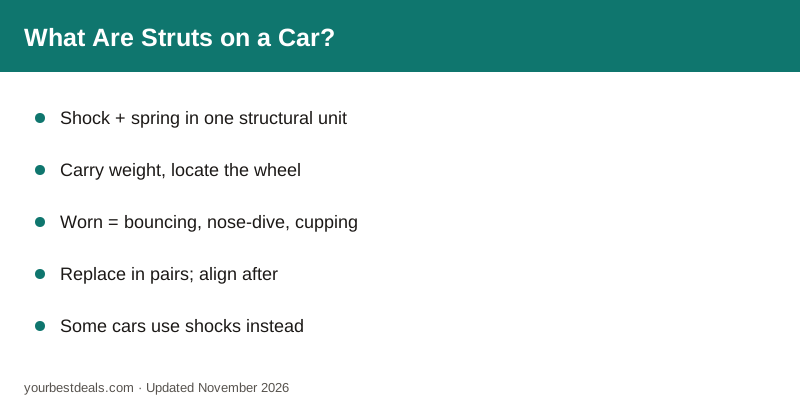
A strut is a suspension unit that does several jobs at once: it combines a shock absorber with the coil spring into one assembly, and it’s structural – it helps hold the wheel in place and carries part of the vehicle’s weight, which a plain shock does not. That’s the key difference from a shock: a shock only damps motion, while a strut damps motion and is part of the suspension’s structure. When struts wear out, you get bouncing over bumps, nose-dive under braking, cupped or uneven tire wear, clunks, and generally sloppy, less stable handling. Two practical rules: struts are replaced in pairs (both fronts or both rears) so the car sits and handles evenly, and a wheel alignment follows because replacing a strut disturbs the suspension geometry. Not every car has struts – many use separate shocks and springs – so the first step is knowing what your car has.
Struts and shocks get used interchangeably in conversation, but they’re not the same part, and the difference matters for what the repair costs and involves. A strut is doing structural work a shock isn’t, which is why replacing one is a bigger job and why it needs an alignment afterward. I spent a lot of my shop years under cars doing exactly this work.
Strut vs shock: the real difference
Both struts and shocks dampen the up-and-down motion of the suspension so the car doesn’t bounce endlessly after a bump. The difference is structural. A shock absorber is just a damper – it controls spring motion but isn’t part of holding the wheel or supporting the car; the spring and the wheel’s location are handled by separate components. A strut integrates the damper and the coil spring into one unit and is a structural, load-bearing member of the suspension that also helps locate the wheel and often provides a pivot point for steering. Because a strut carries weight and locates the wheel, replacing it changes the suspension geometry (hence the alignment), and it’s a more involved job than swapping a shock. Many vehicles use struts at the front (common on front-wheel-drive cars) and may use shocks or struts at the rear – it varies by design, which is why identifying your setup matters.
Signs your struts are worn
Worn struts show up as: excessive bouncing after bumps (the car keeps oscillating instead of settling), nose-dive when braking and squat when accelerating, body roll and instability in turns, cupped or uneven tire wear (the tire bounces and wears in a scalloped pattern), clunks or knocking over bumps, a rougher, bouncier ride, and sometimes fluid leaking from the strut. The classic quick test (the “bounce test”) is to push down hard on a corner of the car and let go – a good strut settles in about one bounce, a worn one keeps bouncing. Worn struts also lengthen stopping distance and hurt stability, so they’re a safety item, not just a comfort one. For cupped-tire specifics, see our tire wear patterns guide.
Shop Talk
Two things save you money and trouble on struts. First, replace them in pairs – both front struts together, or both rears together – even if only one seems worn. The reason is that struts wear gradually and evenly over the same miles, so if one front strut is worn out, the other is close behind, and more importantly, a fresh strut on one side and a worn one on the other makes the car handle and sit unevenly (it’ll pull or feel lopsided under braking and cornering). Doing them in pairs keeps the car balanced and means you’re not back in the shop for the other side soon. Second, budget for a wheel alignment after strut replacement, because removing and reinstalling a strut disturbs the suspension geometry (camber especially), and skipping the alignment leads to uneven tire wear and poor handling – so the alignment isn’t an upsell, it’s part of doing the job right. One more money tip: you can buy a “loaded” or “quick” strut assembly that comes with the spring and top mount already assembled, which cuts labor (no need for a spring compressor and the time to rebuild the assembly) and often costs about the same or less overall than a bare strut plus the labor to transfer the spring. Ask the shop whether they’re using loaded assemblies. Know whether your car even has struts first – many use shocks at one or both ends.
What Gets Misdiagnosed
The common confusion is strut versus shock – people (and even some casual advice) use the words interchangeably, but they’re different parts with different jobs, costs, and procedures. Assuming your car has struts when it has shocks (or vice versa) leads to wrong expectations about the repair. The first step is always identifying what your vehicle actually uses at each end.
The other is blaming struts for noises or symptoms that are actually other suspension parts. Clunks over bumps can come from sway-bar links, worn bushings, ball joints, or the strut’s top mount rather than the strut cartridge itself; cupped tires point to worn struts/shocks but can involve other issues too. A proper inspection distinguishes a worn strut from a worn link, bushing, or mount so you replace the right part – see our sway bar guide and control arm guide.
The Real Number
A strut combines the shock absorber and coil spring into one structural unit that carries weight and locates the wheel – unlike a plain shock, which only damps motion. Worn struts cause bouncing, nose-dive braking, cupped tires, clunks, and sloppy handling, and they lengthen stopping distance, so they’re a safety item. Replace them in pairs and get an alignment afterward (the geometry is disturbed), and ask about “loaded” strut assemblies to cut labor. First confirm whether your car even has struts – many use shocks at one or both ends. For cupped tires, see our tire wear guide.
Frequently Asked Questions
What’s the difference between struts and shocks?
The difference between struts and shocks is that a strut is a structural suspension component that combines the shock absorber and the coil spring into one unit and helps hold the wheel in place and carry the vehicle’s weight, while a shock absorber is only a damper that controls spring motion and is not part of the suspension’s structure – so a strut does more jobs and is more involved to replace. Both struts and shocks perform the damping function, controlling the up-and-down motion of the suspension so the car settles after bumps instead of bouncing. But a shock is purely a damper: the spring and the wheel’s location are handled by separate parts, and the shock just bolts in to control motion. A strut, by contrast, integrates the damper with the coil spring and is a load-bearing, structural member – it helps support the car’s weight, locates the wheel, and often serves as a steering pivot point. This structural role is why replacing a strut is a bigger job than replacing a shock, why it changes the suspension geometry and requires an alignment afterward, and why struts and shocks aren’t interchangeable. Many vehicles use struts at the front and shocks or struts at the rear, varying by design, so a given car might have struts on one axle and shocks on the other. Because people often use the terms interchangeably in conversation, the practical first step for any suspension work is to identify what your specific car actually has at each end. For replacement cost, see our strut replacement guide.
How do I know if my struts are worn out?
You can tell your struts are worn out by several signs: excessive bouncing after bumps (the car keeps oscillating rather than settling quickly), the nose diving noticeably when you brake and the rear squatting when you accelerate, body roll and instability in turns, cupped or uneven tire wear, clunking or knocking over bumps, a generally rougher and bouncier ride, and sometimes visible fluid leaking from the strut. A simple at-home check is the bounce test: push down firmly on one corner of the car and release – a good strut lets the car settle in roughly one bounce, while a worn strut lets it keep bouncing two or more times, indicating the damping is weak. Beyond comfort, worn struts affect safety and handling: they lengthen stopping distances (the nose-dive and reduced tire contact hurt braking), reduce stability in corners and crosswinds, and cause the tires to lose consistent road contact, which both degrades handling and wears the tires unevenly (the cupped, scalloped pattern is a telltale sign of worn struts or shocks). Because the decline is gradual, many drivers don’t notice how worn their struts are until they’re quite bad or until a new set reveals how much better the car should feel. If you’re seeing these signs – especially bouncing, nose-dive, cupped tires, or leaking struts – have the suspension inspected, and remember that worn struts are a safety and tire-wear issue, not just a ride-comfort one. For cupped-tire specifics, see our tire wear patterns guide; for cost, our strut replacement guide.
Do struts have to be replaced in pairs?
Struts should be replaced in pairs – both front struts together, or both rear struts together – even if only one appears worn, because struts wear gradually and evenly over the same mileage, so the other side is usually close behind, and more importantly, mismatched struts (one new, one worn) make the car sit and handle unevenly, affecting braking balance and cornering. This is the same principle that applies to shocks and other ride-control components: the left and right units on an axle work together to keep the car balanced, so if one is fresh and firm while the other is worn and soft, the suspension responds differently side to side, which can cause the car to pull or feel lopsided under braking, lean unevenly in turns, and wear tires unevenly. Replacing them as a pair keeps the car’s handling symmetric and predictable. On top of that, since both struts on an axle have seen the same miles and conditions, a worn one strongly implies the other is near the end of its life too, so replacing just one often means being back in the shop for the second before long – doing both at once saves a return visit and duplicate labor. So while it’s physically possible to replace a single strut, it’s not recommended; pairs are the standard, sensible practice. The same logic means you don’t necessarily have to replace all four at once – you do the pair that’s worn (e.g., both fronts) – though if all four are of similar age and wear, doing all four may make sense. For cost, see our strut replacement guide.
Why do I need an alignment after replacing struts?
You need a wheel alignment after replacing struts because removing and reinstalling a strut disturbs the suspension’s geometry – particularly the camber angle, and sometimes others – so the wheels may no longer sit at their correct angles, and driving without correcting that leads to uneven tire wear and compromised handling. The strut is a structural part of the suspension that helps locate the wheel, and its mounting is tied into the angles that determine how the tire meets the road. When a strut is replaced, the assembly is taken apart and put back together, and on many designs the camber (the inward or outward tilt of the wheel) can shift from where it was, even slightly; if left uncorrected, an off camber or toe angle causes the tire to wear unevenly (often on one edge) and can make the car pull, wander, or handle poorly. An alignment measures and resets those angles to the manufacturer’s specification, ensuring the new struts and the tires perform correctly. This is why a reputable shop includes (or strongly recommends) an alignment as part of strut replacement – it’s not an upsell but a necessary step to protect your tires and restore proper handling after the geometry was disturbed. Skipping it to save money is a false economy, because the uneven tire wear it causes can ruin a set of tires far faster than the alignment would have cost. So budget for the alignment as part of the strut job. For alignment cost, see our wheel alignment guide; for strut cost, our strut replacement guide.
How long do struts last?
Struts typically last a long time – often somewhere in the range of 50,000 to 100,000 miles or more – but their lifespan varies widely with driving conditions, road quality, vehicle weight and use, and how the car is driven, so there’s no single mileage at which they must be replaced; instead, they’re replaced based on wear and symptoms. Struts wear gradually as their internal damping degrades over tens of thousands of miles, and because the decline is slow, drivers often don’t notice it until the struts are quite worn. Rough roads, potholes, heavy loads, towing, and aggressive driving all accelerate wear, so a car driven on poor roads or worked hard may need struts sooner, while one driven gently on smooth roads may go longer. Rather than replacing struts purely by a mileage number, the better approach is to watch for the symptoms of wear – bouncing, nose-dive, cupped tires, clunks, a deteriorating ride – and have the suspension inspected if they appear or periodically as the car ages past moderate mileage. Some owners also notice the decline when they drive a similar newer car and feel how much more controlled it is. Because worn struts affect safety (braking and stability) as well as comfort and tire wear, it’s worth having them checked when symptoms show rather than stretching them indefinitely. So think of strut life as a range influenced heavily by conditions, with replacement driven by inspection and symptoms rather than a fixed interval. If your car is past moderate mileage and the ride has gotten bouncy or the tires are cupping, have the struts evaluated. For replacement cost, see our strut replacement guide.
Is it safe to drive with worn struts?
Driving with worn struts is possible but not advisable for long, because worn struts compromise safety – they lengthen braking distances, reduce stability and control (especially in turns, emergency maneuvers, and crosswinds), and cause uneven tire wear – so while a car with mildly worn struts still drives, badly worn struts are a genuine safety concern worth addressing rather than ignoring. Struts keep the tires in consistent contact with the road and control the car’s body motion; when they’re worn, the tires can bounce and lose grip over bumps, the nose dives under braking (shifting weight and lengthening stopping distance), and the car becomes less stable and more prone to body roll and wandering. In an emergency maneuver or on a rough or wet road, that reduced control matters. Worn struts also cause the tires to wear unevenly (the cupped pattern), which further degrades grip and can ruin tires prematurely. So the practical guidance is that mildly worn struts aren’t an immediate emergency – you can drive to get them replaced – but you shouldn’t treat significantly worn struts as a comfort-only issue to put off indefinitely, because the safety degradation is real and gradual enough that you may not notice how much control you’ve lost. If your struts are leaking, the ride is very bouncy, braking feels unstable, or the tires are cupping, have them replaced reasonably soon. Think of struts as a safety component with a comfort side effect, not the other way around. For cost, see our strut replacement guide.
What is a “loaded” or “quick” strut assembly?
A “loaded” or “quick” strut assembly is a replacement strut that comes pre-assembled with the coil spring, top mount, and bearing already installed as a complete unit, so it can be bolted in as one piece – which saves labor compared to a bare strut, because it eliminates the need to compress and transfer the spring from the old strut, and it often makes the overall job comparable in cost or cheaper despite the part itself costing more. When you replace a traditional bare strut (just the strut cartridge), the technician has to use a spring compressor to safely remove the coil spring and top mount from the old strut and transfer them to the new one – a time-consuming and somewhat hazardous task (compressed springs store a lot of energy). A loaded/quick strut skips all that: the spring, mount, and bearing are already assembled on the new strut, so it installs as a single bolt-in unit, cutting labor time and the risk of spring-compressor work. The trade-off is that the loaded assembly costs more as a part than a bare strut, but because it saves significant labor and also renews the spring and top mount (which wear too) at the same time, the total installed cost is often similar to or less than a bare strut plus the labor to transfer the old spring – and you get fresh springs and mounts in the bargain. Many shops prefer loaded assemblies for these reasons, and it’s worth asking whether yours is using them. For the DIY-minded, loaded struts also make the job far more approachable by avoiding spring-compressor use. For cost context, see our strut replacement guide.
Sources
Strut function, wear-sign, and replacement-practice information verified against standard suspension service practice in November 2026. Have a professional inspect and align after replacement.
- ASE – National Institute for Automotive Service Excellence
- NHTSA – vehicle safety
- Cars.com – maintenance and repair resources
Related Guides
- Strut Replacement Cost
- What Does a Sway Bar Do?
- What Is a Control Arm?
- Reading Tire Wear Patterns
- Suspension Guides

Eddie Brennan is an ASE Master Certified technician (A4 Suspension & Steering) who spent 11 years in an independent shop in Columbus, OH, before a back injury moved him into writing. He spent a lot of those years under cars doing strut work, and he’ll correct anyone who uses “strut” and “shock” as the same word – the difference changes the job and the cost. He drives a 2015 Subaru Outback with over 250,000 miles and a 2020 Ford F-150, and takes no referral fees or advertising money from any shop or chain.