
Last updated: November 3, 2026 – By Eddie Brennan
November 2026 update: reconfirmed the limp-mode explanation, common sensor causes, and cost ranges.
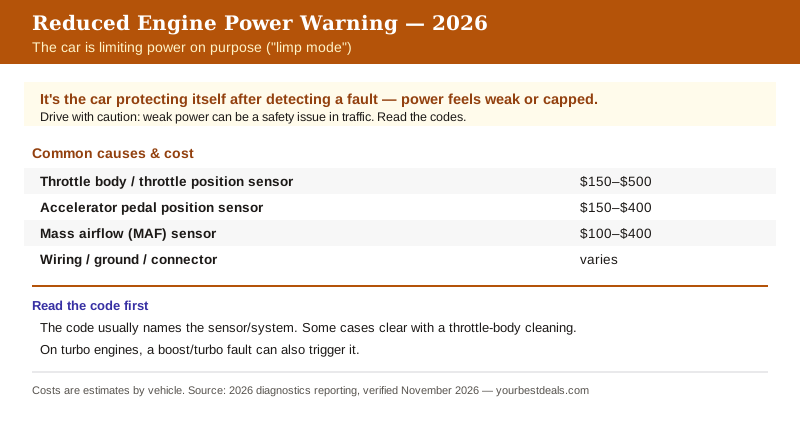
A reduced engine power warning means your car has deliberately limited its own power output – often called “limp mode” – to protect itself after detecting a fault. You’ll feel it as weak, capped acceleration: the car may struggle to speed up or feel like it won’t rev past a certain point. It’s a protective measure, not a random glitch, and the computer triggers it when a sensor or system reading tells it something’s wrong. Common causes are relatively affordable: a dirty throttle body or throttle position sensor ($150 to $500), an accelerator pedal position sensor ($150 to $400), or a mass airflow sensor ($100 to $400), though wiring problems and, on turbo engines, boost faults can also cause it. Read the trouble codes, because they usually name the specific culprit. Here’s what it means and what to do.
Reduced power mode alarms people because the car suddenly feels broken, but it’s actually the car being cautious. Still, it’s a drive-with-caution situation, not a shrug – weak acceleration can be a safety problem merging into traffic, and the underlying fault won’t fix itself. Let me explain why the car does this, the common causes, and how to sort it out.
Why the car limits its own power
Modern cars use electronic throttle control, where sensors on the accelerator pedal and throttle body tell the computer how much power you want and manage the engine accordingly. When the computer detects a fault in that system – a sensor reading that doesn’t add up, a mismatch between the pedal and throttle signals, or another protective trigger – it defaults to a safe, reduced-power state to prevent unpredictable behavior or further damage. That’s limp mode: the car sacrifices performance to stay controllable and protect itself.
So reduced engine power isn’t the problem itself; it’s the car’s response to a problem. That’s why it almost always comes with stored trouble codes pointing at the specific sensor or system that triggered it. The practical upshot: the fix is usually addressing whatever fault the computer detected – often a throttle or pedal sensor – after which the car returns to normal power. Reading the codes is the essential first step, since guessing at reduced-power causes is difficult without them. Our check engine light guide covers reading codes, which usually accompany this warning.
The common causes and costs
Here’s what usually triggers reduced engine power, with rough costs. These are estimated ranges that vary by vehicle.
| Cause | Typical cost | Notes |
|---|---|---|
| Dirty/failing throttle body or TPS | $150–$500 | Cleaning sometimes fixes it |
| Accelerator pedal position sensor | $150–$400 | Common on drive-by-wire cars |
| Mass airflow (MAF) sensor | $100–$400 | Affects air/fuel readings |
| Wiring, ground, or connector fault | Varies | Can be cheap or tricky to find |
| Misfire or turbo/boost fault | Varies | More serious causes |
The throttle body and its sensor are frequent culprits, and sometimes a throttle-body cleaning restores normal operation without a new part. Pedal and airflow sensors are the next common suspects. Wiring, ground, and connector problems can also trigger it and range from a cheap fix to a tricky diagnosis. On turbocharged engines, a boost or turbo fault can put the car in reduced power too. The code narrows it down, which is why you read it first rather than replacing parts. See our engine guide for related sensor issues.
Shop Talk
If your car drops into reduced power, first get somewhere safe – the weak acceleration is a real hazard when you’re trying to merge or cross traffic, so don’t push it into a tight spot. Sometimes reduced power is triggered by a one-off glitch, and turning the car off and restarting it (a key cycle) will restore normal power temporarily; that’s fine to get home or to a shop, but it doesn’t fix the cause, and it’ll likely come back. Before you replace an expensive part, know that a dirty throttle body is a common and cheap culprit on higher-mileage cars – a throttle-body cleaning sometimes clears the problem for the cost of a can of cleaner and some labor. And always read the codes: reduced power is nearly impossible to diagnose by feel alone, but the stored code usually points right at the sensor or circuit that tripped it.
What Gets Misdiagnosed
The main misstep is treating reduced power as a mystery and throwing parts at it without reading the codes. Because the warning is the car’s response to a fault rather than a specific failure itself, it’s very hard to diagnose by symptom alone – but it almost always sets a code that names the throttle, pedal, airflow, or other system that triggered it. Guessing wastes money on parts that may not be the cause. So the first and cheapest step is always a code scan, which turns a vague “reduced power” into a specific target.
The second is overlooking the cheap fixes – a throttle-body cleaning or a wiring/connector repair – in favor of assuming an expensive part. A dirty throttle body is a common cause on higher-mileage cars and can sometimes be cleaned rather than replaced, and a corroded connector or bad ground can trigger reduced power for very little. So before authorizing a pricey sensor or throttle body, ask whether a cleaning or a wiring check could resolve it. The pattern is the same as most electronic faults: read the code, check the simple and cheap causes first, and confirm before replacing. That keeps reduced-power repairs from being more expensive than they need to be.
The Real Number
Reduced engine power (“limp mode”) is your car deliberately capping power to protect itself after detecting a fault, so acceleration feels weak. It’s drive-with-caution – weak power is a safety risk in traffic – and it needs diagnosis, not ignoring. Common causes: a throttle body or throttle position sensor ($150 to $500), an accelerator pedal sensor ($150 to $400), a mass airflow sensor ($100 to $400), or a wiring/ground fault (varies) – all estimated ranges. Read the trouble codes first, since they name the culprit; a throttle-body cleaning sometimes fixes it cheaply, so check the simple causes before replacing an expensive part.
Frequently Asked Questions
What does “reduced engine power” mean?
It means your car has intentionally limited its own power output – commonly called limp mode – to protect itself after the computer detected a fault. You feel it as weak or capped acceleration, where the car struggles to speed up or won’t rev normally. It’s a protective response, not a random malfunction: modern cars use electronic throttle control, and when a sensor reading doesn’t add up, the computer defaults to a safe, reduced-power state. So the warning isn’t the problem itself but the car’s reaction to one, which is why it almost always comes with trouble codes pointing at the specific sensor or system that triggered it. Reading those codes is the key to fixing it.
Is it safe to drive with reduced engine power?
You can drive short distances with caution, but it’s not something to ignore or drive on long-term. The reduced power means weak acceleration, which is a real safety hazard when merging onto a highway, crossing traffic, or trying to accelerate out of a situation. So get the car somewhere safe and, ideally, to a shop rather than continuing on it. It’s drive-with-caution, not drive-and-see. In some cases a key cycle (turning the car off and back on) temporarily restores power to get you home, but the fault remains and will likely return. Because the underlying cause won’t fix itself and the weak power is hazardous, get it diagnosed promptly.
What causes the reduced engine power warning?
The most common causes are faults in the electronic throttle system: a dirty or failing throttle body or throttle position sensor ($150 to $500), a bad accelerator pedal position sensor ($150 to $400), or a failing mass airflow sensor ($100 to $400). Wiring, ground, and connector problems can also trigger it, ranging from cheap to tricky to find, and on turbocharged engines a boost or turbo fault can cause it. More serious issues like a significant misfire can too. Because the causes vary widely, the trouble code the car stores is essential for identifying the specific culprit. Reading the code is the first step rather than guessing at which sensor is responsible.
Can I fix reduced engine power myself?
It depends on the cause, which you’ll only know after reading the codes. Some causes are DIY-friendly: a throttle-body cleaning (removing carbon buildup) can restore normal power on higher-mileage cars for the cost of cleaner and some time, and replacing an accessible sensor is doable for the mechanically inclined. Others – like tracing an intermittent wiring or ground fault – are harder and often best left to a shop with the right tools. So start by reading the code with an OBD-II scanner to identify the system, then decide. A throttle-body cleaning is a reasonable first DIY attempt if the code points there. For electrical faults or if you’re unsure, a shop diagnosis is worth it.
Will reduced engine power go away on its own?
Sometimes temporarily, but not usually for good. If the trigger was a momentary glitch, turning the car off and restarting it (a key cycle) may restore normal power. However, if the underlying fault is still present – a failing sensor, dirty throttle body, or wiring problem – the car will drop back into reduced power again, often soon. So a return to normal power after a restart doesn’t mean the problem is fixed; it means the car reset temporarily. The fault needs to be diagnosed and repaired for the fix to last. If reduced power keeps recurring, read the codes to find the recurring fault rather than relying on restarts to clear it.
Does reduced engine power always come with a check engine light?
Usually yes. Because reduced engine power is the computer’s response to a detected fault, that fault typically also sets a diagnostic trouble code and often illuminates the check engine light (or a related warning). So you’ll generally have codes to read, which is what makes the diagnosis possible. Occasionally the specific warning message (“reduced engine power” or a similar dashboard message) appears with or instead of the standard check engine light, depending on the vehicle. Either way, scanning for codes is the path forward. If you have reduced power, have the codes read even if you’re not sure the check engine light is on, since the stored code is what identifies the cause.
How much does it cost to fix reduced engine power?
It depends on the cause the code points to, and the common ones are moderate. A throttle body or throttle position sensor runs $150 to $500 (a cleaning can be cheaper), an accelerator pedal position sensor $150 to $400, and a mass airflow sensor $100 to $400. Wiring, ground, or connector faults vary widely – sometimes a cheap repair, sometimes a time-consuming trace. More serious triggers like a misfire or a turbo/boost fault can cost more. These are estimated ranges that vary by vehicle. Because the causes span a range, the diagnostic code and, if needed, a proper diagnosis are what set your actual bill – and checking cheap fixes like a throttle-body cleaning first can keep it at the lower end.
Sources
Reduced-power causes and cost ranges verified against 2026 diagnostic reporting on November 3, 2026. Costs are estimated ranges that vary by vehicle; read the trouble codes to identify the specific cause.
- Telle Tire – reduced power and diagnostic costs, 2026
- RepairPal – throttle body replacement cost, 2026
- RepairPal – mass airflow sensor replacement cost, 2026
Related Guides
- What does a check engine light mean?
- Check engine light on but car runs fine?
- Engine and fuel system: parts and cost
- What is a car diagnostic test?

Eddie Brennan spent 11 years as an ASE Master Certified technician at an independent shop in Columbus, OH, where “reduced engine power” was nearly impossible to diagnose by feel but usually pointed straight at a throttle or pedal sensor once he read the code. His A6 electrical certification covers this system. He takes no referral fees and drives a 250,000-mile 2015 Subaru Outback and a 2020 Ford F-150.