
Last updated: November 7, 2026 – By Eddie Brennan
November 2026 update: reconfirmed the steady-vs-flashing distinction, cheap causes, and scan-it advice.
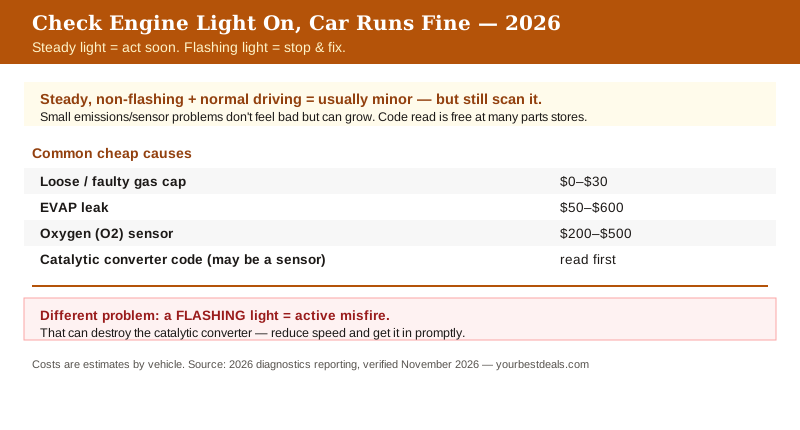
A steady check engine light on a car that drives completely normally is usually not an emergency – it most often points at a minor emissions or sensor issue rather than a mechanical problem you’d feel. But “runs fine” doesn’t mean “ignore it,” because small problems can quietly grow, and some cheap fixes turn expensive if left. The good news is the common causes are inexpensive: a loose or faulty gas cap ($0 to $30), an EVAP leak ($50 to $600), an oxygen sensor ($200 to $500), or an early catalytic-converter code that might just be a lazy sensor. Get the code read – free at many parts stores. And know the crucial distinction: a steady light is act-soon, but a flashing light means an active misfire and is stop-and-fix. Here’s how to think about it.
This is the most common check-engine scenario I saw, and people either panicked or ignored it entirely – both wrong. A steady light on a normally running car is worth a calm, prompt scan, not a tow and not a shrug. Let me explain what it usually means, the cheap likely causes, and why the light’s behavior (steady vs. flashing) tells you how urgent it is.
Steady light, normal driving: usually minor
When the check engine light is on steady and the car accelerates, idles, and drives normally, the problem is usually something the engine management system detected that doesn’t dramatically affect drivability – most often in the emissions or sensor systems. These issues trip the light because the car constantly monitors emissions-related components, but many don’t produce symptoms you’d feel behind the wheel. So a normally running car with a steady light is typically dealing with a minor fault, not impending failure.
That said, “minor” doesn’t mean “no action.” A small EVAP leak or a lazy sensor won’t strand you, but the light also masks anything new – if a second, more serious problem develops, you won’t get a fresh alert because the light is already on. And some cheap issues (like a failing sensor) can lead to pricier ones (like a fouled catalytic converter) over time. So the right move is to get the code read promptly, even though the car feels fine. Our check engine light guide covers reading codes.
The common cheap causes
Here’s what usually causes a steady light on a well-running car, cheapest first. These are estimated ranges that vary by vehicle.
| Cause | Typical cost | Notes |
|---|---|---|
| Loose or faulty gas cap | $0–$30 | Tighten it, or replace the cap |
| EVAP (evaporative emissions) leak | $50–$600 | Often a valve or small hose |
| Oxygen (O2) sensor | $200–$500 | Common, affects economy |
| Catalytic converter code (P0420) | read first | Often a sensor, not the converter |
| Mass airflow or minor sensor | $100–$400 | Varies by sensor |
The loose gas cap is the classic – a cap that isn’t tight, or a worn seal, trips an EVAP code and the light, and tightening or replacing it (then driving a while) can clear it for free. Beyond that, a proper diagnosis reads the specific code so you fix the actual cause. Importantly, a catalytic-converter code doesn’t mean you need a converter – it’s often a cheap oxygen sensor, as our converter guide explains. Read the code before assuming anything expensive.
Shop Talk
Before anything, check your gas cap – really. A surprising share of “check engine light, car’s fine” cases are just a gas cap that wasn’t clicked tight, especially right after a fill-up. Tighten it until it clicks, drive for a day or two, and the light may clear itself. If it doesn’t, get the code read free at a parts store to see what you’re dealing with. And here’s the money-saver on that free scan: use it to get oriented, but don’t let the store sell you the part the code “names” – a P0420 isn’t a receipt for a catalytic converter, and an O2 code doesn’t always mean the sensor. For a steady light on a car that drives fine, you have time to diagnose it right rather than throwing parts at it. The one thing you don’t have time to ignore is a flashing light.
Steady vs. flashing: the urgency test
This is the distinction that matters most. A steady check engine light on a normally running car means a stored fault that isn’t critical – act soon, but you can drive to a shop and diagnose it calmly. A flashing check engine light means something very different: an active engine misfire happening right now, where unburned fuel is being dumped into the exhaust and can rapidly overheat and destroy the catalytic converter (a four-figure part). A flashing light is a reduce-speed, get-it-in-promptly situation, not a “runs fine, ignore it” one.
So the light’s behavior is your urgency gauge. Steady and driving normally: minor, scan it soon. Flashing, or steady with the car running rough, losing power, or overheating: treat as urgent. If your light is flashing, especially with shaking, see our flashing light guide. For the common steady-light case here, the takeaway is calm and prompt: read the code, check the gas cap, and fix the actual cause rather than panicking or ignoring it.
The Real Number
A steady check engine light on a car that drives normally usually means a minor emissions or sensor issue – not an emergency, but still get the code read (free at many parts stores) rather than ignoring it, since the light masks any new fault and small problems can grow. Common cheap causes: a loose gas cap ($0 to $30), an EVAP leak ($50 to $600), or an oxygen sensor ($200 to $500) – and a converter code is often just a sensor, so read before you buy. The key: a flashing light is completely different, meaning an active misfire that can destroy the catalytic converter, so reduce speed and fix it promptly.
Frequently Asked Questions
Is it safe to drive with the check engine light on if the car runs fine?
Generally yes, in the short term, if the light is steady (not flashing) and the car drives, idles, and accelerates normally. A steady light on a well-running car usually indicates a minor emissions or sensor issue that isn’t an immediate danger, so you can drive to a shop to have it diagnosed. However, you shouldn’t ignore it indefinitely: the light masks any new problem that develops, and some cheap faults worsen over time. So drive with reasonable caution and get the code read promptly. The exception is a flashing light, which signals an active misfire that can damage the catalytic converter and should be addressed right away, not driven on.
Why is my check engine light on if nothing feels wrong?
Because your car monitors many emissions and sensor systems that can trip the light without producing symptoms you’d feel. Common examples are a loose or faulty gas cap, a small EVAP (evaporative emissions) leak, a lazy oxygen sensor, or an early catalytic-converter efficiency code – none of which necessarily affect how the car drives, but all of which the computer detects. So “nothing feels wrong” is normal for a steady light; the problem is often in a system you don’t experience directly. The way to know what it is, is to read the code, which is free at many auto-parts stores. Don’t assume it’s nothing just because the car feels fine.
Can a loose gas cap cause the check engine light?
Yes, very commonly. The gas cap seals the fuel system, and if it’s loose, cross-threaded, or has a worn seal, it can cause a small leak in the evaporative emissions (EVAP) system, which trips an EVAP code and turns on the check engine light. This is one of the most common and cheapest causes. The fix is to tighten the cap until it clicks, or replace it if the seal is bad (a $0-to-$30 fix), then drive for a day or two – the light will often clear itself once the system passes its check. So before assuming anything expensive, check that your gas cap is tight, especially if the light came on right after refueling.
How much does it cost to fix a check engine light?
It depends entirely on the cause, which is why reading the code matters. The cheapest fixes are a loose gas cap ($0 to $30) or a minor EVAP repair ($50 to $600). An oxygen sensor runs $200 to $500, and other sensors $100 to $400. At the higher end, a genuine catalytic converter is $900 to $2,500-plus – but a converter code is often actually a cheaper sensor, so it should be confirmed before replacement. These are estimated ranges that vary by vehicle. Because the spread is so wide, getting the specific code read and the cause diagnosed before buying parts is what keeps a minor light from turning into an unnecessary big repair.
Will the check engine light turn off by itself?
Sometimes. If the underlying issue resolves – for example, you tighten a loose gas cap, or a temporary condition clears – the car will often turn the light off on its own after it re-runs its self-checks over several drive cycles (typically a few days of normal driving). So a light that came on from a minor or intermittent cause may clear itself once the problem is gone. However, if the fault is still present, the light will stay on or come back. Don’t assume a light that turns off means the problem is fixed for good; if it recurs, get the code read. And a stored code can often still be retrieved even after the light goes out.
What’s the difference between a steady and flashing check engine light?
It’s the key urgency distinction. A steady (solid) check engine light indicates a stored fault that generally isn’t critical – often a minor emissions or sensor issue – so you can drive to a shop and have it diagnosed soon. A flashing check engine light is a serious warning: it means an active engine misfire is occurring, dumping unburned fuel into the exhaust, which can quickly overheat and destroy the catalytic converter, a costly part. A flashing light means reduce speed and get the car to a shop promptly, not drive on it. So if your light is steady and the car runs fine, act soon; if it’s flashing, treat it as urgent.
Should I get the code read even though the car drives fine?
Yes. Even with the car running normally, reading the code tells you what the computer detected, which could be a free gas-cap fix or an early warning of something worth addressing. It’s also important because while the light is on, the system can’t alert you to a new problem – so leaving it on means you’d miss a fresh fault. Reading the code is free at many auto-parts stores and quick at a shop, so there’s little reason not to. Use the scan to get oriented, then decide whether it’s a simple fix or warrants a proper diagnosis. Ignoring a steady light indefinitely is how a cheap issue becomes a hidden expensive one.
Sources
Check-engine causes and cost ranges verified against 2026 diagnostic reporting on November 7, 2026. Costs are estimated ranges that vary by vehicle; read the specific code before replacing parts.
- Telle Tire – check engine light diagnostic costs, 2026
- RepairPal – oxygen sensor replacement cost, 2026
- ConsumerAffairs – catalytic converter and emissions repair cost, 2026
Related Guides
- What does a check engine light mean?
- Why is my check engine light flashing?
- 8 signs of a failing oxygen sensor
- What is a car diagnostic test?

Eddie Brennan spent 11 years as an ASE Master Certified technician at an independent shop in Columbus, OH, where a steady check engine light on a fine-running car was often a loose gas cap – and where his A6 electrical certification covered reading the codes that told the real story. He takes no referral fees and drives a 250,000-mile 2015 Subaru Outback and a 2020 Ford F-150.