
Last updated: November 9, 2026 – By Diane Holcomb
November 2026 update: reconfirmed accumulator/receiver-drier pricing and the replace-it-with-any-major-AC-work point.
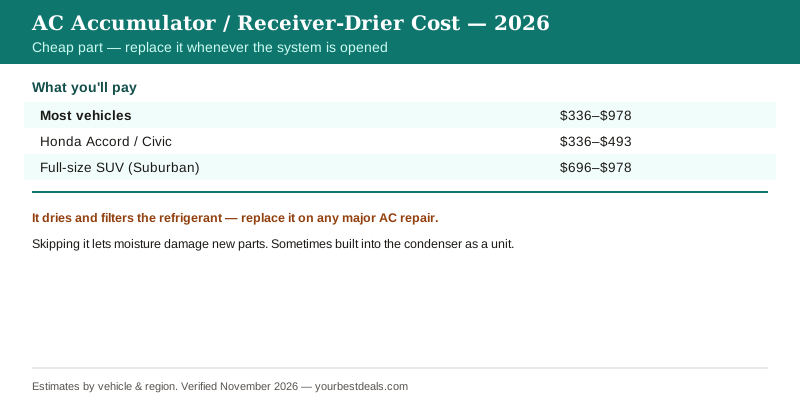
An AC accumulator or receiver-drier replacement runs about $336 to $978 depending on the vehicle – a Honda Accord lands around $371 to $493, a Honda Civic around $336 to $439, and a full-size SUV like a Chevrolet Suburban around $696 to $978. The part itself is usually inexpensive; most of the cost is the labor to evacuate and recharge the AC system around it. This part – called an accumulator or a receiver-drier depending on the system – absorbs moisture from the refrigerant and filters out debris, protecting the rest of the AC. Because of that job, it’s routinely replaced whenever the system is opened for a major repair like a compressor, condenser, or evaporator, and skipping it on such work lets moisture attack the new parts. On some vehicles the drier is built into the condenser and replaced as a unit.
This is a cheap part that does an outsized job protecting the expensive AC components, which is why it rides along on bigger repairs. Let me cover the cost, what it does, and when it should be replaced.
What you’ll actually pay
Here’s the price picture. These are estimated ranges that vary by vehicle and shop.
| Vehicle | Cost | Notes |
|---|---|---|
| Most vehicles | $336–$978 | Part cheap; labor + recharge |
| Honda Accord / Civic | $336–$493 | Mainstream cars |
| Full-size SUV (Suburban) | $696–$978 | More refrigerant, labor |
The cost is driven by the evacuation-and-recharge labor, not the part. Our AC repair guide and AC condenser guide cover the related components it protects.
Shop Talk
Think of the accumulator or receiver-drier as the AC system’s moisture sponge and filter – its whole job is to trap water and debris so they don’t corrode and clog your compressor, condenser, and evaporator. That’s why the rule in the trade is simple: any time the AC system is opened for a major repair, you replace this part. Once the system’s been open to the air, or has had a failure that put moisture or debris into it, the old drier is saturated and can’t protect the new parts – reusing it to save a modest amount is exactly the kind of false economy that comes back as a second failure. So if you’re quoted a compressor, condenser, or evaporator, make sure the accumulator/drier is on the bill too; a reputable shop includes it automatically. Replacing it on its own is less common and usually only done if the part itself failed or got contaminated. One detail to know: on some systems the drier is integrated into the condenser, so you can’t replace it separately – the whole condenser-and-drier unit gets replaced together. And whenever this part is changed, the system needs a proper vacuum-down before recharging to pull out any moisture, which is part of what you’re paying for.
Where Drivers Overpay
The real overpay with this part is skipping it – not replacing the accumulator/drier during a major AC repair to save a little, then having the trapped-moisture-and-debris attack the brand-new compressor or condenser and cause a repeat failure. For a cheap part, including it is clear insurance on the expensive ones.
The flip side: on its own, replacing just the drier is uncommon and mostly warranted only if the part itself failed or the system was contaminated, so it shouldn’t be sold as a standalone upsell without reason. And the job requires a proper evacuation before recharge; a shortcut there wastes the replacement. The pattern: always include the drier on major AC work, don’t pay for a standalone swap without cause, and insist on a proper vacuum-down and recharge.
The Real Number
An AC accumulator or receiver-drier is $336 to $978 – a cheap part, with the cost mostly in the evacuate-and-recharge labor. Its job is to trap moisture and debris that would otherwise corrode the compressor, condenser, and evaporator, so it’s replaced any time the system is opened for a major repair. Make sure it’s on the bill with a compressor, condenser, or evaporator job; skipping it risks the new parts. On some cars it’s built into the condenser and replaced as a unit.
Frequently Asked Questions
How much does it cost to replace an AC accumulator or receiver-drier?
About $336 to $978 depending on the vehicle – a Honda Accord runs around $371 to $493, a Honda Civic around $336 to $439, and a full-size SUV like a Chevrolet Suburban around $696 to $978. The part itself is usually inexpensive; most of the cost is the labor to recover the refrigerant, replace the part, evacuate the system, and recharge it. These are estimates that vary by vehicle and shop. The price is higher on vehicles with more refrigerant capacity or harder access. When this part is replaced as part of a larger AC repair, much of that labor overlaps, so the incremental cost of including it is small.
What does the accumulator / receiver-drier do?
It protects the AC system by absorbing moisture and filtering debris from the refrigerant. Water is the enemy of an AC system – it causes corrosion and can form damaging acids – so this component contains a desiccant that traps moisture, along with a filter for particles. The term depends on the system design: “accumulator” on orifice-tube systems, “receiver-drier” on expansion-valve systems, but the moisture-and-debris protection role is the same. By keeping the refrigerant dry and clean, it safeguards the much more expensive compressor, condenser, and evaporator. That protective job is exactly why it’s replaced whenever the system is opened, so it can keep doing its work with a fresh desiccant.
When should the accumulator / receiver-drier be replaced?
The main rule is: whenever the AC system is opened for a major repair – a compressor, condenser, or evaporator replacement, or any significant failure – the accumulator or receiver-drier is replaced too. Once the sealed system has been opened to the atmosphere or has had a failure introduce moisture or debris, the old part is saturated and can’t protect the new components. It’s also replaced if the part itself has failed or the system was contaminated (for example, after a compressor failure that shed debris). It’s not a routine mileage-based maintenance item on its own; it’s replaced in conjunction with other AC work or when the system has been compromised.
Why is it replaced with a compressor or condenser?
Because once the system is open, the old drier can no longer protect the new parts, and because a major failure often contaminates the drier. For example, when a compressor fails it can send metal debris and moisture through the system; the drier catches some of that and becomes saturated and clogged. Installing a new compressor or condenser without a fresh drier would let residual moisture and debris attack the new component, risking a repeat failure. Since the system is already open and evacuated for the bigger repair, adding the inexpensive drier is cheap insurance. That’s why reputable shops automatically include it, and why you should check that it’s on the estimate for any major AC job.
Can I replace just the accumulator by itself?
You can, but it’s uncommon as a standalone repair and usually only warranted if the part itself failed, is clogged, or the system was contaminated. More often it’s replaced as part of a larger AC job. If it is done alone, the work still requires recovering the refrigerant, replacing the part, evacuating the system to remove moisture, and recharging – so most of the cost is that service labor rather than the part. If a shop recommends replacing only the drier, ask what symptom or finding prompts it; a saturated or clogged drier can justify it, but it shouldn’t be an unexplained add-on when nothing else in the system is being serviced.
What happens if the accumulator / receiver-drier isn’t replaced when needed?
Moisture and debris stay in the system and can damage the components you’re trying to protect. A saturated drier can’t absorb more water, so moisture circulates, causing corrosion and acid formation that attack the compressor, condenser, and evaporator – potentially leading to another, costlier failure not long after the repair. A clogged drier can also restrict refrigerant flow and hurt cooling performance. That’s why skipping it on a major AC repair is a false economy: you risk the expensive new parts to save the modest cost of the drier. Replacing it as recommended keeps the refrigerant dry and clean and helps the whole repair last.
Is the drier always a separate part?
Not always. On many vehicles the accumulator or receiver-drier is a separate component you can replace on its own. But on some vehicles the drier is built into the condenser as an integrated unit, meaning you can’t replace just the drier – if it needs replacing, the condenser-and-drier assembly is replaced together, which costs more. This is worth knowing when you get an estimate, because it explains why the “drier” might be priced as part of a condenser on some cars. Your shop can tell you which design your vehicle uses. Either way, the drier’s protective role and the rule of replacing it when the system is opened still apply.
Sources
Price ranges verified against 2026 AC accumulator/receiver-drier pricing in November 2026. Dollar amounts are estimates that vary by vehicle and shop.
- RepairPal – receiver-drier assembly replacement estimates
- J.D. Power – car air conditioner repair cost
- ASE – National Institute for Automotive Service Excellence
Related Guides
- Car AC Repair Cost
- AC Condenser Replacement Cost
- AC Compressor Replacement Cost
- AC Evaporator Replacement Cost
- Car Repair Cost Estimator

Diane Holcomb spent seven years as a service advisor at multi-brand dealerships in Charlotte, NC, where she made sure the little drier was always on the compressor estimate – because the ones that got skipped came back as repeat failures. She drives a 2019 Honda CR-V and a hand-me-down 2007 Toyota Camry, and takes no referral fees or advertising money from any shop or chain.