
Last updated: November 10, 2026 – By Diane Holcomb
November 2026 update: reconfirmed evaporator pricing, the dash-out labor reality, and the bundle-the-drier point.
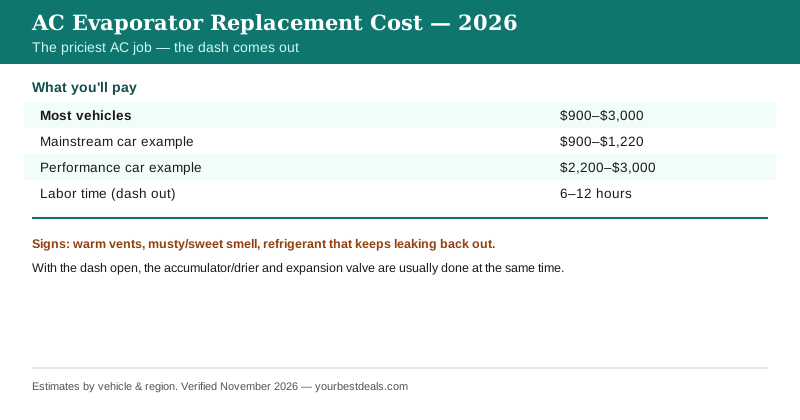
An AC evaporator replacement is the most expensive AC repair on most cars, running about $900 to $3,000 depending on the vehicle – a mainstream car lands around $900 to $1,220, while a performance car can run $2,200 to $3,000. The reason isn’t the part, it’s the labor: the evaporator sits inside the HVAC box behind the dashboard, so the dash usually has to come out to reach it, a job often taking 6 to 12 hours. Signs of a bad evaporator include warm air from the vents, a musty or sweet smell (sometimes with wetness), and a slow refrigerant loss that keeps returning after every recharge. Because the dash is open and the system is evacuated anyway, the accumulator or receiver-drier and the expansion valve are usually replaced at the same time.
This is the AC repair that makes people wince, and it’s all about access, not the part. Let me cover the cost, why the labor is so heavy, and what should be bundled into the job.
What you’ll actually pay
Here’s the price picture. These are estimated ranges that vary by vehicle and shop.
| Item | Cost | Notes |
|---|---|---|
| Most vehicles | $900–$3,000 | Labor-dominated |
| Mainstream car example | $900–$1,220 | Model-specific |
| Performance car example | $2,200–$3,000 | Harder access |
| Labor time (dash out) | 6–12 hours | The main cost |
The evaporator is the component inside the cabin that the refrigerant cools, so cabin air passing over it comes out cold. Its deep location is the whole expense. Our AC repair guide and AC leak guide cover the rest of the system.
Shop Talk
An evaporator leak is the worst-case AC repair because the part is buried in the HVAC box behind the dash, and reaching it means pulling the dashboard apart – often 6 to 12 hours of labor. So the single most important thing is to confirm the leak is really the evaporator before anyone starts, since a leak that produces warm air could be a cheap O-ring or a condenser out front that costs a fraction to fix. Evaporator leaks have a tell: because the part is inside the HVAC box, the refrigerant leaks internally, so you often can’t see dye outside, and shops may detect it by sniffing refrigerant at the vents or by the slow, persistent loss that keeps coming back after recharges, sometimes with a musty smell. Once you’ve committed to the job, bundle the parts that are now easy to reach and should be fresh anyway: the accumulator or receiver-drier (it’s saturated) and usually the expansion valve or orifice tube that meters refrigerant into the evaporator. Doing those while the system’s open and the dash is out saves you from ever paying this labor twice. And make sure they properly evacuate and recharge afterward – moisture left in a system this hard to service will haunt it.
Where Drivers Overpay
The biggest risk is authorizing a dash-out evaporator job when the leak was somewhere cheaper. A warm-air, low-refrigerant symptom can come from an O-ring or the front condenser just as easily, so confirming the evaporator specifically – via the persistent internal leak that returns after recharges, or sniffing at the vents – before the teardown is essential protection against a huge unnecessary labor bill.
Once the job is justified, the economy is in bundling: the accumulator/drier and the expansion valve or orifice tube are right there and should be done at the same time, so you never pay this labor twice. A rushed evacuation leaves moisture that shortens the repair’s life. The pattern: confirm the evaporator is the leak, bundle the drier and valve, and insist on a proper evacuation and recharge.
The Real Number
An AC evaporator is $900 to $3,000 – the priciest AC job, because the dash comes out (6 to 12 hours). Confirm the leak is really the evaporator before that teardown; the same warm-air symptom can be a cheap O-ring or the front condenser. Once committed, bundle the accumulator/drier and the expansion valve while the system’s open so you never pay this labor twice, and insist on a proper evacuation and recharge.
Frequently Asked Questions
How much does it cost to replace an AC evaporator?
About $900 to $3,000 depending on the vehicle. A mainstream car runs around $900 to $1,220, while a performance or luxury car can run $2,200 to $3,000. The part itself is often modest; the cost is overwhelmingly labor, because the evaporator sits behind the dashboard and the dash usually has to come out – a job of roughly 6 to 12 hours. These are estimates that vary by vehicle and shop. The accumulator or receiver-drier and the expansion valve are usually replaced at the same time, and the system must be evacuated and recharged, all of which good estimates include. A model-specific quote is the most accurate.
Why is the evaporator so expensive to replace?
Because of access, not the part. The evaporator is housed inside the HVAC (heater/AC) box deep behind the dashboard, so reaching it typically requires removing much of the dash – and sometimes the steering column and center console – which is many hours of careful labor. That teardown and reassembly is what drives the cost into the thousands, while the evaporator part itself is comparatively inexpensive. It’s the same reason a heater core (also buried in the dash) is costly to replace. This is exactly why confirming the evaporator is truly the leaking component before starting matters so much: you don’t want to pay for that teardown to fix a leak that was actually elsewhere and cheaper.
What are the signs of a bad AC evaporator?
The main signs are AC that blows warm because the system keeps losing refrigerant, a loss that persists and returns after every recharge (an internal leak), and often a musty or sweet smell from the vents, sometimes with dampness. Because the evaporator leaks inside the sealed HVAC box, you usually can’t see dye leaking externally the way you can with other components, so shops often detect it by sniffing refrigerant at the vents or by the pattern of slow, recurring loss with no visible external leak. A frozen-up evaporator or reduced airflow can also point to evaporator issues. These clues help distinguish it from a cheaper external leak.
How do shops find an evaporator leak?
Since the evaporator leaks internally, standard external dye inspection often won’t reveal it, so shops use other methods. They may use an electronic refrigerant detector to “sniff” for refrigerant coming out of the vents or the HVAC drain, which indicates a leak inside the box. They also look at the overall pattern: a system that holds pressure externally but keeps losing refrigerant with no visible leak, and that needs repeated recharges, points toward the evaporator. Some use nitrogen pressure testing. Because the repair is so costly, thorough confirmation that the evaporator (and not a cheaper external component) is the leak is worth doing before committing to the dash-out job.
Should other AC parts be replaced with the evaporator?
Yes, typically. Because the system is opened and evacuated and the dash is out, it’s standard to replace the accumulator or receiver-drier at the same time (it absorbs moisture and is considered saturated once the system’s been open), and usually the expansion valve or orifice tube that meters refrigerant into the evaporator, since it’s right there and inexpensive relative to the labor. Doing these together means you won’t have to pay the heavy dash-out labor again if one of them fails later. Ask your shop which related components they include. Bundling the easy-to-reach parts into this one expensive job is the smart, economical approach.
Can I drive with a bad AC evaporator?
Yes – a leaking evaporator affects comfort, not drivability, so the car runs fine; you just lose cold air as the refrigerant leaks out. The considerations are that you’ll have no working AC (and reduced defogging in humid weather), and that repeatedly recharging a system that keeps leaking wastes money and can let the compressor run low on refrigerant and oil, risking compressor damage over time. There’s no safety emergency in driving with a bad evaporator, so some owners defer this costly repair, especially on older cars, and simply go without AC. But if you want AC back, the evaporator has to be properly fixed rather than endlessly recharged.
Is an evaporator replacement worth it?
It depends on the car’s value and how much you need AC. On a newer or higher-value vehicle, or if you live somewhere hot where AC is close to essential, a $1,000-to-$3,000 evaporator repair can be justified. On an older, lower-value car, the cost may approach a large share of what the car is worth, and some owners choose to live without AC instead. Because it’s such a labor-heavy job, it’s especially important to confirm the evaporator is truly the problem and to bundle the related parts so you only pay the big labor once. Weigh the repair against the car’s value and your need for working AC.
Sources
Price ranges verified against 2026 AC evaporator repair pricing in November 2026. Dollar amounts are estimates that vary by vehicle and shop.
- RepairPal – AC evaporator replacement estimates
- J.D. Power – car air conditioner repair cost
- ASE – National Institute for Automotive Service Excellence
Related Guides
- Car AC Repair Cost
- Car AC Leak Repair Cost
- AC Accumulator Replacement Cost
- Heater Core Replacement Cost
- Car Repair Cost Estimator

Diane Holcomb spent seven years as a service advisor at multi-brand dealerships in Charlotte, NC, where the evaporator estimate was the one she double-checked the diagnosis on, because the dash-out labor was too big to spend on a guess. She drives a 2019 Honda CR-V and a hand-me-down 2007 Toyota Camry, and takes no referral fees or advertising money from any shop or chain.