
Last updated: November 9, 2026 – By Diane Holcomb
November 2026 update: reconfirmed leak-repair pricing by source and the stop-leak-sealant warning.
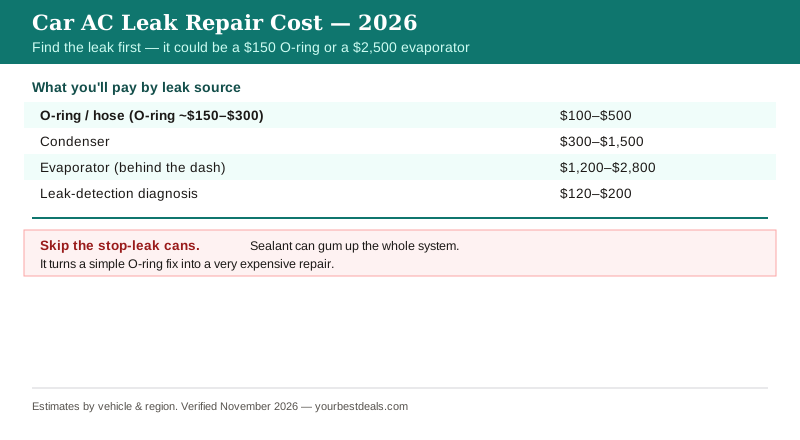
Car AC leak repair costs depend entirely on where the leak is, which is why the first dollar is best spent finding it. An O-ring or hose is the cheapest fix at about $100 to $500 (a single O-ring or Schrader valve runs $150 to $300). A leaking condenser runs about $300 to $900, sometimes up to $1,500. An evaporator, buried behind the dashboard, is the most expensive at about $1,200 to $2,800 because of the labor to reach it. A proper leak-detection diagnosis runs about $120 to $200 and is money well spent – it tells you whether you’re facing a cheap seal or a major component before you authorize anything. And whatever you do, skip the stop-leak sealant cans: the sealant can gum up the whole system and turn a simple O-ring fix into a very expensive repair.
The repair price swings from a cheap seal to a dashboard-out job, so knowing the leak source is everything. Let me cover the costs by source, why diagnosis pays for itself, and the sealant trap.
What you’ll actually pay
Here’s the price picture by leak source. These are estimated ranges that vary by vehicle and shop.
| Leak source | Cost | Notes |
|---|---|---|
| O-ring / hose | $100–$500 | O-ring/Schrader ~$150–$300 |
| Condenser | $300–$1,500 | Front-mounted, stone-damage prone |
| Evaporator | $1,200–$2,800 | Behind the dash, labor-heavy |
| Leak-detection diagnosis | $120–$200 | Worth it first |
A car AC system is sealed, so if it’s low on refrigerant, it’s leaking somewhere – adding refrigerant without finding the leak is temporary. Our general AC repair cost guide and AC system guide cover the full system and recharge pricing.
Shop Talk
Spend the $120 to $200 on leak detection before you spend anything else – it’s the best money in this whole repair. The difference between the cheap fix and the expensive one is just location: an O-ring at a fitting is a quick, inexpensive seal, while an evaporator leak means pulling the dashboard apart for well over a grand. You can’t tell which you have by how warm the air is, so a shop uses UV dye, an electronic sniffer, or a pressure test to pinpoint it. Once you know the source, you can make a smart call on whether the repair is worth it on your car. Now the trap: those stop-leak cans sold as a cheap fix can really wreck you here. The sealant is designed to plug leaks from the inside, but it doesn’t know the difference between a tiny leak and your AC components – it can gum up the compressor, condenser, and lines, so a leak that would’ve been a $200 O-ring becomes a flush-the-whole-system job. If a shop finds sealant in your system, expect the repair to cost more because of the cleanup. Fix the actual leak; don’t pour a bandage into a sealed system.
Where Drivers Overpay
The worst overpay here is self-inflicted: a stop-leak sealant can. Marketed as a cheap fix, the sealant can gum up the compressor, condenser, and lines, so a leak that would have been a $200 O-ring becomes a flush-the-whole-system repair. Skipping the can and fixing the real leak is far cheaper in the end.
The second is authorizing a repair without knowing the source. Because the price ranges from a cheap seal to a $2,800 evaporator, spending $120 to $200 on leak detection first tells you what you’re actually facing – and whether it’s worth it on your car. The pattern: find the leak before paying to fix it, never pour sealant into a sealed system, and let the leak source, not a guess, guide the decision.
The Real Number
AC leak repair ranges from a $100-to-$500 O-ring to a $300-to-$1,500 condenser to a $1,200-to-$2,800 evaporator – the price is all about the leak’s location. Spend $120 to $200 on leak detection first; you can’t tell the cheap fix from the expensive one by feel. And never use a stop-leak can: the sealant can gum up the whole system and turn a $200 O-ring into a flush-everything repair.
Frequently Asked Questions
How much does it cost to fix a car AC leak?
It depends entirely on where the leak is. An O-ring or hose is the cheapest at about $100 to $500 (a single O-ring or Schrader valve $150 to $300). A leaking condenser runs about $300 to $900, sometimes up to $1,500. An evaporator, buried behind the dashboard, is the most expensive at about $1,200 to $2,800 because of the labor to reach it. A leak-detection diagnosis runs about $120 to $200. These are estimates that vary by vehicle and shop. Because the range is so wide, finding the exact leak source first is the key to knowing what you’ll actually pay.
How do shops find an AC leak?
Shops use a few methods, often in combination. UV dye is added to the system, then a UV light reveals where the dye (and refrigerant) is escaping. An electronic leak detector, or “sniffer,” senses refrigerant near a leak. A pressure test – sometimes with nitrogen – checks whether the system holds pressure and helps locate leaks. These approaches pinpoint whether the leak is at a cheap O-ring or fitting, a condenser, the evaporator, or the compressor. That diagnosis, typically $120 to $200, is worth doing before any repair, because it determines whether you’re facing a minor seal or a major, labor-intensive component – and whether the fix is worth it.
Why not just use a stop-leak product?
Because AC stop-leak sealants can cause expensive damage. The sealant is meant to plug leaks from inside the system, but it can’t distinguish a small leak from your AC’s own components, so it can gum up the compressor, condenser, orifice tube, and lines. A leak that would have been a $200 O-ring repair can become a job that requires flushing or replacing much of the system. Many shops also charge more if they find sealant, because of the cleanup it requires. The reliable approach is to find and fix the actual leak rather than pour a sealant into a sealed system and hope. It’s a false economy that frequently backfires.
Is a small AC leak worth fixing?
Usually yes, and sooner rather than later. Beyond losing cold air, a leak lets the system run low on refrigerant – and because the refrigerant carries the compressor’s lubricating oil, a system running low can starve and damage the compressor, which is a far more expensive repair ($800 and up). So fixing even a small leak promptly often prevents a much bigger bill. If leak detection shows it’s a cheap O-ring or hose, the fix is easy to justify. If it’s a major evaporator job on an older, low-value car, the decision is closer, but ignoring the leak and repeatedly recharging is generally the most expensive path of all.
What’s the most common car AC leak?
O-rings, seals, and hose connections are among the most common and least expensive leak points, since rubber seals dry out and degrade with age and heat. The condenser is also a frequent leaker because it sits at the front of the car and can be damaged by road debris and corrosion. Evaporator leaks are less common but the most expensive to fix due to their location behind the dashboard. The compressor’s shaft seal can leak as well. Because the cheap and the expensive leaks produce the same symptom – warm air from lost refrigerant – only a proper leak-detection diagnosis tells you which one you have.
How long does an AC leak repair last?
A properly done repair on the actual leak source should last for years. Replacing a failed O-ring, hose, condenser, or evaporator with a quality part, then correctly evacuating and recharging the system, restores it to proper operation. Longevity problems usually trace back to either not fixing the real leak (just recharging), or sealant residue complicating the system. If a repair fails quickly, it often means there was a second leak that wasn’t found, which is another argument for thorough leak detection up front. Keeping the system properly charged and having leaks fixed rather than masked is the best way to get lasting AC performance.
Can I drive with an AC leak?
Mechanically, yes – an AC leak won’t stop the car. But there are reasons not to leave it. You’ll lose cooling (and effective defogging in humid weather), and more importantly, running the system low on refrigerant can damage the compressor over time because it loses lubrication, turning a cheap leak into an expensive repair. If you’re not using the AC at all, the immediate harm is limited, but the leak won’t fix itself and the cheap-repair window can close as components get damaged. The practical advice is to have the leak found and fixed reasonably soon, especially before a hot season, rather than repeatedly topping off refrigerant that keeps leaking out.
Sources
Price ranges verified against 2026 automotive AC leak repair pricing in November 2026. Dollar amounts are estimates that vary by vehicle and shop.
- J.D. Power – car air conditioner repair cost
- RepairPal – AC repair estimates
- ASE – National Institute for Automotive Service Excellence
Related Guides
- Car AC Repair Cost
- Car AC & Climate System Guide
- AC Compressor Replacement Cost
- AC Recharge Cost
- Car Repair Cost Estimator

Diane Holcomb spent seven years as a service advisor at multi-brand dealerships in Charlotte, NC, where she learned to ask a warm-AC customer one question first – “did you put a can of something in it?” – because the answer changed the whole repair. She drives a 2019 Honda CR-V and a hand-me-down 2007 Toyota Camry, and takes no referral fees or advertising money from any shop or chain.