
Last updated: November 8, 2026 – By Diane Holcomb
November 2026 update: reconfirmed scratch-repair pricing by depth and the DIY-vs-shop point.
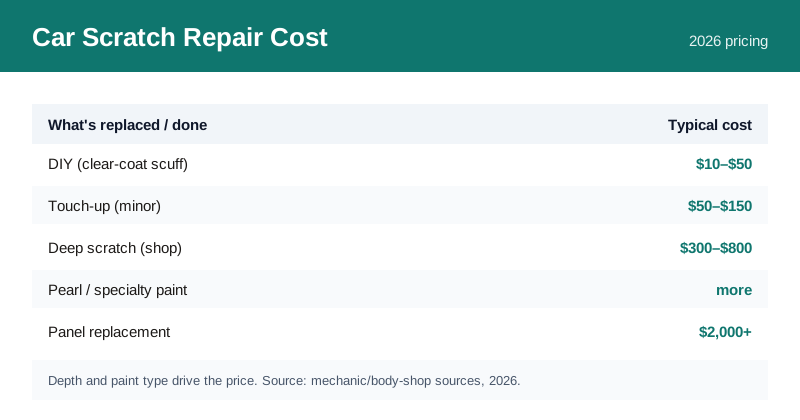
Car scratch repair ranges enormously because it depends almost entirely on how deep the scratch is. A light clear-coat scuff you buff out yourself is $10 to $50 in materials. A minor touch-up is $50 to $150. A deep scratch that reaches the base coat or primer and needs a body shop to sand, prime, and repaint runs $300 to $800. Pearl or specialty paint (tri-coat finishes) costs more to match. Severe damage needing a new panel can exceed $2,000. Your paint has layers – clear coat on top, then color (base coat), then primer, then metal – and the repair cost climbs with each layer the scratch cuts through. The quick test: run your fingernail across the scratch. If your nail doesn’t catch, it’s likely clear-coat-only (cheap to fix); if it catches, it’s into the paint and needs more than a buff.
Depth is everything here, and the fingernail test tells you which bracket you’re in. Let me break it down.
What you’ll actually pay
Here’s the range by depth. These are estimates that vary by vehicle, paint, and shop.
| Scratch type | Cost | Notes |
|---|---|---|
| DIY clear-coat scuff | $10–$50 | Buff/compound |
| Minor touch-up | $50–$150 | Touch-up pen |
| Deep scratch (shop) | $300–$800 | Sand, prime, repaint |
| Panel replacement | $2,000+ | Severe damage |
Scratch repair is body/paint work; our quarter panel guide, car door guide, and side mirror guide cover related body repairs.
Shop Talk
The whole cost of a scratch repair comes down to depth, so start with the fingernail test: drag your fingernail lightly across the scratch. If it glides over without catching, the scratch is only in the clear coat – that’s the cheap one, often buffable with a rubbing compound and a microfiber cloth for $10 to $50 of materials, no repainting needed. If your nail catches in the scratch, it’s cut through the clear coat into the color (base coat), primer, or even metal, and that needs filling and repainting – a body-shop job of $300 to $800 for a proper sand-prime-paint repair, or a touch-up pen ($50 to $150 range) for something small and less fussy. A few things that drive price up: specialty paint. A plain white or black is easy to match, but a tri-coat pearl, a metallic, or a candy color is much harder to blend invisibly, so those cost more. Also, the shop usually has to blend the repaint into the surrounding panel so the color matches – spot-painting just the scratch rarely looks right. One money note: for a cheap scratch, it’s almost never worth an insurance claim, since the deductible usually exceeds the repair. And deep scratches on bare metal should be addressed before they rust. If it’s just a scuff (transferred paint from another car), a little compound or even toothpaste-level polishing can sometimes remove it for nearly nothing.
Where Drivers Overpay
The overpay is paying body-shop prices for a scratch that would buff out. A clear-coat scuff (nail doesn’t catch) is a $10–$50 DIY compound job – so doing the fingernail test first tells you whether you even need a shop.
The other is filing an insurance claim on a cheap scratch where the deductible exceeds the repair, and overlooking that specialty/pearl paint legitimately costs more to match. The pattern: do the fingernail test, DIY or lightly polish a clear-coat scuff, use a shop only for scratches into the paint, skip the insurance claim on anything cheap, and address bare-metal scratches before they rust.
The Real Number
A car scratch is $10 to $50 DIY for a clear-coat scuff, $50 to $150 for a touch-up, $300 to $800 at a body shop for a deep scratch (sand, prime, repaint), and $2,000+ if a panel needs replacing. Depth decides it: do the fingernail test – if your nail doesn’t catch, it’s a cheap buff; if it catches, it’s into the paint and needs a shop. Pearl/specialty paint costs more to match, and a cheap scratch isn’t worth an insurance claim.
Frequently Asked Questions
How much does it cost to repair a car scratch?
It depends almost entirely on depth. A light clear-coat scuff you buff out yourself is $10 to $50 in materials (rubbing compound, microfiber cloth). A minor touch-up (pen or small spot) is $50 to $150. A deep scratch that cuts through the paint and needs a body shop to sand, prime, and repaint runs $300 to $800. Specialty paint (pearl, metallic, tri-coat) costs more to match, and severe damage requiring a new panel exceeds $2,000. These are estimates that vary by vehicle, paint type, and shop. The single biggest factor is how deep the scratch goes – clear-coat-only is cheap and often DIY, while anything through to the color, primer, or metal needs professional refinishing. The fingernail test (whether your nail catches in the scratch) quickly tells you which cost bracket you’re in before getting a quote.
How does scratch depth affect the cost?
Depth is the main cost driver because your car’s paint is layered, and the repair gets more involved with each layer the scratch reaches. From the top: a clear coat (protective top layer), then the base coat (the color), then primer, then the metal body. A scratch only in the clear coat can often be buffed/polished out cheaply with no repainting – the lowest cost. A scratch through the clear coat into the base coat (color) needs color applied and re-cleared, meaning a touch-up or a shop repaint. A scratch down to the primer or bare metal needs priming, color, and clear coat – a full refinish, the higher cost, and bare metal risks rust if left. So the deeper the scratch, the more layers must be rebuilt, and the more it costs. That’s why the same-length scratch can be a $20 buff or a $600 repaint depending purely on how deep it cut.
What is the fingernail test?
The fingernail test is a simple, free way to gauge a scratch’s depth, which tells you the likely repair cost. You lightly drag your fingernail across (perpendicular to) the scratch. If your nail glides over it without catching, the scratch is shallow – likely only in the clear coat – and can often be buffed or polished out cheaply without repainting. If your nail catches in the scratch, it has cut through the clear coat into the base coat (color) or deeper, and it will need filling and repainting rather than just a buff, which costs more. It’s not a precise measurement, but it’s a quick triage: nail glides = cheap, probably DIY; nail catches = deeper, likely a body-shop or touch-up job. So before you assume a scratch needs an expensive repair, do the fingernail test – a lot of scratches that look bad are just clear-coat scuffs that polish right out.
Can I fix a scratch myself?
For shallow clear-coat scratches and scuffs, yes – it’s a very doable DIY and the cheapest route. For a clear-coat-only scratch (nail doesn’t catch), a rubbing/polishing compound and a microfiber cloth ($10 to $50 of materials) can often buff it out; scratch-removal products and kits are sold for exactly this. For a slightly deeper or small scratch into the color, a touch-up paint pen matched to your car’s paint code can fill and hide it reasonably well, though it won’t be invisible. Where DIY struggles is deeper scratches that need proper sanding, priming, base coat, and clear coat blended into the panel – that’s hard to do invisibly without body-shop skills, equipment, and color-matching, so those are better left to a pro. Also, specialty paints (pearl, tri-coat) are very hard to match by hand. So DIY the scuffs and minor scratches; leave the deep ones that need refinishing to a shop for a result you’ll be happy with.
Should I file an insurance claim for a scratch?
Usually not, for a minor scratch – the math rarely works. Most scratch repairs (a buff, a touch-up, even a single-panel repaint) cost less than, or not much more than, a typical collision deductible, so filing a claim means paying your deductible for little or no benefit, plus risking a premium increase or losing a claims-free discount. For a cheap clear-coat scuff or a few-hundred-dollar repaint, paying out of pocket is almost always the better move. An insurance claim makes more sense only for severe damage – deep scratches across multiple panels, or scratching combined with dents/damage that runs into the thousands, well above your deductible, especially if another party or a covered incident (like vandalism) is involved. So weigh the repair estimate against your deductible first: if the repair is less than or close to the deductible, skip the claim. For a simple scratch, it’s almost always a pay-out-of-pocket situation.
Why does pearl or metallic paint cost more to fix?
Because those finishes are much harder to match and blend invisibly. A solid color like plain white or black is relatively simple to mix and apply so the repair blends in. But metallic paints contain tiny metal flakes, and pearl (and tri-coat) finishes use multiple layers with pearlescent pigments that shift color and sparkle with the light and viewing angle. Matching the exact shade, flake size, and layering – and blending it into the surrounding panel so the repair is invisible – takes more skill, more product, and often more labor (sometimes additional coats). An imperfect match on a pearl or metallic shows up badly, so a quality shop spends extra effort to get it right, which raises the cost. That’s why the same-size scratch can cost noticeably more to repair on a pearl-white or candy-colored car than on a solid color. If your car has a specialty finish, expect scratch (and any paint) repairs to run higher and insist on a shop experienced with that paint type.
Should I worry about rust from a deep scratch?
Yes – a scratch that goes down to bare metal should be addressed before it rusts, and that’s a reason not to put off repairing it. The paint and primer protect the metal body from moisture; once a scratch exposes bare steel, that spot can start to rust, and rust spreads under the surrounding paint over time, turning a small scratch into a larger corrosion repair. So while a shallow clear-coat scuff is purely cosmetic and not urgent, a deep scratch down to metal has a time element: covering the bare metal (at minimum with touch-up paint, ideally a proper primer-and-paint repair) protects it from corrosion. If you can’t get a full repair done right away, at least seal exposed metal with touch-up paint as a temporary measure to keep moisture out. So for deep scratches, the fix is both cosmetic and protective – addressing it promptly prevents a rust problem that would cost far more to fix later.
Sources
Price ranges verified against 2026 scratch-repair pricing in November 2026. Dollar amounts are estimates that vary by vehicle, paint, and shop.
- thePricer – car scratch repair cost
- Kelley Blue Book – service and repair guide
- ASE – National Institute for Automotive Service Excellence
Related Guides
- Quarter Panel Repair Cost
- Car Door Replacement Cost
- Side Mirror Replacement Cost
- Tail Light Repair Cost
- Car Repair Cost Estimator

Diane Holcomb spent seven years as a service advisor at multi-brand dealerships in Charlotte, NC, where she’d do the fingernail test with worried customers – plenty of “terrible” scratches turned out to be clear-coat scuffs that buffed out for the price of a compound. She drives a 2019 Honda CR-V and a hand-me-down 2007 Toyota Camry, and takes no referral fees or advertising money from any shop or chain.