
Last updated: November 6, 2026 – By Diane Holcomb
November 2026 update: reconfirmed gooseneck hitch pricing and the under-bed labor point.
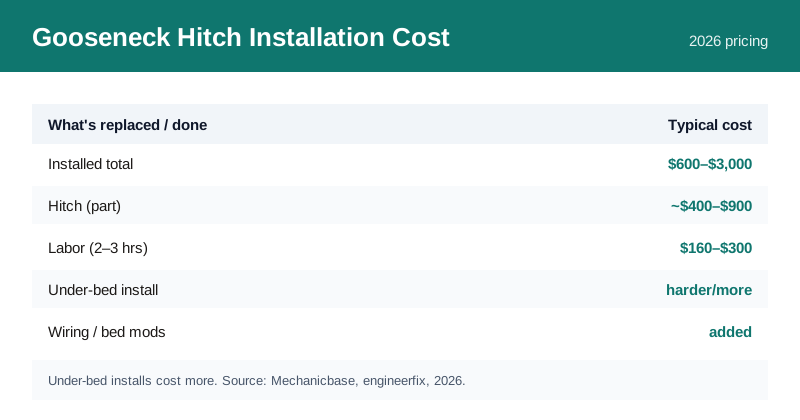
A gooseneck hitch installation runs about $600 to $3,000 installed, depending on the hitch and truck. The hitch itself is roughly $400 to $900, and labor is $160 to $300 for a typical 2-to-3-hour install – but under-bed models (where the mechanism mounts beneath the bed, giving a clean flat bed when not towing) are harder to fit and cost more, and adding trailer wiring or bed modifications adds to the total. A gooseneck hitch is a heavy-duty towing hitch for pickup trucks: it uses a ball mounted in the center of the truck bed (over the rear axle) to tow gooseneck trailers – livestock, flatbed, large utility, and equipment trailers. Because the load sits over the rear axle, it handles much higher towing weights than a bumper or rear receiver hitch. Installation means frame-mounting the hitch under or in the bed, usually with drilling, and often wiring up the trailer connector.
This is a serious towing upgrade for a pickup, and the install type (in-bed vs under-bed) swings the price. Let me break it down.
What you’ll actually pay
Here’s the picture. These are estimates that vary by truck and installer.
| Item | Cost | Notes |
|---|---|---|
| Installed total | $600–$3,000 | By hitch/truck |
| Hitch (part) | $400–$900 | In-bed or under-bed |
| Labor (2–3 hrs) | $160–$300 | Above-bed quicker |
| Under-bed install | more | Harder to fit |
This is a towing accessory install; our truck lift guide and electronics install guide cover related truck add-ons.
Shop Talk
A gooseneck hitch is for serious towing – it puts the trailer’s weight over the truck’s rear axle instead of hanging off the back bumper, so it tows far more (big livestock, flatbed, and equipment trailers) than a rear receiver hitch. First thing to decide: in-bed ball versus under-bed mechanism. A basic rail-and-ball setup mounts hardware in the bed and is cheaper and quicker to install; an under-bed (hideaway) gooseneck tucks the mechanism beneath the bed so you have a flat, usable bed when you’re not towing, flipping a ball up only when needed – nicer, but more labor and usually a pricier kit. That’s the main reason the range is so wide. The install itself is frame-mounted (bolted to the truck’s frame for strength, which is what lets it tow heavy) and usually involves drilling through the bed, plus often wiring in the 7-pin trailer connector and sometimes a brake controller. Two things worth it: have it installed by someone experienced with your truck – it’s structural and safety-critical for heavy towing, so it’s not the place to cut corners – and make sure the hitch is rated for the weight you’ll actually tow. Don’t confuse it with a fifth-wheel hitch, which is a different (larger plate-style) setup for RV-style trailers; some kits share an under-bed base. And budget for the wiring/brake controller if your trailer needs it.
Where Drivers Overpay
The main cost lever is in-bed versus under-bed: a basic rail-and-ball kit is cheaper to buy and quicker to install, while an under-bed hideaway costs more in both. If you don’t need the flat-bed convenience, the simpler kit saves real money – so choose the design by your actual needs, not the fanciest option.
Where not to cut corners is the install quality and weight rating: it’s a structural, safety-critical heavy-towing part. The pattern: pick in-bed vs under-bed by how you use the bed, match the hitch rating to what you’ll tow, budget for trailer wiring/brake controller if needed, and use an installer experienced with your truck.
The Real Number
A gooseneck hitch install is $600 to $3,000 – the hitch is $400 to $900 and labor $160 to $300, with under-bed (hideaway) models costing more than a basic in-bed ball. It’s a frame-mounted, heavy-towing hitch for pickups, so match the rating to your trailer and use an experienced installer – it’s safety-critical. Choose in-bed vs under-bed by how much you need a flat bed, and budget for trailer wiring or a brake controller if required.
Frequently Asked Questions
How much does gooseneck hitch installation cost?
About $600 to $3,000 installed, depending on the hitch type and truck. The hitch itself is roughly $400 to $900, and labor is $160 to $300 for a typical 2-to-3-hour install. Under-bed (hideaway) models, where the mechanism mounts beneath the bed for a flat bed when not towing, are harder to fit and cost more, and adding trailer wiring (a 7-pin connector) or a brake controller adds to the total. These are estimates that vary by truck and installer. The biggest cost variable is the hitch design – a basic in-bed ball-and-rail setup is cheaper and quicker than an under-bed mechanism. Because it’s a frame-mounted, heavy-towing, safety-critical component, it’s worth having installed by someone experienced with your truck rather than chasing the lowest price. Get an itemized quote that includes any wiring.
What is a gooseneck hitch and what is it for?
A gooseneck hitch is a heavy-duty towing hitch for pickup trucks that uses a ball mounted in the center of the truck bed, positioned over (or just ahead of) the rear axle. The trailer’s coupler drops onto that ball, so the trailer’s tongue weight is carried over the rear axle rather than hanging off the rear bumper. This placement lets a gooseneck tow much heavier loads than a bumper or rear receiver hitch, with better stability. It’s used for gooseneck trailers – livestock, flatbed, large utility, car haulers, and equipment trailers – common in agriculture, construction, and heavy hauling. The hitch bolts to the truck’s frame for strength. It’s distinct from a standard receiver hitch (lighter towing, off the bumper) and from a fifth-wheel hitch (a larger plate-style hitch for RV-style trailers, though some under-bed systems can accept both). So a gooseneck is the choice when you need to tow serious weight behind a pickup.
What’s the difference between in-bed and under-bed gooseneck hitches?
It’s the main thing driving the cost and convenience. An in-bed (rail-and-ball) gooseneck mounts hardware – rails and a ball – in the truck bed; it’s cheaper, simpler, and quicker to install, but the ball and rails take up bed space or must be removed when you’re not towing. An under-bed (hideaway/flip-over) gooseneck mounts the mechanism beneath the bed, so when you’re not towing you have a flat, fully usable bed, and you flip or drop a ball up through a small hole only when you need it. The under-bed design is nicer to live with but costs more – a pricier kit and more installation labor. So if you tow often and want an unobstructed bed the rest of the time, the under-bed hideaway is worth the extra; if you tow occasionally and want to save money, the in-bed setup does the same towing job for less. Your towing frequency and how much you use the bed otherwise decide which makes sense.
Can I install a gooseneck hitch myself?
It’s possible for an experienced, well-equipped DIYer, but many sources advise against it, and here’s why. A gooseneck hitch is frame-mounted and safety-critical for heavy towing – it has to bolt to the truck’s frame correctly to safely carry thousands of pounds, and the install typically involves getting under the truck, precise drilling through the bed, torquing hardware to spec, and often wiring the trailer connector and possibly a brake controller. Mistakes aren’t just inconvenient; they’re a safety risk when you’re towing a heavy loaded trailer. The labor to have it done professionally is modest (2 to 3 hours, $160 to $300) relative to the stakes, and a shop ensures it’s mounted and rated correctly. So unless you’re truly experienced with this kind of structural install and have the tools, it’s one worth paying a professional for. If you do it yourself, follow the kit instructions exactly, use the specified hardware and torque, and have the result checked before towing anything heavy.
Is a gooseneck the same as a fifth-wheel hitch?
No – they’re both heavy-duty bed-mounted hitches for pickups, but they’re different and used for different trailers. A gooseneck hitch uses a ball in the bed, and the trailer has a gooseneck coupler that drops onto it; it’s popular for livestock, flatbed, and equipment trailers and takes up less bed space. A fifth-wheel hitch uses a large horseshoe-shaped plate (like a semi-truck’s) mounted in the bed, and the trailer has a kingpin that locks into it; it’s the standard for fifth-wheel RVs and large campers, offering a very stable connection but taking up significant bed space. So the choice depends on your trailer: gooseneck trailers need a gooseneck ball, and fifth-wheel RVs need a fifth-wheel plate. They’re not interchangeable without an adapter. Some under-bed systems provide a base that can accept either a gooseneck ball or a fifth-wheel plate, which is handy if you tow both types. But fundamentally, match the hitch to the trailer coupler you’re towing.
Will I need trailer wiring or a brake controller too?
Often yes, and it’s worth budgeting for alongside the hitch. A gooseneck trailer needs electrical connections for its lights (and usually its brakes), so unless your truck already has a 7-pin trailer connector wired to the back, the install may include adding that wiring – an extra cost beyond the hitch and mounting. For towing heavy gooseneck trailers, which have their own braking systems, you’ll also typically need a trailer brake controller – a device (built-in on many newer trucks, or added) that operates the trailer’s electric brakes from the truck. Many modern tow-package trucks already have both the wiring and a factory brake controller; older or base trucks may need them added. So when getting a gooseneck install quote, ask whether your truck already has the 7-pin wiring and brake controller, or whether those need to be added – because they affect the total cost. Heavy towing safely requires the trailer’s lights and brakes working, so these aren’t optional if your truck lacks them.
How much can a gooseneck hitch tow?
A gooseneck hitch is a high-capacity hitch – gooseneck setups are commonly rated to tow in the range of 25,000 to 30,000 pounds (gross trailer weight) with substantial tongue/pin weight capacity, far more than a bumper or rear receiver hitch. But – and this is critical – the hitch’s rating is only one limit. What you can actually tow is capped by the lowest-rated component in the chain: your truck’s towing capacity, its rear axle and payload ratings, the trailer, and the hitch. So even a 30,000-pound-rated gooseneck hitch doesn’t let a half-ton truck tow 30,000 pounds; the truck’s own limits govern. You must stay within your truck’s manufacturer-specified towing and payload capacities. So match the hitch’s rating to the loads you’ll tow, but always respect the truck’s limits as the real ceiling. For very heavy towing, you need both a properly rated gooseneck hitch and a truck rated for that weight. Check your truck’s towing specs, not just the hitch’s.
Sources
Price ranges verified against 2026 gooseneck hitch pricing in November 2026. Dollar amounts are estimates that vary by truck and installer.
- Mechanic Base – gooseneck hitch installation cost
- EngineerFix – gooseneck hitch installation cost
- ASE – National Institute for Automotive Service Excellence
Related Guides
- Truck Lift Kit Cost
- Car Stereo Installation Cost
- Truck Transmission Replacement Cost
- New Tires Cost
- Car Repair Cost Estimator

Diane Holcomb spent seven years as a service advisor at multi-brand dealerships in Charlotte, NC, where a gooseneck install was one job she steered to an experienced installer – it’s frame-mounted and safety-critical, not a place to save a few dollars. She drives a 2019 Honda CR-V and a hand-me-down 2007 Toyota Camry, and takes no referral fees or advertising money from any shop or chain.