
Last updated: November 3, 2026 – By Diane Holcomb
November 2026 update: reconfirmed set-of-4 pricing and the sticker-isn’t-final point.
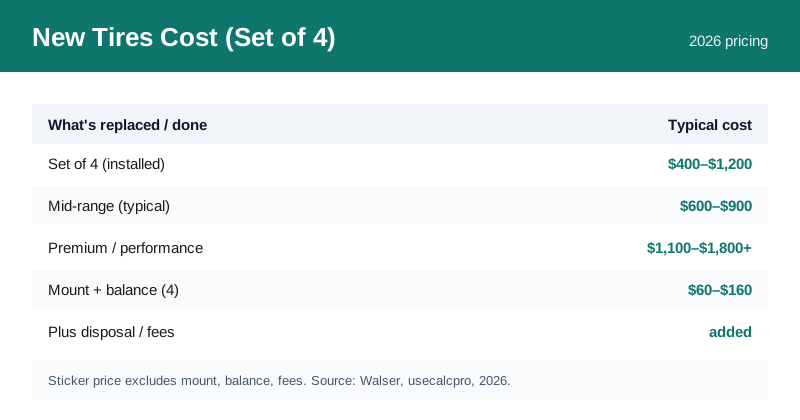
A set of four new tires, installed, runs about $400 to $1,200, with most mid-range sets landing $600 to $900 for a typical sedan or crossover. Premium or performance tires, and large truck/SUV sizes, run $1,100 to $1,800 or more. The thing people miss: the sticker price per tire isn’t the final cost – on top of the tires themselves you pay for mounting and balancing ($60 to $160 for four), new valve stems/TPMS service, old-tire disposal, and sometimes an alignment. New tires are a wear item: you replace them when the tread wears to the legal/safe limit (2/32″ is the legal minimum; many replace around 4/32″), when they’ve aged out (rubber hardens with years regardless of tread), or when they’re damaged. Price depends on tire size, type (all-season, performance, truck, winter), and quality tier. So budgeting means the tire price plus the install extras.
The number on the tire isn’t the number you pay, so let me break down the real installed cost.
What you’ll actually pay
Here’s the picture. These are estimates that vary by tire and vehicle.
| Item | Cost | Notes |
|---|---|---|
| Set of 4 (installed) | $400–$1,200 | Varies widely |
| Mid-range (typical) | $600–$900 | Sedan/crossover |
| Premium / performance | $1,100–$1,800+ | Bigger/better |
| Mount + balance (4) | $60–$160 | Plus disposal/fees |
New tires come with other tire services; our tire mount and balance guide, tire rotation guide, and alignment guide cover the add-ons.
Shop Talk
The number one thing to understand is that the advertised tire price isn’t what you pay out the door. A tire priced at, say, $150 each becomes more once you add mounting and balancing (roughly $15 to $40 per tire), new valve stems or TPMS sensor service, old-tire disposal/recycling fees, and any state tire fee – plus an alignment if you need one. So four “$150” tires isn’t $600; it’s that plus the install package. Ask for the out-the-door price so you can compare shops fairly. A few money angles. One, you don’t have to buy the most expensive tire – a quality mid-grade all-season is the sweet spot for most drivers, and the premium/performance tiers are for specific needs (sporty handling, heavy loads, severe winters). Two, buy the right size and type for your car (check the door-jamb sticker), and match all four when you can – mixing is bad, especially on all-wheel-drive, which is sensitive to tire-diameter differences. Three, watch the tire’s age, not just tread: rubber hardens and cracks with years, so a tire more than about 6 years old (check the DOT date code) is worth replacing even with tread left. Four, consider doing an alignment with new tires if the old ones wore unevenly or the car pulls – it protects your new investment. And rotate them on schedule afterward to get the full life out of the set.
Where Drivers Overpay
The budgeting trap is the sticker price: four advertised tires plus mounting, balancing, valve stems, disposal, fees, and maybe an alignment is noticeably more than four times the tire price – so asking every shop for the out-the-door price is how you compare fairly and avoid surprises.
The value move is tier selection: a quality mid-grade all-season suits most drivers, and the premium/performance tiers are for specific needs you may not have. The pattern: get out-the-door quotes, buy the right size and a sensible tier (not automatically the priciest), match all four, and protect the set with an alignment if needed and rotations on schedule.
The Real Number
A set of four installed tires is $400 to $1,200, most mid-range sets $600 to $900, premium/performance $1,100 to $1,800+. The advertised tire price isn’t the final cost – add mounting, balancing ($60 to $160 for four), valve stems, disposal, fees, and maybe an alignment, so always ask for the out-the-door total. A quality mid-grade all-season suits most drivers; replace on tread or age (over ~6 years), match all four, and rotate to get the full life.
Frequently Asked Questions
How much does a set of 4 new tires cost?
Installed, a set of four runs about $400 to $1,200, with most mid-range sets landing $600 to $900 for a typical sedan or crossover. Premium or performance tires, and larger truck/SUV sizes, run $1,100 to $1,800 or more. These are estimates that vary by tire size, type, quality tier, and vehicle. Importantly, the installed total is more than the tire price alone – you also pay for mounting and balancing ($60 to $160 for four), new valve stems or TPMS service, old-tire disposal, any state tire fee, and sometimes an alignment. So the advertised per-tire price isn’t the out-the-door cost. When comparing shops, ask for the all-in out-the-door price including those extras so you’re comparing fairly. The tire tier you choose is the biggest variable within that range.
Why isn’t the sticker price the final cost?
Because installing tires involves several services beyond the tires themselves. The advertised price is usually just the tire. On top of that, you pay for mounting (getting the old tires off and new ones onto the wheels) and balancing (adding weights so they spin smoothly), which runs about $15 to $40 per tire; new valve stems or TPMS (tire-pressure sensor) service; disposal/recycling of the old tires; and in some areas a state tire fee or tax. You may also need or want a wheel alignment. So four “$150” tires isn’t $600 out the door – it’s that plus the install package and fees. This is why it’s important to ask each shop for the out-the-door (all-in) price rather than comparing sticker prices, which can be misleading. The extras are legitimate and necessary, but they mean your real cost is meaningfully higher than four times the tire’s shelf price.
When do I need new tires?
You need new tires when the tread is worn to the safe/legal limit, when the tires have aged out, or when they’re damaged. On tread: the legal minimum is 2/32 inch (the point where the tread-wear bars are flush with the tread), but many drivers and shops recommend replacing at around 4/32 inch, especially for wet-weather safety. The “penny test” (Lincoln’s head) is a quick check. On age: rubber hardens and cracks over the years regardless of tread, so a tire older than about six years (check the DOT date code on the sidewall) is worth replacing even with tread remaining, and most tires shouldn’t be used past ten years. On damage: sidewall damage, bulges, repeated flats, or irreparable punctures mean replacement. Uneven wear can also prompt replacement (and an alignment). So it’s not just tread depth – age and damage matter too. A shop can measure tread and check the date and condition.
Do I have to replace all four tires at once?
Not always, but often it’s recommended, and on some vehicles it matters a lot. If all four are worn evenly (common with regular rotation), replacing all four keeps grip and handling balanced. You can replace in pairs (always on the same axle) if only two are worn, but matching all four in type and tread is ideal for handling. The big exception is all-wheel-drive (AWD) and some four-wheel-drive vehicles: they’re sensitive to differences in tire diameter (tread depth), and mismatched tires can stress or damage the AWD system – so for AWD, replacing all four with matched tires (or at least staying within the maker’s tolerance) is often required. For a front- or rear-wheel-drive car, you have more flexibility to do pairs. So whether you must do all four depends on your drivetrain and how worn the others are. On AWD especially, check your owner’s manual – matching all four is frequently necessary.
Do I need the most expensive tires?
No – for most drivers, a quality mid-grade all-season tire is the sweet spot, and you don’t need to buy the priciest option. Tires come in tiers: budget, mid-grade, and premium/performance. Budget tires save money upfront but may wear faster, grip less, and be noisier. Premium and performance tires excel at specific things – sporty handling, high-speed stability, long tread life, or severe-weather traction – which matter if you have those needs (a sports car, lots of highway miles, harsh winters). But for an everyday sedan or crossover driven normally, a reputable mid-grade all-season delivers good grip, tread life, and value without the premium price. Match the tire to your actual driving: don’t overspend on performance tires you won’t use, but don’t buy the cheapest no-name tires either, since quality affects safety and longevity. The mid-grade from a known brand is usually the smart, cost-effective choice.
Should I get an alignment with new tires?
It’s worth it in specific situations, and often recommended, to protect your new tires. A wheel alignment isn’t automatically required every time you buy tires, but you should get one if: the old tires showed uneven wear (a sign the alignment is off), the car pulls to one side or the steering wheel is off-center, or you’ve had suspension/steering work. Getting an alignment with new tires in those cases prevents the fresh tires from wearing unevenly and prematurely – protecting your investment. If your previous tires wore evenly and the car tracks straight, an alignment may not be necessary right then. Some shops bundle or recommend it with a tire purchase. So it’s not a mandatory add-on every time, but it’s cheap insurance when there are signs the alignment is off, and skipping it in those cases can ruin a new set of tires quickly. Ask the shop to check your old tires’ wear pattern.
How can I make new tires last longer?
Several habits meaningfully extend tire life. The big ones: keep them properly inflated (check pressure monthly and before trips – under-inflation wears edges and wastes fuel, over-inflation wears the center), rotate them on schedule (every 5,000 to 8,000 miles, often free where you bought them, to even out wear), and keep the alignment correct (a misalignment chews tires quickly). Also drive smoothly – hard braking, fast cornering, and quick starts scrub tread – and avoid overloading the vehicle. Have the suspension in good shape (worn shocks/struts cause cupped wear). And store/replace by age as well as tread. Doing these, especially inflation, rotation, and alignment, can get you close to the tire’s rated mileage rather than wearing them out early. Since a set of tires is a $600-to-$900-plus expense, these cheap maintenance habits pay off directly by delaying your next set. It’s the same logic as any wear item – proper care extends the life.
Sources
Price ranges verified against 2026 tire pricing in November 2026. Dollar amounts are estimates that vary by tire and vehicle.
- Walser – what new tires cost
- Synchrony – cost of new car tires
- ASE – National Institute for Automotive Service Excellence
Related Guides
- Tire Mount and Balance Cost
- Tire Rotation Cost
- Wheel Alignment Cost
- Tire Patch Repair Cost
- Car Repair Cost Estimator

Diane Holcomb spent seven years as a service advisor at multi-brand dealerships in Charlotte, NC, where she’d tell customers to ask for the out-the-door tire price – the sticker never included mounting, balancing, valve stems, disposal, and fees. She drives a 2019 Honda CR-V and a hand-me-down 2007 Toyota Camry, and takes no referral fees or advertising money from any shop or chain.