
Last updated: November 7, 2026 – By Diane Holcomb
November 2026 update: reconfirmed per-tire pricing and the free-with-purchase point.
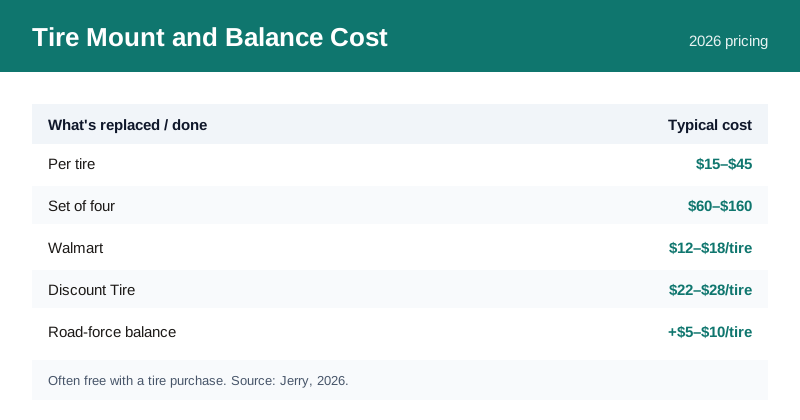
Mounting and balancing runs about $15 to $45 per tire, or $60 to $160 for a set of four. Big retailers are at the low end – Walmart about $12 to $18 and Discount Tire about $22 to $28 per tire – and road-force balancing (a more precise method) adds about $5 to $10 per tire. The best news: it’s often included free when you buy the tires from that shop. “Mount and balance” is two steps done together whenever a tire goes onto a wheel: mounting is getting the tire onto the rim and sealing the bead so it holds air; balancing is spinning the wheel-and-tire assembly on a machine and adding small weights to offset heavy spots, so it spins smoothly without vibration. The two go together because a newly mounted tire must be balanced. One cost note: bringing your own tires (bought elsewhere) often adds a surcharge versus buying them there.
This is the cheap service that makes new tires ride right – and it’s frequently free with a tire purchase. Let me break it down.
What you’ll actually pay
Here’s the picture. These are estimates that vary by shop and location.
| Option | Cost | Notes |
|---|---|---|
| Per tire | $15–$45 | Typical |
| Set of four | $60–$160 | Common |
| Walmart / Discount Tire | $12–$28/tire | Big chains |
| With tire purchase | often free | Included |
Mount and balance is part of tire service; our new tires guide, tire rotation guide, and tire patch guide cover the rest.
Shop Talk
Two quick clarifications and a money tip. First, mount versus balance. Mounting is physically getting the tire onto the wheel – breaking the old tire’s bead, prying the tire off, cleaning the rim, putting the new tire on, and seating/sealing its bead so it holds air. Balancing is a separate step: the mounted wheel-and-tire goes on a spin balancer, which finds heavy spots, and the tech adds small lead or steel weights (the little clips or stick-ons you see on wheels) so the assembly spins perfectly smooth. You balance because even a quality tire isn’t perfectly uniform, and an unbalanced wheel vibrates (felt in the steering wheel or seat, usually at highway speed) and wears the tire and suspension unevenly. The two are always done together when a tire is put on a wheel. Second, road-force balancing – a step up that uses a roller to simulate the load of the road, catching issues a standard spin balance misses; worth the few extra dollars if you’ve had stubborn vibration or on nicer/larger wheels. The money tip: mount and balance is very often free (or heavily discounted) when you buy the tires from that shop or warehouse club, and some include free lifetime rebalancing and rotation. So before paying per tire, check whether it’s bundled with your tire purchase. And note: if you bring tires you bought elsewhere (online), shops usually charge more per tire to mount them.
Where Drivers Overpay
The simplest save is checking whether mount-and-balance is already free with your tire purchase before paying per tire – many tire shops and clubs bundle it, sometimes with free lifetime rebalancing and rotation. Paying separately for what’s included is the avoidable cost.
The related trade-off: buying tires online can look cheaper, but shops charge a higher mount fee for customer-supplied tires, which can erase the savings – so compare the out-the-door total. The pattern: check if it’s bundled, factor the customer-tire surcharge when buying online, and pay for road-force balancing only if you need the precision.
The Real Number
Mount and balance is $15 to $45 per tire ($60 to $160 for four), but it’s often free with a tire purchase – so check before paying. Mounting puts the tire on the wheel; balancing adds weights so it spins without vibration, and the two always go together. Buying tires online can trigger a higher mount fee for customer-supplied tires, so compare the out-the-door total. Road-force balancing (+$5 to $10/tire) is worth it only for stubborn vibration or nicer wheels.
Frequently Asked Questions
How much does it cost to mount and balance tires?
About $15 to $45 per tire, or $60 to $160 for a set of four. Big retailers are cheaper – Walmart around $12 to $18 and Discount Tire around $22 to $28 per tire. Road-force balancing (a more precise method) adds about $5 to $10 per tire. Critically, mount and balance is often included free when you buy the tires from that shop or warehouse club, sometimes with free lifetime rebalancing. These are estimates that vary by shop and location. The cost depends on the shop, your wheel/tire size, and whether you supply your own tires – shops typically charge more per tire to mount tires you bought elsewhere (such as online). So before paying a per-tire fee, check whether mounting and balancing is bundled with a tire purchase, and factor the customer-supplied-tire surcharge if you’re buying tires separately.
What’s the difference between mounting and balancing?
They’re two separate steps done together. Mounting is physically getting the tire onto the wheel: breaking the old tire’s bead, removing it, cleaning the rim, installing the new tire, and seating and sealing its bead so it holds air (then inflating to spec). Balancing is a separate step done after mounting: the wheel-and-tire assembly is spun on a balancing machine that detects heavy spots, and the technician adds small weights (clip-on or stick-on) to counteract them so the assembly spins perfectly smoothly. Mounting puts the tire on; balancing makes it spin true. Both are needed whenever a new tire is installed on a wheel – you can’t balance a tire that isn’t mounted, and a freshly mounted tire must be balanced or it will vibrate. So “mount and balance” bundles the install and the smoothing. Balancing can also be done on its own later (rebalancing) if a wheel develops a vibration, without remounting the tire.
Why do tires need to be balanced?
Because no tire-and-wheel assembly is perfectly uniform, and even small heavy spots cause problems at speed. When a wheel has an imbalance, it creates a vibration as it spins – typically felt in the steering wheel, seat, or floor, and usually most noticeable at highway speeds (around 50 to 70 mph). Beyond being annoying, that vibration causes uneven (“cupped”) tire wear, shortening tire life, and puts extra stress on suspension and steering components. Balancing adds small counterweights to offset the heavy spots so the assembly spins smoothly, eliminating the vibration and the uneven wear. That’s why balancing is done whenever a new tire is mounted, and why a wheel that develops a vibration later should be rebalanced. It protects the ride quality, the tires, and the suspension. So balancing isn’t optional fluff – it’s what keeps new tires from vibrating and wearing out early, which is why it’s always paired with mounting.
Is mount and balance free with new tires?
Very often, yes – this is the key money point. Many tire shops, warehouse clubs, and retailers include mounting and balancing free (or heavily discounted) when you buy the tires from them, and some bundle in extras like free lifetime rebalancing, rotation, and flat repair for the life of the tires. So if you buy your tires at the shop installing them, you frequently pay little or nothing extra for the mount and balance. The flip side: if you buy tires elsewhere (for example, online to save on the tire price) and bring them to a shop, you’ll typically pay a per-tire mount-and-balance fee, and shops often charge more for customer-supplied tires. So before assuming you’ll pay the per-tire rate, check whether it’s included with a tire purchase there – and when comparing buying online versus at a shop, factor the mounting cost into the online option. Often buying where you install nets out cheaper once mounting is counted.
What is road-force balancing?
Road-force balancing is a more advanced balancing method that catches problems a standard spin balance can miss. A standard balancer just spins the wheel to find weight imbalances. A road-force balancer additionally presses a large roller against the spinning tire to simulate the load and force of the road, measuring how the tire actually behaves under weight – this reveals issues like a stiff spot, slight out-of-roundness, or variation in the tire’s construction that cause vibration even when the wheel is “balanced” by weight alone. The machine can also recommend rotating the tire on the rim (match-mounting) to minimize the effect. It costs a few dollars more per tire ($5 to $10). It’s worth it if you’ve had a persistent vibration that regular balancing didn’t fix, or on larger/nicer wheels and performance tires where smoothness matters. For routine tires with no vibration issues, standard balancing is usually fine. So consider road-force balancing for stubborn vibrations or premium setups, and standard balancing for everyday tires.
Is it cheaper to buy tires online and have them mounted?
Sometimes, but you have to count the mounting cost, because it can erase the savings. Buying tires online can offer lower tire prices or more selection, but then you pay a shop to mount and balance them – and shops typically charge more per tire for customer-supplied (bring-your-own) tires than for tires you bought from them, sometimes plus disposal and valve/TPMS fees. Meanwhile, buying at the installing shop often includes free or discounted mounting and extras like lifetime rotation and rebalancing. So to know which is cheaper, compare the full out-the-door totals: (online tire price + shipping + the shop’s customer-tire mount-and-balance fee + any extra fees) versus (the shop’s tire price with mounting included). Sometimes online wins, sometimes the local shop’s bundled deal does. Also, some shops that sell tires won’t prioritize or warranty tires you bought elsewhere. So it can be cheaper to buy online, but do the full math including the higher mounting fee rather than comparing just the tire sticker prices.
Do I need new valve stems or TPMS service too?
Often yes, and it’s a small add-on worth knowing about. When a tire is dismounted and a new one mounted, it’s standard (and recommended) to install a new rubber valve stem, since the old one is cheap and can crack or leak over time – many shops include or charge a small fee for this. On vehicles with TPMS (tire-pressure monitoring sensors, required on modern cars), the sensors live inside the wheel, and mounting work involves them: the sensor’s service kit (seal, cap, valve core) is typically replaced, and the sensors may need to be reset/relearned to the car afterward. If a TPMS sensor is old or failing, it might need replacing (a pricier part). So a tire mount job may include valve stem and TPMS service fees on top of the base mount-and-balance. When getting a quote, ask whether valve stems and TPMS service are included or extra – they’re legitimate small costs that are part of doing the job right, and the TPMS relearn ensures your tire-pressure warning system works correctly after new tires go on.
Sources
Price ranges verified against 2026 tire mount and balance pricing in November 2026. Dollar amounts are estimates that vary by shop and location.
- Jerry – mount and balance tires cost
- TireGrades – cost to mount and balance tires
- ASE – National Institute for Automotive Service Excellence
Related Guides
- New Tires Cost
- Tire Rotation Cost
- Tire Patch Repair Cost
- Wheel Alignment Cost
- Car Repair Cost Estimator

Diane Holcomb spent seven years as a service advisor at multi-brand dealerships in Charlotte, NC, where she’d remind customers that buying tires online only beats the shop once you add the higher mount fee for bring-your-own tires. She drives a 2019 Honda CR-V and a hand-me-down 2007 Toyota Camry, and takes no referral fees or advertising money from any shop or chain.