
Last updated: November 10, 2026 – By Diane Holcomb
November 2026 update: reconfirmed lift-type pricing and the alignment-and-extras point.
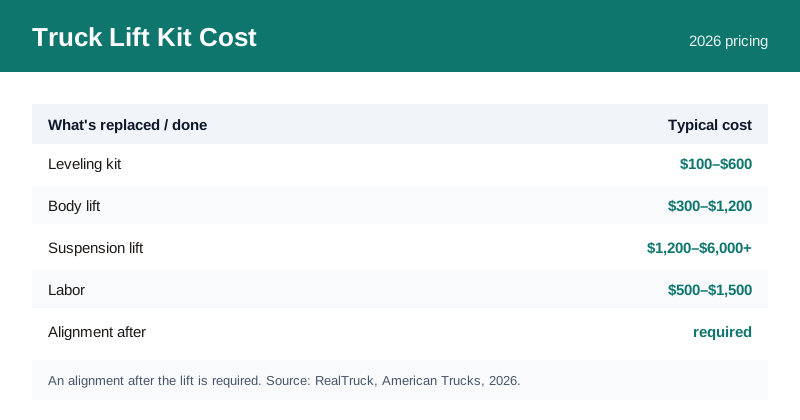
Lifting a truck ranges hugely by the type of lift. A leveling kit (which raises the front to match the rear, a small 1–2.5 inch lift) is $100 to $600. A body lift (spacers that lift the body off the frame) is $300 to $1,200. A suspension lift (new springs, shocks, control arms – a real lift of several inches) is $1,200 to $6,000 or more. On top of the kit, installation labor runs $500 to $1,500, and an alignment afterward is required. Bigger lifts also need extras – longer brake lines, extended sway bar links, driveline/drive-shaft adjustments, and often new larger wheels and tires. Lifting raises a truck’s ride height for ground clearance (off-roading), to fit larger tires, and for the look. The kit type you choose determines both how much lift you get and the price, so that’s the first decision.
Leveling kit, body lift, or suspension lift – the type you pick drives the whole budget, and the extras add up. Let me break it down.
What you’ll actually pay
Here’s the range by lift type. These are estimates that vary by truck and shop.
| Lift type | Cost | Notes |
|---|---|---|
| Leveling kit | $100–$600 | Small lift |
| Body lift | $300–$1,200 | Spacers |
| Suspension lift | $1,200–$6,000+ | Real lift |
| Install labor | $500–$1,500 | Plus alignment |
A lift is a truck modification; our gooseneck hitch guide, alignment guide, and new tires guide cover related truck work.
Shop Talk
Three lift types, three very different budgets. A leveling kit is the cheapest and most popular: it raises the front of the truck 1 to 2.5 inches to level out the factory rake (trucks sit nose-down from the factory) and lets you fit slightly bigger tires – $100 to $600 for the kit, modest labor. A body lift uses spacers to raise the body off the frame a few inches without touching the suspension – cheaper than a suspension lift ($300 to $1,200) but it doesn’t add ground clearance under the axles and can look like a gap between body and frame. A suspension lift actually raises the suspension with new springs, shocks, and often control arms and other components for a real lift (several inches) and genuine off-road clearance – that’s the big one at $1,200 to $6,000-plus, and the more inches, the more it costs. Now the part people underestimate: the kit price isn’t the whole job. Budget for installation labor ($500 to $1,500, more for big lifts), a required alignment afterward (a lift changes all your suspension angles), and on larger lifts, extras like longer brake lines, extended sway bar and shock mounts, driveline angle corrections (even a carrier bearing drop or driveshaft work), and new wheels and tires to fill the fenders. Bigger lifts can also affect ride quality, fuel economy, and sometimes your warranty, so go in clear-eyed. Decide the lift type by your actual goal – looks and bigger tires (leveling kit) versus serious off-roading (suspension lift) – because that decision sets the whole cost.
Where Drivers Overpay
The budget mistake is pricing only the kit and ignoring the extras: installation labor, the required alignment, and – on bigger lifts – brake lines, extended links, driveline corrections, and new wheels and tires. On a suspension lift those extras can rival the kit, so an all-in quote matters.
The other is buying more lift than the goal needs: a leveling kit does the look-and-bigger-tires job for a fraction of a suspension lift, so matching the lift type to your actual purpose is the real save. The pattern: pick the lift type by your goal (leveling kit vs body vs suspension), get an all-in quote including labor, alignment, and extras, and don’t over-buy.
The Real Number
Lifting a truck is $100 to $600 for a leveling kit, $300 to $1,200 for a body lift, and $1,200 to $6,000+ for a suspension lift, plus $500 to $1,500 labor and a required alignment. The kit type drives the whole budget, so match it to your goal – a leveling kit for the look and bigger tires, a suspension lift for real off-road clearance. Budget the extras (alignment, brake lines, driveline, wheels/tires), and get an all-in quote, not just the kit price.
Frequently Asked Questions
How much does it cost to lift a truck?
It depends heavily on the lift type. A leveling kit (a small 1–2.5 inch front lift) is $100 to $600 for the kit; a body lift (spacers that raise the body) is $300 to $1,200; and a suspension lift (a real multi-inch lift with new springs, shocks, and often control arms) is $1,200 to $6,000 or more. On top of the kit, installation labor runs $500 to $1,500 (more for bigger lifts), and a wheel alignment afterward is required. Larger lifts also add costs for extended brake lines, sway bar links, driveline corrections, and often new wheels and tires. These are estimates that vary by truck and shop. So the total ranges from a few hundred dollars for a leveling kit installed to well over $6,000 for a big suspension lift with all the extras. The lift type is the biggest decision, and you should get an all-in quote including labor, alignment, and any extras.
What’s the difference between a leveling kit, body lift, and suspension lift?
They’re three different ways to raise a truck, at three price points. A leveling kit raises the front of the truck (typically 1 to 2.5 inches) to level out the factory nose-down rake, so the truck sits even and can fit modestly larger tires – the cheapest, most popular option. A body lift uses spacers to lift the body up off the frame a few inches without modifying the suspension; it’s cheaper than a suspension lift and gives a taller stance, but it doesn’t increase ground clearance under the axles and can leave a visible gap between body and frame. A suspension lift actually raises the suspension itself with new springs, shocks, control arms, and related parts, giving a real lift of several inches and genuine off-road ground clearance – the most expensive and involved. So the choice comes down to goal and budget: leveling kit for looks and slightly bigger tires on a budget; body lift for height on the cheap; suspension lift for serious height and off-road capability. Each costs accordingly.
Do I need an alignment after lifting my truck?
Yes – a wheel alignment after a lift is necessary, not optional, and should be in the budget. Lifting a truck changes the suspension and steering geometry (the angles the wheels sit at – camber, caster, toe), so after installing a lift, the alignment will be off. Driving on a misaligned lifted truck causes rapid, uneven tire wear (expensive, especially with new larger tires), a steering pull, and compromised handling. So a proper lift job includes a wheel alignment afterward to reset the angles for the new ride height. Bigger suspension lifts may also need alignment-related parts (like adjustable or aftermarket control arms) to bring the angles back into spec, since a large lift can exceed the factory adjustment range. So always factor an alignment into a lift’s cost, and for larger lifts, ask whether additional components are needed to properly align it. Skipping the alignment to save money quickly ruins tires and leaves the truck handling poorly – it’s a required finishing step for any lift.
What extra parts does a bigger lift require?
The taller the lift, the more supporting parts you need beyond the basic kit – which is why big suspension lifts cost so much more. Common extras on larger lifts include: longer (extended) brake lines, because raising the suspension stretches the distance to the brakes; extended sway bar end links and shock mounts; adjustable or aftermarket control arms to correct suspension angles; driveline corrections – a bigger lift changes the driveshaft and CV/U-joint angles, sometimes needing a carrier bearing drop, driveshaft modification, or differential drop kit to avoid vibration and premature wear; a steering/track bar correction; and bump stop extensions. On top of the mechanical parts, most lifts are done to fit larger wheels and tires, which is a significant added cost (and may require fender trimming). So a leveling kit needs little beyond the kit and an alignment, while a serious suspension lift is a package of the kit plus all these supporting components plus wheels and tires – that’s the difference between a few hundred dollars and several thousand. Ask the shop for the complete parts list for the lift height you want.
Does lifting a truck affect ride, fuel economy, or warranty?
Yes, a lift has trade-offs worth knowing before you commit. Ride quality and handling change – a lift raises the center of gravity (more body roll, and big lifts can make the truck feel tippier), and depending on the components, the ride can get firmer or looser; a quality kit minimizes this, a cheap one may not. Fuel economy typically drops, especially with larger, heavier tires and the added wind resistance of a taller profile. The speedometer may read inaccurately with bigger tires until recalibrated. And warranty: a lift can affect your factory warranty – under consumer rules a dealer can’t void the whole warranty for a modification, but damage caused by the lift to related components (suspension, driveline) may not be covered, and some dealers push back on lift-related claims. Larger tires also add stress to the drivetrain and brakes. So a lift is a modification with real downsides alongside the looks and clearance – go in understanding the effects on ride, MPG, speedometer, and warranty, and choose a quality kit and reputable installer to minimize the negatives. For a mild leveling kit the impacts are small; for a big lift they’re significant.
Should I install a lift kit myself?
It depends on the lift type and your skills/tools, and the stakes rise with lift size. A basic leveling kit is a feasible DIY for a mechanically experienced person with the right tools (and it still needs an alignment afterward at a shop). But larger body and especially suspension lifts are complex, safety-critical jobs involving disassembling suspension and steering components, handling heavy parts and compressed springs (dangerous), and often driveline and brake-line work – mistakes can be unsafe at speed. Many sources advise against DIY for bigger lifts, and the risks often outweigh the labor savings. A professional install also ensures everything’s torqued correctly, the needed supporting parts are included, and the truck is aligned and safe. So a leveling kit can be DIY if you’re equipped and careful; a serious suspension lift is best left to a shop experienced with lifts, given the safety-critical nature and the supporting work required. If you do DIY any lift, get a professional alignment and ideally a safety check afterward before driving much. The cost of a mistake on a lifted truck isn’t worth the savings.
Which lift should I get for my goal?
Match the lift to what you actually want, since that sets the cost. If your goal is mainly appearance and fitting slightly larger tires – leveling the factory nose-down stance and a modest, budget-friendly change – a leveling kit ($100 to $600 plus install) is usually the right, economical choice, and it’s the most popular for a reason. If you want more height on a tighter budget and don’t need extra ground clearance under the axles, a body lift adds stance for less than a suspension lift, with the trade-off of no added axle clearance and a possible body-frame gap. If you want serious off-road capability, real ground clearance, and to run significantly larger tires – genuine trail or overlanding use – a suspension lift ($1,200 to $6,000-plus) is what delivers that, and it’s worth the cost for that purpose. Don’t over-buy: a suspension lift for a truck that just wants a slightly tougher look is money wasted versus a leveling kit. So define your goal first – looks and tires, cheap height, or off-road performance – and let that pick the lift type and budget.
Sources
Price ranges verified against 2026 truck lift pricing in November 2026. Dollar amounts are estimates that vary by truck and shop.
- RealTruck – cost to lift a truck
- American Trucks – cost to lift a truck
- ASE – National Institute for Automotive Service Excellence
Related Guides
- Gooseneck Hitch Installation Cost
- Wheel Alignment Cost
- New Tires Cost
- Shocks and Struts Replacement Cost
- Car Repair Cost Estimator

Diane Holcomb spent seven years as a service advisor at multi-brand dealerships in Charlotte, NC, where she’d steer truck owners to match the lift to the goal – a leveling kit for the look, a suspension lift only for real off-roading – and always budget the alignment and extras. She drives a 2019 Honda CR-V and a hand-me-down 2007 Toyota Camry, and takes no referral fees or advertising money from any shop or chain.