
Last updated: November 5, 2026 – By Diane Holcomb
November 2026 update: reconfirmed injection pump pricing and the contamination-doubles-cost point.
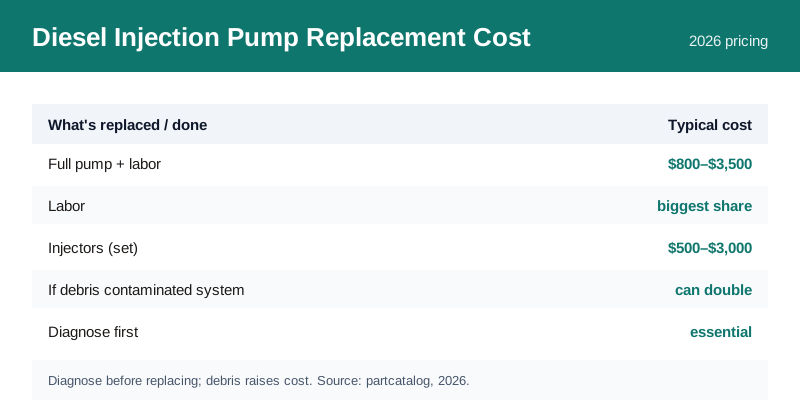
A diesel injection pump replacement runs about $800 to $3,500 including labor, which is the biggest share of the cost. The spread comes from engine type, pump design, and whether other parts are involved – a full set of diesel injectors separately is $500 to $3,000. The critical warning: if a failed pump sent metal debris through the fuel system, the budget can double, because the fuel rails, lines, and injectors all get contaminated and need replacing too. The diesel injection pump is the heart of a diesel’s fuel system – it pressurizes diesel fuel to very high pressure and delivers it precisely to the injectors, which spray it into the cylinders. When it fails, you get hard starting or no-start, loss of power, rough running, excessive smoke, stalling, and sometimes metallic debris in the fuel. Because a self-destructing pump can contaminate the entire system, proper diagnosis before replacement is essential – this is a diesel-specific, higher-stakes repair.
This is a big-ticket diesel repair where a failed pump can take the whole fuel system with it, so diagnosis is everything. Let me break it down.
What you’ll actually pay
Here’s the picture. These are estimates that vary a lot by engine and shop.
| Item | Cost | Notes |
|---|---|---|
| Full pump + labor | $800–$3,500 | By engine |
| Injectors (full set) | $500–$3,000 | If needed |
| Debris contamination | can double | Rails + lines too |
| Labor | biggest share | Diesel-specific |
This is a diesel fuel-system repair; our fuel injector guide, fuel pump guide, and fuel filter guide cover related fuel parts.
Shop Talk
This is a diesel-specific, high-stakes repair, so a couple of things really matter. First, diagnosis before replacement – a diesel injection pump is expensive, and the symptoms (hard starting, power loss, rough running, smoke) can overlap with cheaper problems: a clogged fuel filter, air in the fuel system, water in the fuel, a weak lift pump, or bad injectors. A good diesel shop confirms the pump is actually failing (checking fuel pressure and ruling out the cheaper causes) before condemning it. Second, the big one: contamination. On modern high-pressure common-rail diesels, when an injection pump fails internally, it can shed microscopic metal debris into the fuel, and that debris circulates through the entire fuel system – rails, lines, and injectors. If that’s happened, you can’t just replace the pump; you have to replace or thoroughly clean the contaminated components too, which can double the bill. That’s why a “pump failure” quote on a common-rail diesel is sometimes a whole-fuel-system job. Third, fuel quality is the big preventable cause: water-contaminated or dirty fuel and a neglected fuel filter are hard on these pumps, so keeping the fuel filter(s) changed on schedule and using clean fuel is cheap insurance on an expensive system. If you’ve got a diesel acting up, get it to a shop that knows diesels specifically – this isn’t a guess-and-replace part.
Where Drivers Overpay
The first overpay risk is replacing an expensive pump for symptoms a clogged fuel filter, air or water in the fuel, a weak lift pump, or bad injectors would explain – so a diesel-specific diagnosis that confirms the pump before condemning it is essential.
The bigger-stakes issue is contamination: on common-rail diesels, a self-destructing pump sheds metal through the whole fuel system, so replacing only the pump and reusing contaminated rails, lines, and injectors leads to a repeat failure. The pattern: diagnose with a diesel shop, confirm the pump, check for debris contamination (do the whole system if present), and prevent it with clean fuel and on-schedule filters.
The Real Number
A diesel injection pump is $800 to $3,500 with labor, and a failed pump that sent metal debris through the fuel system can double that, since the rails, lines, and injectors get contaminated too. The symptoms overlap with cheaper issues (clogged filter, water in fuel, bad injectors), so confirm the pump with a diesel shop before replacing. Clean fuel and on-schedule fuel filters are the cheap insurance for this expensive system.
Frequently Asked Questions
How much does it cost to replace a diesel injection pump?
A full injection pump replacement runs about $800 to $3,500 including labor, which is the biggest share of the cost. The wide spread reflects the engine type, pump design, and whether other parts are involved. A full set of diesel injectors, separately, is $500 to $3,000. Critically, if a failed pump sent metal debris through the fuel system, the budget can double, because the fuel rails, lines, and injectors become contaminated and need replacing or thorough cleaning too. These are estimates that vary widely by engine and shop. Because of the high cost and the contamination risk, this is a repair where proper diagnosis first – confirming the pump is actually failing and checking for debris – is essential. Get quotes from a shop that specializes in diesels for an accurate figure.
What does the diesel injection pump do?
The diesel injection pump is the heart of a diesel engine’s fuel system. It takes diesel fuel and pressurizes it to very high pressure, then delivers it precisely – in exact amounts and timing – to the injectors, which spray the fuel into the cylinders where the heat of compression ignites it (diesels have no spark plugs). On modern common-rail diesels, the pump feeds a high-pressure fuel rail that supplies the electronically controlled injectors; older diesels use mechanical injection pumps. Because diesel combustion depends on fuel delivered at the right pressure and timing, the injection pump is fundamental to the engine running at all and running well. It operates under extreme pressure and relies on clean fuel for lubrication and cooling, which is why fuel quality and filtration are so important to its life. A failing pump disrupts that precise fuel delivery.
What are the symptoms of a failing injection pump?
Common symptoms include hard starting or a no-start, loss of power or poor acceleration, rough running or misfiring, excessive exhaust smoke (black, white, or gray depending on the issue), stalling, reduced fuel economy, and a check engine light with fuel-system codes. In some failures you may notice fuel leaks or metallic particles in the fuel. Because diesel engines depend entirely on precise high-pressure fuel delivery, a failing pump affects how the engine starts and runs across the board. However, these same symptoms can come from cheaper causes – a clogged fuel filter, air or water in the fuel, a weak lift pump, or bad injectors – so a failing injection pump should be confirmed by a proper diagnosis, not assumed. Given the pump’s cost, ruling out the cheaper culprits first is important. A diesel specialist can test fuel pressure and pinpoint the fault.
Why can a failed pump double the repair cost?
Because of contamination of the whole fuel system. On modern high-pressure common-rail diesels, when an injection pump fails internally, it can grind up and shed microscopic metal debris into the fuel. That debris doesn’t stay put – it circulates through the entire high-pressure fuel system: the fuel rail, the lines, and the injectors. Once metal has gone through the system, you can’t just bolt on a new pump and call it done; the contaminated rails, lines, and injectors must be replaced or thoroughly cleaned, or they’ll damage the new pump and injectors and cause a repeat failure. Replacing all those components roughly doubles the cost compared to the pump alone. That’s why a catastrophic pump failure on a common-rail diesel can turn into a whole-fuel-system job. It’s also why confirming whether contamination occurred is a key part of diagnosing and quoting the repair.
Is it safe to drive with a failing injection pump?
It’s not advisable to keep driving on a clearly failing diesel injection pump. Beyond the drivability problems (power loss, rough running, stalling, hard starting), continuing to run a pump that’s failing internally risks spreading metal contamination further through the fuel system, which increases the damage and the repair cost. A pump that’s starting to self-destruct can turn a pump replacement into a whole-fuel-system replacement if you keep driving. There’s also the risk of being stranded if it fails completely. So if your diesel is showing signs of injection pump trouble, it’s best to stop driving it hard and get it diagnosed promptly by a diesel specialist, rather than pushing on. Catching it early – and confirming whether contamination has started – can be the difference between a pump-only repair and a far costlier full-system job. Don’t ignore diesel fuel-system symptoms.
How can I prevent injection pump failure?
Fuel quality and filtration are the big preventable factors. Diesel injection pumps rely on clean diesel fuel for lubrication and cooling, so the main things that protect them are: changing the fuel filter(s) on schedule (diesels often have more than one, and clean filters keep debris and water out of the pump), draining any water separator regularly, and using clean fuel from reputable sources (water-contaminated or dirty/off-spec fuel is hard on the pump). Avoiding running the tank very low (which can draw in sediment and air) and not letting the engine run out of fuel also help. On modern common-rail systems, the fuel is the pump’s lubricant, so contamination or running dry is directly harmful. Following the manufacturer’s fuel-filter interval and being careful about fuel quality is relatively cheap insurance on a very expensive system. Neglected filters and bad fuel are behind many premature pump failures, so staying on top of those pays off.
Should I use a diesel specialist for this repair?
Yes – this is a repair where a shop that specializes in diesels is worth seeking out. Diesel fuel systems, especially modern high-pressure common-rail systems, require specific knowledge, diagnostic equipment, and experience to test fuel pressure, confirm a pump failure, check for contamination, and do the job correctly. A general shop may not have the right tools or expertise, and the stakes are high given the cost and the contamination risk. A diesel specialist can accurately diagnose whether it’s really the pump (versus a filter, injectors, or fuel issue), assess whether metal contamination has occurred, and properly clean or replace the affected components so the repair lasts. Given that a misdiagnosis or incomplete repair on this system can cost thousands, the expertise of a diesel shop is especially valuable here. If your diesel has fuel-system symptoms, getting it to someone who knows diesels specifically is the smart move.
Sources
Price ranges verified against 2026 diesel injection pump pricing in November 2026. Dollar amounts are estimates that vary by engine and shop.
- PartCatalog – diesel fuel injector pump replacement cost guide
- FridayParts – diesel fuel injector replacement cost
- ASE – National Institute for Automotive Service Excellence
Related Guides
- Fuel Injector Replacement Cost
- Fuel Pump Replacement Cost
- Fuel Filter Replacement Cost
- Injector Pump Replacement Cost
- Car Repair Cost Estimator

Diane Holcomb spent seven years as a service advisor at multi-brand dealerships in Charlotte, NC, where diesel fuel-system jobs went to the diesel specialist – because a failed injection pump can contaminate the whole system and double the bill if it’s handled wrong. She drives a 2019 Honda CR-V and a hand-me-down 2007 Toyota Camry, and takes no referral fees or advertising money from any shop or chain.