
Last updated: November 9, 2026 – By Diane Holcomb
November 2026 update: reconfirmed pricing and the under-the-intake labor reality.
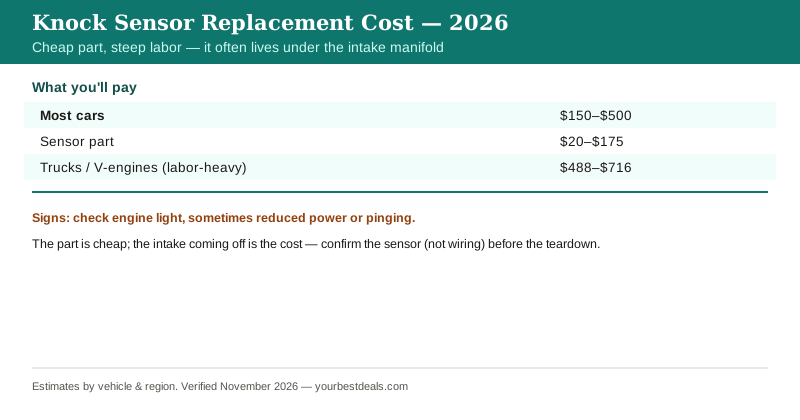
A knock sensor replacement runs about $150 to $500 for most cars, parts and labor. The sensor part is cheap at roughly $20 to $175 – but labor is the bulk of the bill, because the knock sensor often sits under the intake manifold, which has to come off to reach it. On some trucks and V-engines that labor runs $488 to $716, and luxury European cars can be much more. The knock sensor detects engine detonation (“knock,” or pinging) so the computer can retard ignition timing to protect the engine, so a fault usually brings a check engine light and sometimes reduced power or economy. Because the part is cheap and the labor steep, it’s worth confirming the sensor is actually the fault (not wiring, or a genuine knock condition) before the intake manifold comes off.
This is a classic “two-dollar part, two-hour job” repair, so the diagnosis – before the intake comes off – is where the money is. Let me cover the cost, the labor reality, and what to confirm first.
What you’ll actually pay
Here’s the price picture. These are estimated ranges that vary by vehicle and shop.
| Item | Cost | Notes |
|---|---|---|
| Most cars | $150–$500 | Labor-dominated |
| Sensor part | $20–$175 | Cheap |
| Trucks / V-engines (labor-heavy) | $488–$716 | Intake off |
| Luxury European | much more | Pricier |
The sensor bolts to the engine block, frequently beneath the intake manifold, which is why access drives the cost. Our check engine light guide covers the codes, and our tune-up-related guides cover the pinging causes a knock sensor responds to.
Shop Talk
The knock sensor is a cheap part in an expensive spot. It’s a small sensor bolted to the engine block that “listens” for detonation and tells the computer to pull timing to protect the engine – and on a lot of engines, especially V6s and V8s, it sits down in the valley under the intake manifold. That means to replace a $20-to-$175 part, the shop may have to remove the intake manifold and related bits, which is the bulk of the labor and why the same job is $200 on one engine and $700 on another. So the smart move is to make sure it’s really the knock sensor before anyone pulls the intake. A knock-sensor code (like P0325 or P0330) can come from the sensor, but also from its wiring or connector – and a good tech checks those first, because a wiring fix is far cheaper than the teardown. It’s also worth distinguishing a sensor fault from an actual knock condition: if the engine is really pinging (from carbon, bad fuel, or over-advanced timing), the knock sensor is doing its job reporting it, and replacing the sensor won’t fix the underlying knock. Confirm the sensor is the fault, check the wiring, and rule out a real knock problem – then, if it truly is the sensor, accept that the labor is what it is on your engine.
Where Drivers Overpay
Because the part is cheap and the labor steep, the overpay is spending hours pulling the intake to replace a sensor that wasn’t the problem. A knock-sensor code can come from the sensor’s wiring or connector (a far cheaper fix) rather than the sensor itself, so checking those before the teardown is the key.
The other trap is a genuine knock (pinging from carbon, bad fuel, or timing) – there the sensor is correctly reporting a real problem, and replacing it won’t fix the knock. The pattern: confirm the code points to the sensor, check the wiring and connector first, rule out an actual knock condition, and only then accept the labor to reach the sensor if it’s truly failed.
The Real Number
A knock sensor is $150 to $500 ($488 to $716 on trucks/V-engines where the intake comes off) – a $20-to-$175 part with steep labor. Before that teardown, confirm it’s the sensor: a knock-sensor code can come from wiring or a connector (cheaper), and a genuine pinging condition means the sensor is just reporting a real knock that replacing it won’t fix. Check the wiring and rule out actual knock first.
Frequently Asked Questions
How much does it cost to replace a knock sensor?
About $150 to $500 for most cars, parts and labor. The sensor part is inexpensive at roughly $20 to $175, so labor is the bulk of the bill – and on trucks and V-engines where the knock sensor sits under the intake manifold, that labor can run $488 to $716. Luxury European cars can be much more. These are estimates that vary by vehicle and shop. Because the part is cheap and the access often difficult, the cost is driven almost entirely by how buried the sensor is on your engine. For an accurate figure, get a quote for your specific engine, and confirm the sensor is the fault before the intake comes off.
Why is a cheap knock sensor so expensive to replace?
Because of where it lives. The knock sensor is a small, inexpensive part, but on many engines – especially V6s and V8s – it’s bolted to the engine block down in the valley beneath the intake manifold. To reach it, the shop has to remove the intake manifold and sometimes other components, which is hours of labor. So you’re paying for the teardown, not the part. On engines where the sensor is more accessible, the job is much cheaper. This access difference is why the same repair is a couple hundred dollars on one car and $700 on another. It’s also why confirming the sensor is truly the problem before that labor is worthwhile.
What are the signs of a bad knock sensor?
The most common sign is a check engine light with a knock-sensor code (such as P0325 or P0330). You may also notice reduced engine power or performance and slightly worse fuel economy, because when the computer loses a reliable knock signal it may run a more conservative (retarded) timing strategy to protect the engine. In some cases there are no obvious drivability symptoms beyond the light. Because a knock-sensor code can come from the sensor, its wiring, or an actual knock condition, the specific code and testing are used to confirm the sensor. If you have a knock-sensor code, the diagnosis should distinguish a failed sensor from a wiring fault or a genuine engine knock before replacement.
Could the code be wiring or a real knock instead of the sensor?
Yes, and both are important to rule out before the costly teardown. A knock-sensor code can be triggered by the sensor’s wiring or connector (corrosion or a break) rather than the sensor itself – and fixing wiring is far cheaper than removing the intake to replace the sensor. Separately, the knock sensor’s whole job is to detect real engine knock (detonation), so if the engine is really pinging – from carbon buildup, low-octane or bad fuel, or over-advanced timing – the sensor is correctly reporting it, and replacing the sensor won’t stop the knock. A proper diagnosis checks the wiring and determines whether there’s an actual knock condition, so you don’t pull the intake for a sensor that wasn’t the problem.
Can I drive with a bad knock sensor?
You can usually drive short-term. A faulty knock sensor typically causes a check engine light and possibly slightly reduced power or economy (as the computer runs safer timing), rather than a breakdown. However, it shouldn’t be ignored indefinitely: if the sensor can’t detect real knock, the engine loses a layer of protection against detonation, which over time could allow damaging knock under certain conditions. The persistent check engine light also masks other codes and fails emissions tests. So while it’s generally safe to drive briefly, it’s worth diagnosing and addressing – and importantly, if the “knock sensor” light is really reporting an actual knock condition, that underlying problem (not the sensor) needs attention to protect the engine.
What causes a knock sensor to fail?
Knock sensors can fail from age and heat exposure, internal degradation of the piezoelectric element, corrosion, or wiring and connector problems. Moisture intrusion and vibration over high mileage contribute. Sometimes what’s diagnosed as a “failed knock sensor” is actually a wiring or connector fault rather than the sensor itself. There’s no scheduled replacement; it’s replaced when it fails and sets a code. Because the sensor and its circuit both can cause the same code, and because an actual engine knock can trigger the system too, confirming the true cause matters – especially given the labor to reach the sensor on many engines. A really failed sensor with a confirmed fault is replaced; a wiring issue is repaired instead.
Is replacing a knock sensor a DIY job?
It depends entirely on access. On engines where the knock sensor is reasonably accessible, a confident DIYer can unbolt the old sensor, unplug it, and install the new one (torque matters on some knock sensors). But on the many engines where it sits under the intake manifold, the job requires removing the intake and related parts – a much bigger undertaking with gaskets and reassembly, which pushes most people toward a shop. Either way, confirming the sensor (not wiring or a real knock) is the fault comes first, since you don’t want to do that teardown for the wrong reason. For an accessible sensor with a confirmed diagnosis, DIY is feasible; for a buried one, a shop is usually the practical choice.
Sources
Price ranges verified against 2026 knock sensor pricing in November 2026. Dollar amounts are estimates that vary by vehicle and shop.
- J.D. Power – knock sensor replacement cost
- RepairPal – knock sensor estimates
- ASE – National Institute for Automotive Service Excellence
Related Guides
- Check Engine Light Guide
- Spark Plug Replacement Cost
- Camshaft Position Sensor Replacement Cost
- Intake Manifold Repair Cost
- Car Repair Cost Estimator

Diane Holcomb spent seven years as a service advisor at multi-brand dealerships in Charlotte, NC, where a knock-sensor code meant checking the wiring and ruling out a real ping first – because nobody wanted to pull an intake manifold for a sensor that wasn’t bad. She drives a 2019 Honda CR-V and a hand-me-down 2007 Toyota Camry, and takes no referral fees or advertising money from any shop or chain.