
Last updated: November 5, 2026 – By Diane Holcomb
November 2026 update: reconfirmed per-wheel and all-four pricing, the relearn labor, and the low-pressure-vs-sensor distinction.
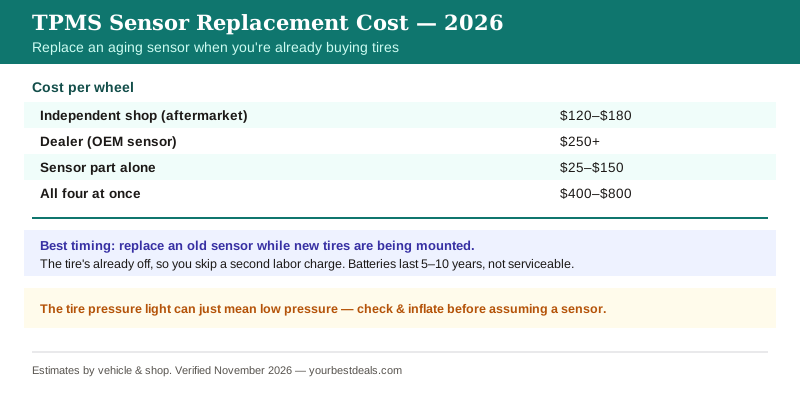
A TPMS (tire pressure monitoring system) sensor costs about $120 to $180 per wheel at an independent shop using quality aftermarket sensors, or $250 or more per wheel at a dealer requiring OEM parts – with a broad range of $50 to $350 per sensor depending on vehicle and parts. All four at once commonly runs $400 to $800. The reason it’s not just the price of a cheap sensor ($25 to $150 each) is the labor: the tire has to be dismounted, the sensor installed, the tire remounted and balanced, and the sensor “relearned” to the car. The smartest way to save is timing – replace an aging sensor when you’re already buying new tires, since the tire’s off anyway and you skip a second labor charge. And before you assume a bad sensor, check your tire pressure: the light often just means a tire is low.
TPMS questions came up a lot once the systems became universal, and two things surprised people: why a tiny sensor costs over a hundred dollars to replace, and why the light doesn’t always mean a broken sensor. Both are worth understanding before you pay. Let me cover the cost, the best timing, and the light trap.
What you’ll actually pay
Here’s the price picture per wheel. These are estimated ranges that vary by vehicle and shop.
| Option | Cost per wheel | Notes |
|---|---|---|
| Independent shop (aftermarket) | $120–$180 | Quality aftermarket sensor |
| Dealer (OEM sensor) | $250+ | OEM parts, higher labor |
| Sensor part alone | $25–$150 | Aftermarket to OEM |
| Labor + relearn | $50–$150 | Dismount, install, balance, relearn |
| All four at once | $400–$800 | Sometimes a bulk discount |
The sensor itself is cheap; the cost is the labor to get to it and the relearn step that pairs the new sensor to your car’s computer. That’s why replacing all four at once (often when they’re all aging out together) can be more economical per wheel than one-at-a-time visits. TPMS sensor batteries are sealed and typically last 5 to 10 years, and they aren’t serviceable – when the battery dies, you replace the whole sensor. Our tire pressure light guide explains the warnings.
Shop Talk
The single best money move on TPMS is timing: if your sensors are aging (5-plus years old) and you’re already replacing your tires, have the sensors done at the same time. The tire is already dismounted for the new tire, so you pay little or no extra labor – versus a separate visit later where you pay the full dismount-and-remount labor just for the sensor. Many tire shops will even quote sensors as an add-on to a tire purchase for this reason. Second, before you spend anything on a sensor, rule out the cheap cause: a TPMS light very often just means a tire is really low on pressure (cold weather drops it, or you have a slow leak), not that a sensor failed. So check and properly inflate all four tires first – the light may simply go out. A steady TPMS light usually means low pressure; a light that blinks for a while then stays on often means a sensor or system fault. Don’t pay for a sensor to fix what a $1 air fill would have solved. And if you have aftermarket wheels or a spare, ask whether they even have sensors before assuming.
Where Drivers Overpay
The biggest overpay is replacing a TPMS sensor to chase a light that was really just low tire pressure. The system’s whole job is to warn you about low pressure, so a steady light most often means exactly that – a tire is low, often from cold weather or a slow leak. Check and inflate all four tires first; the light frequently goes out on its own. Paying a shop for a sensor when a free air fill was the fix is a common, avoidable waste.
The other overpay is paying full separate labor for a sensor that could have been done during a tire change. If your sensors are old and you’re getting new tires anyway, bundling the sensor replacement avoids a second dismount-and-remount charge. And going to a dealer for OEM sensors when quality aftermarket sensors from an independent shop would work fine can nearly double the cost. So check pressure first, time sensor replacement with tire service, and consider aftermarket sensors at an independent shop to keep the bill down.
The Real Number
A TPMS sensor runs about $120 to $180 per wheel at an independent shop, $250+ at a dealer, or $400 to $800 for all four – the labor and relearn, not the cheap sensor, drive the cost. Time replacement with new tires to skip a second labor charge, and consider aftermarket sensors at an independent shop. Before spending anything, check and inflate your tires: a TPMS light usually just means low pressure, not a dead sensor.
Frequently Asked Questions
How much does it cost to replace a TPMS sensor?
About $120 to $180 per wheel at an independent shop using quality aftermarket sensors, or $250 or more per wheel at a dealer with OEM parts, with an overall range of $50 to $350 per sensor. All four at once commonly runs $400 to $800. The sensor part is cheap ($25 to $150 each) – most of the cost is labor to dismount the tire, install the sensor, remount and balance, and relearn it to the car. These are estimates that vary by vehicle and shop. Timing the replacement with new tires reduces the labor cost.
Why is TPMS sensor replacement so expensive for a small part?
Because the labor and the relearn step cost more than the sensor itself. To replace a sensor, the shop has to dismount the tire from the wheel, install the new sensor, remount and rebalance the tire, and then “relearn” or program the sensor so the car’s computer recognizes it – several steps of work for a $25-to-$150 part. That’s why per-wheel cost lands at $120 to $180 or more even though the sensor is cheap, and why doing all four together, or during a tire change, is more economical per wheel.
Do I need to replace all four TPMS sensors at once?
Not required, but often sensible. Sensors have sealed batteries that last 5 to 10 years, so if one has died of old age, the others are usually close behind – replacing all four together avoids repeat visits and can come with a bulk discount. If a single sensor failed early (from damage rather than age), you can replace just that one. The best economy is doing them when you’re already replacing tires, since the labor overlaps. So it’s a judgment call based on the sensors’ age and whether you’re doing tire work anyway.
Can I drive with a bad TPMS sensor or a TPMS light on?
You can drive, but you shouldn’t ignore it. If the light is on because a tire is really low, that’s a safety and tire-wear issue you should fix by inflating (or repairing a leak) promptly. If it’s on because a sensor failed, the car is drivable but you’ve lost automatic pressure monitoring for that wheel, so you’ll need to check that tire’s pressure manually with a gauge. In many states a TPMS warning can also affect inspection. So driving is fine short-term, but address the cause – low pressure or a bad sensor – rather than leaving the light on indefinitely.
Does a TPMS light always mean a bad sensor?
No – most often it means a tire is actually low on pressure, which is exactly what the system is designed to warn about. Cold weather commonly drops pressure enough to trigger the light, as does a slow leak. So the first step is always to check and properly inflate all four tires; the light frequently goes out on its own. A steady light usually points to low pressure, while a light that blinks for a minute or so at startup and then stays on often indicates a sensor or system fault. Check pressure before assuming a sensor failed.
How long do TPMS sensors last?
Typically 5 to 10 years, limited by their sealed internal battery, which isn’t serviceable – when it dies, you replace the whole sensor. Actual life depends on use and climate. Because they age out on a similar timeline, sensors often start failing around the same time, which is why replacing all four together (especially during a tire change) can make sense once they reach that age. If your car is getting into the 7-to-10-year range and a sensor fails, expect the others may not be far behind.
Can I replace a TPMS sensor myself?
It’s difficult for most DIYers because the tire has to be dismounted from the wheel to reach the sensor, which requires a tire machine most people don’t have, plus the new sensor usually needs to be programmed or relearned to the car. Some sensors and vehicles allow a relearn procedure with a scan tool or a specific key-cycle sequence, but the tire dismounting is the real barrier. For most people it’s a shop job, best bundled with tire service. If you’re mounting your own tires already, then adding a sensor is more feasible.
Sources
Price ranges verified against 2026 TPMS service pricing in November 2026. Dollar amounts are estimates that vary by vehicle, parts choice, and shop.
- Kelley Blue Book – TPMS sensor replacement costs
- AutoZone – tire sensor replacement cost
- NHTSA – tire pressure monitoring and safety
Related Guides
- What Does the Tire Pressure Light Mean?
- Tire Pressure Light On But Tires Fine?
- New Tires Cost
- Tire Balancing & Rotation Cost
- Tires Guide

Diane Holcomb spent seven years as a service advisor at multi-brand dealerships in Charlotte, NC, where she learned to send customers to check their tire pressure before quoting a TPMS sensor. She drives a 2019 Honda CR-V and a hand-me-down 2007 Toyota Camry, and takes no referral fees or advertising money from any shop or chain.