
Last updated: November 9, 2026 – By Eddie Brennan
November 2026 update: reconfirmed the “looks fine but is low” point, cold-weather trigger, and sensor costs.
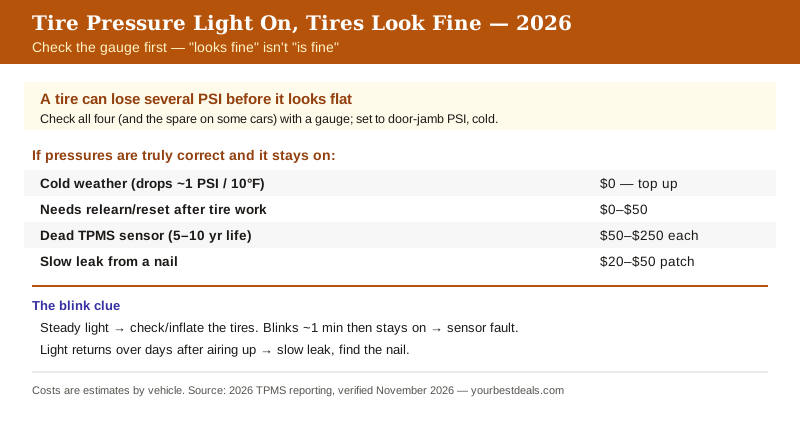
If your low tire pressure light is on but the tires look perfectly fine, the first thing to know is that “looks fine” isn’t “is fine” – a tire can lose several PSI and still look completely normal, because it takes a lot of air loss before a tire visibly sags. So step one is always to check all four with a gauge (and the spare, on some vehicles) and set them to the door-jamb pressure when cold. The most common reason the light comes on with normal-looking tires is simply cold weather, which drops pressure about 1 PSI per 10-degree fall. If the pressures are really correct and the light stays on, then it’s a TPMS sensor issue, a needed reset, or a slow leak. Here’s how to sort it out.
This is one of the most-searched tire questions, and the answer usually starts with “your tires probably are a little low, even though they look okay.” Let me walk through why that’s so common, and what it means if the pressures really are correct and the light still won’t go off.
First: your tires are probably actually low
The single biggest reason for a tire pressure light on “fine-looking” tires is that the tires are, in fact, low – you just can’t see it. A tire can be several PSI under spec and still look normal, because modern tires hold their shape until they’re quite deflated. The TPMS is more sensitive than your eyes: it typically triggers at about 25% below the recommended pressure, which is enough to affect handling and wear but not enough to make the tire look flat. So don’t trust the eyeball test – grab a gauge.
Cold weather is the top trigger. Air pressure drops roughly 1 PSI for every 10-degree fall in temperature, so a cold snap or the first cold morning of the season can pull tires below the threshold overnight even though nothing’s wrong with them. Check and set all four to the door-jamb pressure (not the sidewall max) when the tires are cold, and the light usually clears after a short drive. This simple check resolves the large majority of “light on but tires fine” cases. See our tire pressure light guide for the full rundown.
If the pressures really are correct
Once you’ve confirmed with a gauge that all four tires are at the proper pressure and the light still won’t go off, you’re into three possibilities. First, a dead TPMS sensor: the sensors inside each wheel run on batteries that last 5 to 10 years, and a dead one keeps the light on regardless of actual pressure – replacement runs $50 to $250 per sensor. A key tell here is the light blinking for about a minute at startup before staying on solid, which signals a sensor fault rather than low pressure.
Second, the system may need a relearn or reset, especially if the light appeared right after new tires, a rotation, or a sensor change – some cars reset automatically after driving, others need a scan tool ($0 to $50 at a shop). Third, a slow leak: if the light keeps coming back a day or two after you air up, you likely have a slow leak from a nail or a bad valve, which a shop can find and patch for $20 to $50. So the sequence is: confirm pressures, then look at the sensor, the reset, or a slow leak. Our blinking light guide covers the sensor-fault case.
Shop Talk
Two things people miss. First, don’t forget the spare – on some vehicles the full-size spare has its own TPMS sensor, so a low or dead-sensor spare in the trunk can light up the dash while all four road tires are perfectly fine. If you’ve checked all four and they’re good, check the spare’s pressure too. Second, use your own gauge, not the gas-station one, which is often wildly inaccurate and can read several PSI off, sending you chasing a problem that isn’t there. A $10 digital gauge in the glovebox pays for itself. And remember to set pressure cold – after driving, the tires warm up and read higher, so a “correct” hot reading can leave you actually low once they cool, which brings the light right back.
What Gets Misdiagnosed
The classic mistake is trusting the eyeball test and concluding the sensor must be broken when the tires are simply low. Because a tire can lose meaningful pressure without looking flat, people skip the gauge, assume a false alarm or a bad sensor, and either ignore the light or pay for an unnecessary sensor. A thirty-second gauge check on all four (and the spare) resolves most of these for free. Never conclude the sensor is bad until you’ve verified actual pressures with a gauge.
The second miss is ignoring a slow leak because the light “keeps being wrong.” If you air up to spec and the light returns over the next day or two, that’s not a faulty sensor – it’s the sensor correctly reporting a tire that’s leaking down again, usually from a nail or a valve. Chasing a reset or blaming the sensor wastes time while the tire keeps losing air. So if the light recurs after proper inflation, look for a slow leak rather than assuming a sensor fault. Matching the pattern – one-time cold-weather trigger, sensor fault, or recurring slow leak – to the right cause keeps you from replacing a good sensor or driving on a leaking tire.
The Real Number
A tire pressure light on “fine-looking” tires usually means the tires are actually low – a tire loses several PSI before it looks flat – so check all four (and the spare) with your own gauge and set them cold to the door-jamb PSI. Cold weather is the top trigger, dropping ~1 PSI per 10°F. If the pressures are truly correct and the light stays on, it’s a dead TPMS sensor ($50 to $250 each), a needed relearn/reset ($0 to $50), or a slow leak from a nail ($20 to $50 patch) if the light returns over days. A light that blinks then stays solid points at a sensor fault, not low pressure.
Frequently Asked Questions
Why is my tire pressure light on if my tires look fine?
Most likely because the tires are actually low even though they look normal – a tire can lose several PSI before it visibly sags, and the TPMS triggers at about 25% below spec, which is enough to matter but not enough to look flat. Cold weather is the top trigger, dropping pressure about 1 PSI per 10-degree fall. So the first step is to check all four with a gauge and set them to the door-jamb pressure when cold, rather than trusting your eyes. If the pressures really are correct and the light stays on, then look at a dead TPMS sensor, a needed system reset, or a slow leak.
Can cold weather turn on the tire pressure light?
Yes, it’s the most common trigger. Air pressure drops roughly 1 PSI for every 10-degree fall in temperature, so a cold snap or the first cold morning of the season can lower your tires below the warning threshold overnight, even though nothing is wrong with the tires. The light often appears in the morning and may even clear by afternoon as the day warms and driving heats the tires. But don’t just wait it out – if cold dropped your pressure below the threshold, the tires were probably a bit low to start, so top them up to spec. Underinflated tires wear faster and handle worse, so the cold-morning light is a useful reminder to set them right.
My tires are at the right pressure but the light is still on – why?
If you’ve confirmed with a gauge that all four are at the correct pressure and the light won’t clear, there are three likely reasons. A TPMS sensor with a dead battery (they last 5 to 10 years) will keep the light on regardless of pressure and costs $50 to $250 per sensor to replace – often signaled by the light blinking for about a minute before staying solid. The system may need a relearn or reset, especially after tire work, which some cars do automatically and others need a scan tool for. Or a slow leak is dropping a tire between your checks. Don’t forget to check the spare, which has its own sensor on some vehicles.
How do I reset the tire pressure light?
First fix the cause: set all tires to the door-jamb pressure when cold. Many cars then clear the light automatically after a few miles once the system re-reads the tires. Some vehicles have a TPMS reset button or a menu procedure – check your owner’s manual, since it varies by make. If the light appeared after new tires or a sensor replacement, the system may need a relearn with a scan tool, which a shop can do for a small fee. If the light won’t clear after correct inflation and a drive, don’t just force a reset – have it checked, since a dead sensor or a slow leak may be the real cause that a reset won’t fix.
Could it be a slow leak I can’t see?
Yes, and this is common. A nail, screw, or a bad valve stem can cause a slow leak that drops a tire a few PSI over days – not enough to look flat, but enough to trip the light after you’ve aired up. The tell is timing: if the light clears when you inflate to spec but returns a day or two later, you have a slow leak, not a faulty sensor. A shop can find it by submerging the tire or using soapy water to spot the bubbles, and patch it for $20 to $50. Don’t ignore a recurring light after proper inflation, since a slow leak worsens and can leave you with a flat at a bad time.
Is it safe to drive with the tire pressure light on?
It’s fine to drive to a gas station or shop to check and inflate, but don’t ignore a steady light for long. It comes on around 25% low, which is enough to wear the tire unevenly, hurt fuel economy, worsen handling, and raise blowout risk. Even if the tires look fine, they may be low enough to matter. Check and set the pressure promptly. If the light is due to a dead sensor rather than low pressure and you’ve confirmed the tires are properly inflated, it’s safe to drive while you arrange the sensor fix, but you lose the monitoring in the meantime, so check pressures manually until it’s repaired.
How much does it cost to replace a TPMS sensor?
A TPMS sensor replacement runs about $50 to $250 per sensor installed, depending on the vehicle and whether it’s an OEM or aftermarket part. Because the sensor batteries all age together, if one dies the others often aren’t far behind, so some people replace all four at once during a tire change to save on repeated labor. Many shops reset or relearn the system as part of the job. These are estimated ranges that vary by vehicle. If your light blinks for about a minute then stays solid, that’s the sensor-fault pattern that leads to this repair, whereas a steady light usually just means low pressure that a gauge check and inflation will resolve.
Sources
TPMS behavior and sensor costs verified against 2026 tire maintenance reporting on November 9, 2026. Costs are estimated ranges that vary by vehicle; confirm pressures with your own gauge, set cold.
- UseCalcPro – TPMS and tire service costs, 2026
- OK Tire – tire maintenance and TPMS, 2026
- K&K Richardson – tire care and pricing, 2026
Related Guides
- What does the tire pressure light mean?
- Tire care guide: pressure, tread, and cost
- How often should I rotate my tires?
- TPMS sensor replacement cost

Eddie Brennan spent 11 years as an ASE Master Certified technician at an independent shop in Columbus, OH, where “the tires look fine but the light’s on” almost always ended with a gauge showing they were low. His A6 electrical certification covers the TPMS sensor diagnostics. He takes no referral fees and drives a 250,000-mile 2015 Subaru Outback and a 2020 Ford F-150.