
Last updated: November 4, 2026 – By Diane Holcomb
November 2026 update: refreshed where to find the correct psi and the cold-check guidance.
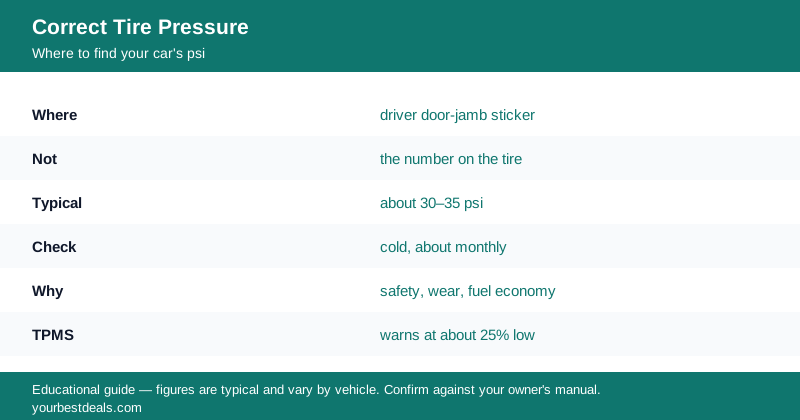
Your car’s correct tire pressure is on a sticker in the driver’s door jamb (sometimes in the fuel door or glovebox, and always in the owner’s manual) – not the number molded on the tire sidewall, which is the tire’s maximum pressure, not your car’s recommendation. Most passenger cars call for somewhere around 30 to 35 psi, but use your specific number. Check pressure when the tires are cold (sitting a few hours, before driving), about once a month and before long trips. Correct pressure matters for three reasons: safety (handling and blowout risk), even tire wear (so your tires last), and fuel economy. It’s a two-minute check that saves money and keeps you safe.
This is the question I most wished every customer knew the answer to, because the wrong number costs them tires and mpg. The door-jamb sticker is the one to trust – the big number on the tire is a trap.
Where to find it and how to check
The door-jamb sticker is the authority: open the driver’s door and look at the frame (B-pillar) for a label listing the recommended cold tire pressures, usually front and rear (sometimes different), in psi. The owner’s manual has the same figures. Some older cars put the sticker in the fuel door or glovebox.
Don’t use the tire’s sidewall number. The “Max. Press. XX psi” molded on the tire is the maximum the tire can hold, not the pressure your car’s engineers chose for the best balance of ride, handling, wear, and economy. Inflating to the sidewall max usually over-inflates for your vehicle.
Check cold. Tire pressure rises as tires warm from driving, so check when cold (parked several hours or driven less than a mile) for an accurate reading against the recommended cold psi. Use a decent gauge, check all four (and the spare occasionally), and add air to the recommended number.
Pressure ties into wear and TPMS; our tire wear patterns guide, TPMS sensor guide, and new tires cost guide cover the related topics.
Shop Talk
The single most common tire mistake I saw was people inflating to the big number on the tire sidewall – that’s the tire’s maximum, not your car’s spec, and it over-inflates most vehicles, giving a harsh ride and center tire wear. Always use the door-jamb sticker number instead. A few practical tips: check pressure cold, because driving heats the air and raises the reading several psi, so a “correct” reading on warm tires is actually low once they cool. Temperature swings matter too – pressure drops roughly 1 psi for every 10°F drop, which is why the TPMS light often pops on the first cold morning of fall; that’s usually just the cold, so check and top off rather than assume a leak (though if one tire is consistently low, it may have a slow leak worth inspecting). Keep a decent gauge in the car; gas-station gauges are often inaccurate. Don’t forget the spare if you have one. Correct pressure is really a money-saver: under-inflation wears the tire edges and hurts fuel economy, over-inflation wears the center and rides rough, and both are avoidable with a monthly check. The door sticker and a $10 gauge are all you need – and if your car has TPMS, treat the light as a prompt to check, not a replacement for checking, since it usually only warns once you’re already significantly low.
Where Drivers Overpay
The overpay from wrong pressure is premature tire wear and wasted fuel. Under-inflation wears the edges and drags down mpg; over-inflation wears the center and rides harshly – and inflating to the sidewall max (instead of the door sticker) is the usual cause of the latter. Either way you’re buying tires sooner and burning more gas.
The pattern: use the door-jamb number, check cold about monthly, top off for cold-weather drops, and inspect a tire that’s repeatedly low rather than just refilling it.
The Real Number
Your correct tire pressure is on the driver’s door-jamb sticker (or owner’s manual), not the max number on the tire – most cars want around 30 to 35 psi, but use your specific figure. Check it cold, about monthly and before trips, with a decent gauge. Correct pressure protects safety, tire life, and fuel economy, while inflating to the sidewall max over-inflates and wears the center. Treat a TPMS light as a prompt to check, and inspect any tire that’s repeatedly low.
Frequently Asked Questions
Where is the correct tire pressure listed?
Your car’s recommended tire pressure is on a sticker in the driver’s door jamb (the door frame visible when you open the driver’s door), and it’s also in your owner’s manual – those are the figures to use. The door-jamb label lists the recommended cold tire pressures in psi, usually for the front and rear tires (which can differ), and sometimes separate figures for the spare or for heavy loads. On some older vehicles the sticker is located in the fuel-filler door or the glovebox instead, but the driver’s door jamb is the most common spot. These numbers were chosen by your vehicle’s engineers for the best balance of ride comfort, handling, tire wear, and fuel economy for your specific car, so they’re the correct target. Do not use the pressure molded into the tire’s sidewall for your everyday inflation – that’s the tire’s maximum pressure, a different thing (explained below). If you can’t find the door sticker, the owner’s manual has the same specification. Once you know your recommended front and rear psi, you can check and set your tires to those numbers. It takes just a moment to locate, and knowing it is the foundation of proper tire maintenance, so check your door jamb and note the figures for your car.
Why shouldn’t I use the pressure number on the tire?
The number molded on the tire sidewall (often shown as “Max. Press. XX psi”) is the tire’s maximum safe pressure, not your car’s recommended pressure, so using it usually over-inflates your tires and causes problems. That sidewall figure tells you the most pressure the tire is rated to hold, which is a property of the tire itself; it is not tailored to your vehicle’s weight, suspension, and engineering. Your car’s correct pressure – the one on the door-jamb sticker – is typically lower than the tire’s max, chosen for the best ride, handling, wear, and fuel economy for your vehicle. If you inflate to the sidewall max, you’ll likely over-inflate, which gives a harsher ride, reduces the tire’s contact patch (hurting grip), and causes the center of the tread to wear faster than the edges, shortening tire life. So the sidewall max and your recommended pressure are two different numbers for two different purposes. Always set your everyday pressure to the door-jamb (vehicle) recommendation, not the tire’s maximum. The sidewall number is useful to know as an upper limit, but it’s not your target. This is one of the most common tire mistakes, and avoiding it is simple once you know to use the door sticker instead. Set to your car’s spec, and your tires wear evenly and ride as intended.
Should I check tire pressure when tires are hot or cold?
Check tire pressure when the tires are cold – meaning the car has been parked for several hours or driven less than about a mile – because the recommended pressures on your door sticker are cold-inflation figures, and driving heats the air inside, raising the reading. As you drive, friction and road heat warm the tires, and the air inside expands, increasing the measured pressure by several psi. So if you check pressure on warm tires and set it to the recommended number, the tires will actually be under-inflated once they cool back down. To get an accurate reading against the spec, check first thing in the morning or after the car has sat, before driving far. If you must add air at a gas station after driving (tires warm), a common approach is to set them a few psi above the cold target to account for the warmth, then recheck cold later and fine-tune – but checking cold is the clean way. This is also why pressure readings differ between a cold morning and a hot afternoon, and why the TPMS light often appears on the first cold day (cold air contracts, lowering pressure). The rule is simple: measure and set pressure cold for accuracy, and remember that warm readings run high. Keep a gauge in the car so you can check cold at home rather than relying on after-driving station checks. Cold is the standard for a reason.
How often should I check my tire pressure?
Check your tire pressure about once a month, and always before a long road trip – more often in seasons with big temperature swings. Tires naturally lose a little air over time (a pound or two a month is normal even without a leak), and pressure changes with temperature, so a monthly check keeps all four at the correct level for safety, even wear, and fuel economy. Before a long trip is a smart extra check, since you’ll be at highway speeds for extended periods where correct pressure matters most. In fall and winter, when temperatures drop, pressure falls with them (roughly 1 psi per 10°F), so check more frequently and expect to add air – this is why the TPMS light commonly appears on the first cold mornings. If your car has a tire-pressure monitoring system (TPMS), treat its warning as a prompt to go check and top off, not as a substitute for monthly checks, because TPMS typically only warns once a tire is already significantly low (around 25 percent under). A monthly habit catches slow losses before they become a problem or a warning. It takes a couple of minutes with a gauge, and it’s one of the cheapest, most effective maintenance habits for tire life and safety. So set a monthly reminder, check before trips, and check more in cold weather – and keep a good gauge in the glovebox to make it easy.
What happens if my tires are under- or over-inflated?
Both under- and over-inflation cause problems – under-inflation wears the tire edges, hurts fuel economy, and raises blowout risk, while over-inflation wears the center, gives a harsh ride, and reduces grip – which is why hitting the correct pressure matters. Under-inflated tires flex more, run hotter, and wear on both outer edges of the tread; they also increase rolling resistance, so your fuel economy drops, and the extra heat and flex raise the risk of a blowout, especially at highway speed. Over-inflated tires are too stiff, so only the center of the tread contacts the road, wearing the middle faster and leaving less rubber gripping the road (reducing traction and giving a jarring ride). Both conditions shorten tire life by wearing them unevenly, meaning you replace tires sooner than you should. Correct pressure – the door-sticker number – spreads wear evenly across the tread, maximizes the contact patch for grip, optimizes fuel economy, and gives the intended ride. So the cost of wrong pressure is real: premature tire replacement and wasted fuel, both avoidable. This is why the monthly cold check pays off. If you notice uneven wear (edges or center), check your pressure first, as it’s a common and fixable cause. For reading wear patterns, see our tire wear patterns guide. Keep your tires at the recommended psi and they’ll last longer and perform as designed.
Why does my tire pressure light come on in cold weather?
The tire-pressure warning (TPMS) light commonly comes on during the first cold mornings because air contracts as temperature drops – pressure falls roughly 1 psi for every 10°F decrease – so a tire that was properly inflated in warm weather can read low enough to trigger the warning when it gets cold. This is usually not a leak; it’s simple physics. When a cold front moves in or on the first chilly fall morning, the drop in temperature lowers your tire pressure across all four tires, and if that brings them below the TPMS threshold (typically around 25 percent under the recommended pressure), the light illuminates. The fix is simply to check the pressure (cold) and add air back to the recommended level; the light should go off after you’ve driven a short distance or it recalibrates. That said, don’t automatically dismiss the light – if it comes on and one tire is significantly lower than the others, that tire may have a slow leak (a nail, a valve issue) worth inspecting, versus all four being a bit low from cold. So treat the cold-weather TPMS light as a prompt to check all four pressures: if they’re uniformly a little low, it’s the cold, so top them off; if one is notably low, inspect it for a leak. Either way, checking is the response, since the light means at least one tire is below spec. Keeping up with pressure in cold months prevents the recurring light and keeps the tires safe. For TPMS sensor issues, see our TPMS sensor guide.
Do I need to set front and rear tires to different pressures?
Possibly – many vehicles specify the same pressure for all four tires, but some call for different front and rear pressures, so check your door-jamb sticker, which lists the correct figure for each. The sticker will show the recommended cold pressure for the front tires and for the rear tires; if they’re the same number, set all four alike, but if the front and rear figures differ (which is common on some vehicles, especially those with particular weight distributions or towing considerations), set each axle to its specified pressure. Don’t assume all four are the same without checking the sticker, and don’t average them – use the exact front and rear numbers given. Some stickers also list a higher pressure for heavy loads or towing, which you’d use only in those conditions. Matching each axle to its spec ensures even wear and proper handling as the engineers intended. This is another reason to rely on the door-jamb label rather than a generic number: it tells you precisely what each position needs. So when you check and set your pressures, note whether your car’s front and rear recommendations differ, and set them accordingly. For most cars it’s a single number for all four, but a quick look at the sticker confirms whether yours is an exception. Setting the correct, possibly different, pressures front and rear is part of doing tire pressure right, and it’s no extra effort once you know your car’s figures.
Sources
Tire-pressure guidance verified against standard tire-safety and manufacturer placard practice in November 2026. Always use the recommended pressures on your vehicle’s door-jamb sticker or owner’s manual.
- NHTSA – tire safety and pressure
- Tire Rack – tire pressure basics
- ASE – National Institute for Automotive Service Excellence
Related Guides
- Reading Tire Wear Patterns
- TPMS Sensor Replacement Cost
- Tire Rotation Cost
- New Tires Cost
- Tire Guides

Diane Holcomb spent seven years as a service advisor at multi-brand dealerships in Charlotte, NC, where she saw how many people inflated to the tire’s max number and wore out tires early – so she always pointed them to the door-jamb sticker and a monthly cold check. She drives a 2019 Honda CR-V and a hand-me-down 2007 Toyota Camry, and takes no referral fees or advertising money from any shop or chain.