
Last updated: November 3, 2026 – By Eddie Brennan
November 2026 update: reconfirmed the warped-rotor cause, resurface-vs-replace costs, and the timing clue.
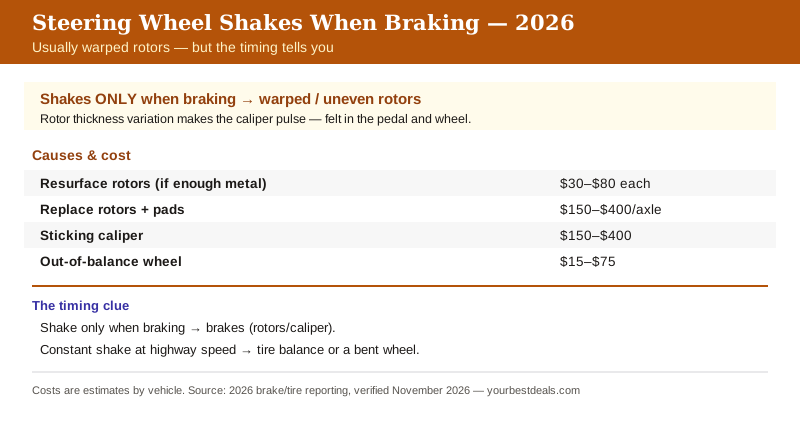
If your steering wheel shakes, wobbles, or pulses specifically when you brake, the classic cause is warped or unevenly worn brake rotors. As the caliper squeezes a rotor that has thickness variation, it grabs and releases in a rhythm, and that pulsing feeds back through the pedal and steering wheel – usually worst at higher speeds. The fix is either resurfacing the rotors ($30 to $80 each, if there’s enough metal left) or replacing them with new pads ($150 to $400 per axle). The key diagnostic is timing: a shake only when braking points at the brakes, while a constant shake at highway speed points at tire balance or a bent wheel. Here’s how to tell which and what each costs.
This is one of the most common complaints I heard, and the timing of the shake usually told me the answer before I even drove the car. Let me walk through why rotors cause it, the other possibilities, and the simple clue that separates a brake problem from a tire problem.
Why warped rotors cause the shake
Your brakes work by squeezing the pads against a spinning rotor. For smooth braking, the rotor needs to be a perfectly even thickness all the way around. Over time – from heat, hard braking, or uneven pad deposits – a rotor can develop thickness variation, often loosely called “warping.” When the caliper clamps a rotor that’s thicker in some spots than others, it’s pushed in and out with each rotation, and that pulsing travels up through the brake pedal and, on the front brakes, into the steering wheel.
That’s why the shake appears only when you’re braking and often gets stronger the harder or faster you brake. Front rotor problems shake the steering wheel; rear rotor problems are felt more as a pulsing pedal or a shudder in the seat. The rotors don’t have to be dramatically warped – even small thickness variation is enough to feel. This is a common wear issue, not usually a sign of anything catastrophic, but it’s worth fixing because uneven braking lengthens your stopping distance. See our brakes guide for the full system.
The causes and costs
Here’s what’s usually behind a brake-related shake, with rough costs. These are estimated ranges that vary by vehicle.
| Cause | Typical cost | Clue |
|---|---|---|
| Resurface (machine) rotors | $30–$80 each | If enough metal remains |
| Replace rotors + pads | $150–$400 per axle | If rotors are too thin to machine |
| Sticking brake caliper | $150–$400 | Pulling, uneven wear, hot wheel |
| Out-of-balance wheel | $15–$75 | Shakes at speed even without braking |
| Bent wheel / worn suspension | Varies | Constant vibration or clunk |
Whether rotors can be resurfaced or must be replaced depends on their remaining thickness – a shop measures them against the minimum spec. Modern rotors are often thin enough that replacement is the norm, and since new pads are usually done at the same time, a per-axle brake job is the common outcome. Our brake pad and rotor cost page has the detail.
Shop Talk
The timing of the vibration is the whole diagnosis, so pay attention to when it happens. Shakes ONLY when braking? Brakes – rotors or a caliper. Shakes constantly at highway speed, braking or not, and smooths out below a certain speed? That’s a tire balance problem or a bent wheel, a much cheaper $15-to-$75 fix. Feels like a clunk or wander plus vibration? Suspect worn suspension. One more real-world note: sometimes what feels like “warped rotors” is actually uneven pad material deposited on the rotor from riding the brakes or from cheap pads. A shop can sometimes clean that up, and using quality pads and bedding them in properly prevents it. So don’t always assume you need new rotors – ask whether it’s true thickness variation or just deposits.
What Gets Misdiagnosed
The most common mix-up is blaming the brakes for a shake that’s really tire balance, or vice versa. The timing clue settles it: a shake that appears only under braking is the brakes, while a vibration that’s there at highway speed whether or not you’re braking is tire balance or a bent wheel – a far cheaper fix. Replacing rotors won’t fix an unbalanced tire, and rebalancing won’t fix warped rotors, so matching the symptom’s timing to the right system avoids paying for the wrong repair.
The second is assuming every brake shake means new rotors when resurfacing or even cleaning off uneven pad deposits would do. If the rotors have enough thickness, machining them is cheaper than replacement; and sometimes the “warping” is just pad material transferred unevenly onto the rotor, which can be corrected without new parts. A good shop measures the rotors and tells you honestly whether they can be saved. So before authorizing full rotor-and-pad replacement, ask whether resurfacing is an option and whether it’s true thickness variation. Getting the timing and the rotor condition right keeps a cheap vibration from being treated as an expensive one.
The Real Number
A steering wheel that shakes only when braking is almost always warped or uneven front rotors – resurface for $30 to $80 each if there’s enough metal, or replace rotors and pads for $150 to $400 per axle. Use the timing clue: a shake only under braking is the brakes, while a constant shake at highway speed is tire balance or a bent wheel ($15 to $75). Don’t assume you need new rotors before a shop measures them or checks for uneven pad deposits, and don’t let a cheap balance problem be treated as a brake job. Either way, fix it, because uneven braking lengthens your stopping distance.
Frequently Asked Questions
Why does my steering wheel shake only when I brake?
A shake that appears only when braking is almost always caused by warped or unevenly worn front brake rotors. When the caliper squeezes a rotor that varies in thickness, it grabs and releases rhythmically, and that pulsing travels up through the steering wheel, usually worse at higher speeds or under harder braking. Front rotors shake the wheel; rear rotors are felt more as a pulsing pedal. The fix is resurfacing the rotors if they have enough metal, or replacing them with new pads. Because the shake is tied specifically to braking, it points at the brakes rather than tire balance, which would cause a vibration even when you’re not braking.
How much does it cost to fix warped rotors?
If the rotors have enough thickness left, resurfacing (machining them smooth) runs about $30 to $80 per rotor. More often on modern cars, the rotors are too thin to machine and get replaced, typically with new pads, at $150 to $400 per axle. A shop measures the rotors against the manufacturer’s minimum thickness to decide which applies. These are estimated ranges that vary by vehicle. If a sticking caliper caused the problem, add $150 to $400 for that. Because a brake shake affects stopping, it’s worth fixing promptly, and asking whether resurfacing is possible can save money versus automatic replacement.
Is it safe to drive with a shaking steering wheel when braking?
You can drive short-term, but it’s not something to ignore, because it means your braking is uneven, which lengthens stopping distance and stresses brake components. Warped rotors won’t usually fail catastrophically right away, but the problem tends to worsen and can indicate related issues like a sticking caliper. If the shaking is severe, the braking feels weak, or you hear grinding, treat it as more urgent and get it checked soon. For safety, brakes are not the place to defer repairs for long. Have the rotors and pads inspected promptly so a simple resurface or pad-and-rotor job doesn’t become a bigger problem.
Can warped rotors fix themselves or go away?
No. Rotor thickness variation is a physical condition that doesn’t correct itself with driving – if anything, it tends to get worse over time as the uneven surface wears further. Sometimes what feels like warping is uneven pad material deposited on the rotor, and in some cases that can be reduced by driving habits or corrected by a shop, but true thickness variation requires resurfacing or replacement. So a brake shake that has appeared won’t disappear on its own; it needs the rotors addressed. Ignoring it lets the problem grow and can shorten the life of the new pads once you do fix it. Get it inspected rather than waiting for it to resolve.
Why does my car shake at high speed but not when braking?
A vibration that’s present at highway speed whether or not you’re braking, and often smooths out below a certain speed, points at the tires or wheels rather than the brakes. The most common cause is a wheel that’s out of balance, a cheap $15-to-$75 fix, or a tire with uneven wear or a bent wheel. This is a completely different problem from warped rotors, which only shake when braking. So the timing is the key clue: braking-only means brakes, constant-at-speed means tire balance or a wheel. Getting this distinction right avoids paying for a brake job when a simple rebalance would fix it, or vice versa.
Could it be something other than rotors?
Yes. While warped rotors are the most common cause of a brake shake, a sticking brake caliper can cause uneven braking and vibration, often with a pull to one side or a hot wheel, at $150 to $400 to fix. Worn suspension or steering parts – a ball joint, tie rod, or wheel bearing – can also produce vibration, sometimes with a clunk or wander. And as noted, tire balance issues cause a shake at speed rather than under braking. A proper inspection checks the rotors’ thickness, the calipers, the suspension, and the tire balance to pinpoint the cause. So if new rotors don’t fully solve it, the caliper or suspension may be involved.
Should I replace rotors in pairs?
Yes, rotors are typically replaced in axle pairs – both fronts or both rears – even if only one is warped, because matched rotors give even, balanced braking side to side. Replacing just one can cause the car to pull or brake unevenly, since the two sides would have different surfaces and thicknesses. New pads are usually installed at the same time, since fresh pads bed in best against fresh rotor surfaces. This is why a brake job is quoted per axle rather than per wheel. It’s not upselling; it’s how you get even, safe braking. Budget for the pair plus pads on the affected axle when you fix a rotor-related shake.
Sources
Brake shake causes and rotor cost ranges verified against 2026 brake and tire reporting on November 3, 2026. Costs are estimated ranges that vary by vehicle; a shop measures rotor thickness to decide resurface vs replace.
- RepairPal – brake rotor replacement cost estimate, 2026
- CarParts.com – brake rotor replacement and resurfacing, 2026
- K&K Richardson – wheel balancing and tire service, 2026
Related Guides
- Why does my car shake when I brake?
- Tire care guide: pressure, tread, and cost
- Brake pad and rotor replacement cost
- How often should I rotate my tires?

Eddie Brennan spent 11 years as an ASE Master Certified technician at an independent shop in Columbus, OH, where the timing of a vibration told him whether it was rotors or tire balance before he even drove the car. His A5 Brakes certification covers exactly this diagnosis. He takes no referral fees and drives a 250,000-mile 2015 Subaru Outback and a 2020 Ford F-150.