
Last updated: November 7, 2026 – By Diane Holcomb
November 2026 update: refreshed the rebuild-vs-reman-vs-used comparison and the car-value decision rule.
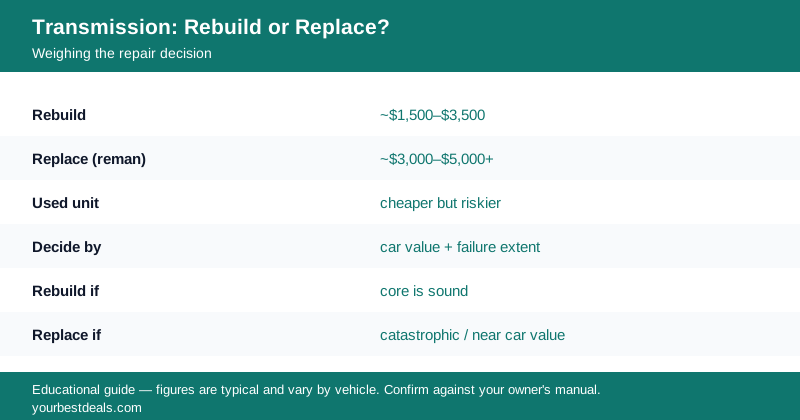
When a transmission is truly failing, you’ve got three paths, and the right one depends on cost, warranty, and what the car is worth. A rebuild reuses your transmission’s case and replaces the worn internal parts – its quality depends heavily on who does the work and what warranty comes with it. A remanufactured (“reman”) unit is rebuilt to factory spec in a dedicated facility, usually with the strongest, longest warranty – often the most reliable choice. A used (junkyard) transmission is the cheapest up front but a gamble on an unknown unit with unknown remaining life and little or no warranty. The decision that matters most isn’t just which is cheapest today – it’s comparing total cost plus warranty against the car’s value, because on an older car a major transmission job can cost more than the car is worth.
This was one of the hardest conversations I had as a service advisor – telling someone their transmission is done and walking them through options that all cost real money. The honest version of that conversation always included “what’s this car worth to you,” because the cheapest repair isn’t always the right one, and neither is the most expensive.
The three options, side by side
Rebuild. A technician (or transmission specialist) disassembles your existing transmission, replaces the worn clutches, bands, seals, gaskets, and any damaged hard parts, and reassembles it. The appeal is keeping your original unit and often a mid-range price. The catch is that quality varies with the skill of whoever does it and the thoroughness of the work, so the shop’s reputation and the warranty they stand behind matter enormously. A good rebuild from a reputable transmission shop with a solid warranty can be an excellent value; a cut-rate rebuild with a short warranty is a risk.
Remanufactured. A reman transmission is rebuilt in a dedicated facility to factory specifications, typically with updated parts that address known weak points, tested before shipping, and backed by a strong nationwide warranty. It’s often priced similar to or somewhat above a rebuild, but the standardized process and warranty make it frequently the most reliable choice – you’re getting a known quantity.
Used. A used transmission pulled from another vehicle is the cheapest option up front. The trade-off is real: you’re buying an unknown unit with unknown mileage and remaining life, usually with a short warranty or none, and if it fails you’ve paid the labor to install it twice. A used unit can make sense on a low-value car where you’re minimizing spend, but it’s the highest-risk path.
For the actual dollar figures, see our transmission repair and rebuild cost guide and replacement cost guide.
Shop Talk
The number that actually decides this isn’t the repair price – it’s the repair price next to what your car is worth. Look up your car’s value (a quick trade-in or private-party estimate), then compare it to the total cost of each transmission option installed. If a reman transmission installed costs more than the car is worth, you’re deciding whether to put more money into the car than you could sell it for, which only makes sense if the car is otherwise solid and you plan to keep it a good while. On the labor side, here’s a thing people don’t realize: the labor to remove and install the transmission is largely the same whether you go rebuild, reman, or used, and it’s a big chunk of the bill. That’s why a used unit’s lower part price can be deceptive – if it fails in a year, you pay that heavy install labor a second time, wiping out the savings. So weigh the warranty seriously: a reman with a long nationwide warranty means if it fails, you’re covered, including (on many warranties) the labor. A used unit with a 30-day warranty means you’re on your own. If you’re keeping the car, the warranty often justifies spending a bit more on a reman. If the car’s on its last legs and you just need it to run a while longer, a good used unit or an as-is rebuild might be the rational gamble. Match the repair to the car’s future, not just today’s lowest quote.
Where Drivers Overpay
The place people lose money here is treating the three options as interchangeable and just picking the cheapest quote – or the most expensive assuming it’s “safest” – without matching the choice to the car. Someone with a high-value car they’ll keep for years sometimes gambles on a cheap used unit and pays the heavy install labor twice when it fails. Someone with a nearly worthless older car sometimes sinks reman money into a vehicle worth less than the repair.
The other overpay is not comparing warranties. Two quotes can look similar on price while one includes a long nationwide warranty (often covering labor if it fails) and the other is 30 days parts-only. The warranty is part of the price – a cheaper quote with no coverage can be the more expensive choice if the unit fails. Always compare total cost and warranty together, against the car’s value.
The Real Number
Three options: a rebuild (reuses your case, quality depends on the shop and warranty), a remanufactured unit (factory-spec, strongest warranty, often the most reliable), and a used unit (cheapest up front, a gamble with little warranty). Since the install labor is similar across all three, a used unit’s low part price can be false economy if it fails and you pay that labor twice. Compare total cost and warranty together, then weigh against the car’s value – if the repair costs more than the car is worth, only a car you’ll keep a while justifies it. For figures, see our transmission repair and rebuild cost guide.
Frequently Asked Questions
What’s the difference between a rebuilt and a remanufactured transmission?
The core difference is where and how the work is done: a rebuilt transmission is your (or a) transmission taken apart and reassembled with new worn components, often by a local shop, while a remanufactured transmission is rebuilt in a dedicated facility to factory specifications, typically with updated parts, standardized testing, and a stronger warranty. In a rebuild, the technician disassembles the unit, inspects the parts, replaces the clutches, bands, seals, gaskets, and any failed hard parts, and reassembles it – the quality depends on the skill and thoroughness of whoever does the work, which is why the shop’s reputation and the warranty matter so much. In a remanufacture, the process is industrialized: units are completely disassembled, all wear items are replaced as a matter of course, components are often upgraded to address known design weaknesses, everything is tested to a specification before the unit ships, and the result comes with a strong, usually nationwide warranty. The practical upshot is that a reman transmission is a known, standardized quantity with good warranty coverage, while a rebuild’s quality ranges from excellent (a reputable specialist) to risky (a cut-rate job). Price is often similar between a quality rebuild and a reman, so the decision frequently comes down to warranty and your confidence in the specific shop. Both are legitimate; the reman trades a bit of cost for standardization and warranty, while a good local rebuild can be an excellent value. For costs, see our transmission repair and rebuild cost guide.
Is a used transmission a bad idea?
A used transmission isn’t automatically a bad idea, but it’s the highest-risk of the three options, so it makes the most sense in specific situations – namely a lower-value car where minimizing spend matters more than long-term certainty – and much less sense on a car you intend to keep for years, because you’re buying an unknown unit with unknown remaining life and usually little or no warranty. The appeal is obvious: a used (salvage/junkyard) transmission is the cheapest part cost by a wide margin. The risk is equally real: you don’t know the mileage or condition of what’s inside it, whether it was pulled from a well-maintained car or a neglected one, or how much life it has left, and warranties on used units are typically short (30 to 90 days) or nonexistent. The hidden danger is the install labor – removing and installing a transmission is labor-intensive and largely the same cost regardless of which unit goes in, so if a cheap used transmission fails shortly after installation, you pay that substantial labor a second time, often erasing the savings and then some. That’s why a used transmission is best reserved for cases where the car’s overall value is low enough that you’re deliberately spending as little as possible and accepting the risk, ideally from a reputable salvage source that offers at least some warranty and can tell you the donor vehicle’s mileage. On a car worth keeping, the certainty of a reman or quality rebuild usually justifies the higher cost. For replacement costs, see our transmission replacement guide.
How do I decide if the repair is worth it versus junking the car?
The clearest way to decide whether a transmission repair is worth it or whether you should let the car go is to compare the total installed cost of the repair against your car’s current market value and its overall condition – if the repair costs more than the car is worth and the car has other looming issues, replacement of the vehicle often makes more sense, while if the car is otherwise solid and you’ll keep it for years, even a repair exceeding its resale value can be justified. Start by getting your car’s value (a trade-in and private-party estimate from a valuation source). Then get total installed quotes for your transmission options. Now weigh: if a reman transmission installed costs, say, more than the car’s value, you’re putting more into it than you could sell it for – which is fine if the rest of the car (engine, body, other systems) is in good shape and you plan to drive it several more years, because a known-good transmission in an otherwise sound car you keep is cheaper than a car payment. But if the car is high-mileage with other problems brewing, or you were planning to replace it soon anyway, sinking major money into the transmission may not pay off. Also consider sentimental or practical factors (a paid-off car you like, the cost and hassle of finding a replacement). There’s no universal cutoff, but the “repair cost versus car value, adjusted for how long you’ll keep it and its other condition” framework is how to think about it clearly. For repair costs to plug into that comparison, see our transmission repair and rebuild cost guide and replacement cost guide.
Why is the labor cost so high for a transmission?
Transmission labor is expensive because the transmission is one of the largest, heaviest, and most deeply integrated components in the car, so removing and reinstalling it involves hours of work – disconnecting it from the engine, driveline, linkages, cooler lines, wiring, and mounts, lowering it out (often requiring a lift and a transmission jack), and reversing all of that on the way back in – and that labor is largely the same regardless of whether you install a rebuild, reman, or used unit. The transmission bolts directly to the engine and connects to the drivetrain, so accessing it typically means working under the car, supporting or partially lowering the engine or subframe on some vehicles, and carefully handling a very heavy assembly. On front-wheel-drive and all-wheel-drive cars especially, the packaging can be tight and the procedure involved. Because this teardown-and-reinstall labor is a fixed, significant part of the job no matter what unit goes in, it has two important implications: first, it’s why total quotes don’t vary as much between options as the part prices alone would suggest, and second, it’s why a cheap used unit that fails is so costly – you repay that heavy labor to do the job over. It also underscores the value of getting the install done once, correctly, with a quality unit and a good warranty, rather than taking a gamble that might force a repeat. When comparing quotes, remember a large portion is this labor, which is why warranty coverage that includes labor on a future failure is worth real money. For cost breakdowns, see our transmission replacement guide.
Does a rebuilt or reman transmission come with a warranty?
Yes – both rebuilt and remanufactured transmissions normally come with warranties, but the length and coverage vary significantly, and this warranty is one of the most important factors to compare because it can be worth as much as the price difference between options. Remanufactured transmissions typically carry the strongest warranties, often nationwide and lasting a few years or a substantial mileage, frequently including coverage for the labor to replace the unit if it fails – which matters enormously given how high transmission labor is. A quality rebuild from a reputable transmission shop usually comes with a solid warranty too, though it may be shorter than a reman’s and sometimes limited to the shop that did the work (a local warranty rather than nationwide), which matters if you travel or move. Cut-rate rebuilds may offer only a short warranty, and used transmissions typically come with little (30 to 90 days) or none. When comparing quotes, you should always ask about the warranty’s length, mileage limit, whether it’s nationwide or local, and crucially whether it covers the labor to reinstall if the unit fails – because a failure that’s covered parts-only still leaves you paying that heavy install labor again. A longer, labor-inclusive, nationwide warranty really offsets a higher purchase price, since it protects you from the worst-case repeat-labor scenario. So treat the warranty as part of the price, not an afterthought. For cost context, see our transmission repair and rebuild cost guide.
Can I avoid a transmission rebuild with maintenance?
You can’t reverse a transmission that already needs a rebuild through maintenance, but you can substantially reduce the risk of ever needing one by keeping the transmission fluid serviced on schedule and by not ignoring early warning signs – because the leading preventable cause of transmission failure is neglected, overheated, or degraded fluid, and catching problems early (a slip, a leak) while they’re still a cheap fix prevents them from becoming a rebuild. Transmission fluid lubricates, cools, and provides the hydraulic pressure the transmission runs on, and it degrades over time and especially with heat; letting it go too long (or running it low from an unaddressed leak) is what wears the internal clutches and leads to failure. So servicing the fluid at the manufacturer’s recommended interval (and more often under severe use like towing or heavy heat) is the single best preventive measure. Beyond fluid, addressing issues early matters: a transmission that’s just starting to slip, or a small leak, is far cheaper to fix than one driven until the internals are destroyed, so not ignoring symptoms is itself preventive. An auxiliary transmission cooler can help on vehicles that tow or run hot. None of this helps a transmission that’s already failed – at that point you’re choosing among rebuild, reman, or used – but going forward, and on your next car, fluid maintenance and early attention to symptoms are what keep you out of this decision in the first place. For fluid service, see our transmission fluid change guide and our slipping guide.
How long should a rebuilt or reman transmission last?
A quality rebuilt or remanufactured transmission, properly installed and maintained, should last a long time – potentially comparable to a new transmission, often many years and well over a hundred thousand miles – but the actual lifespan depends heavily on the quality of the work or reman process, correct installation, and whether you maintain the fluid and avoid the conditions that caused the original failure. A reman transmission built to factory spec with upgraded parts and tested before shipping is designed to deliver reliable, long-term service, which is part of what you’re paying for and why it carries a substantial warranty. A quality rebuild from a skilled shop can last just as long, since the worn components have been replaced; the variability comes in when the rebuild is done cheaply or incompletely, in which case it may not last. Equally important is what happens after installation: the same factors that kill a factory transmission – neglected or overheated fluid, an unaddressed leak, heavy towing without adequate cooling – will shorten a rebuilt or reman unit’s life too, so maintaining the fluid and addressing any cause of the original failure (like a cooling issue) is essential to getting full life out of the new unit. Also, the installer should address related items (fresh fluid, a new filter, often a flush of the cooler lines to remove debris from the failed unit) to protect the replacement. So with quality work and good maintenance, expect long service; with a cut-rate unit or continued neglect, expect less. The warranty length is a reasonable proxy for how long the provider expects their unit to last. For costs, see our transmission repair and rebuild cost guide.
Sources
Rebuild, remanufactured, and used transmission comparison verified against standard transmission-service practice in November 2026. Always compare total installed cost and warranty for your specific vehicle.
- ASE – National Institute for Automotive Service Excellence
- Cars.com – maintenance and repair resources
- Kelley Blue Book – vehicle values
Related Guides
- Transmission Slipping: Signs and Causes
- Transmission Repair and Rebuild Cost
- Transmission Replacement Cost
- Transmission Fluid Change Cost
- Transmission Guides

Diane Holcomb spent seven years as a service advisor at multi-brand dealerships in Charlotte, NC, translating repair estimates for customers, before moving into writing about real-world service costs in 2023. The “rebuild, reman, or used” conversation was one of the hardest she had at the counter, and she always folded in the question of what the car was actually worth. She drives a 2019 Honda CR-V EX-L and a 2007 Toyota Camry, and takes no referral fees or advertising money from any shop or chain.