
Last updated: November 10, 2026 – By Eddie Brennan
November 2026 update: reconfirmed the shift-interlock causes, the free fixes, and the override-slot guidance.
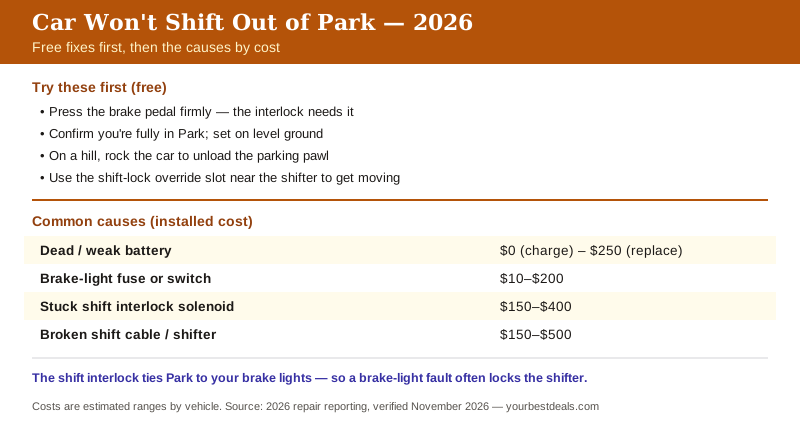
If your car won’t shift out of park, the good news is that it’s usually not the transmission – it’s the shift interlock, a safety system that keeps you locked in Park until you press the brake, and it’s often tripped by something cheap like a weak battery or a bad brake-light switch. Before you panic or call a tow, there are free things to try: press the brake pedal firmly, make sure you’re truly all the way in Park, and on a hill rock the car gently. If those don’t work, the likely causes run from a $10 fuse to a few hundred dollars for a solenoid or shift cable – rarely the four-figure transmission repair people fear.
I got this call a lot, and half the time it was a dead battery or a burned-out brake-light switch, not the transmission at all. The system that locks your shifter is tied to your brake lights, which surprises people, so a brake-light problem can strand you in Park. Let me walk through the free fixes, why the brake connection matters, and what each real cause costs.
Try these free fixes first
Start with the brake pedal. The shift interlock won’t release until it senses a firm brake press, so push the pedal down hard and hold it while you move the shifter – a light tap sometimes isn’t enough, especially if the brake-light switch is marginal. Next, confirm you’re fully in Park and not resting between Park and Reverse; nudge the shifter firmly into Park first, then try again. Parking on level ground helps too.
If you’re parked on a hill, the car’s weight can press the parking pawl – the little pin that locks the transmission in Park – so hard that it binds and won’t release. The fix is to have someone gently rock the car, or briefly apply the parking brake and shift while the pawl unloads. That hillside bind is a classic “stuck in park” that isn’t a fault at all, just physics. If none of these free steps free the shifter, you’re into an actual cause, and every car has a manual override to get you moving in the meantime.
The brake-light connection most people miss
Here’s the part that trips people up: the shift interlock is wired to the same circuit as your brake lights. The system confirms your foot is on the brake by way of the brake-light switch, so if that switch fails or the brake-light fuse blows, the interlock never gets the “brake is pressed” signal and keeps the shifter locked – even though your foot is on the pedal. A quick tell is to check whether your brake lights are working; if they’re out, that’s very likely your culprit.
A brake-light switch is a small part behind the brake pedal, and replacing it or the blown fuse runs roughly $10 to $200 depending on the vehicle and whether it’s a DIY fuse or a shop switch job. It’s one of the cheapest and most common fixes for a car stuck in Park, which is why it’s worth checking your brake lights before assuming anything expensive. This is also why a dead or weak battery can lock you in Park: the electronic interlock needs power to release, so a battery that’s too weak to run it leaves the shifter stuck. Our guide on a battery that won’t hold a charge covers that side.
What Gets Misdiagnosed
The big misdiagnosis is assuming a stuck shifter means a failing transmission. It almost never does – the transmission itself doesn’t care whether you can move the lever; the lock is in the interlock and shifter mechanism, not the gearbox. People imagine a four-figure repair when the actual cause is a $15 brake-light switch or a battery that needs a jump. So before you tow it to a transmission shop, check the cheap, common causes: brake lights, battery, and whether you’re fully in Park.
The other miss is forgetting the shift-lock override. Every automatic has a manual release – usually a small slot or button near the shifter, sometimes under a little cover, that you press with a key or screwdriver while pressing the brake to move out of Park. That’s not a repair, it’s a get-moving workaround so you can drive to a shop instead of paying for a tow. Using it doesn’t fix the cause, but it turns “stranded” into “inconvenienced.” Check your owner’s manual for its exact location, since it’s easy to overlook.
Shop Talk
Learn where your shift-lock override is before you ever need it – it’s a small slot near the base of the shifter, often under a snap-out cap, and your manual shows it. With the brake pressed and the key on, insert a key or small screwdriver into the slot and you can move out of Park. That single trick saves a tow fee on a car that’s otherwise fine to drive. And if you’re stuck in Park with dashboard lights that look weak or a slow crank, suspect the battery first: the electronic interlock needs power to release, so a jump-start often frees the shifter instantly and tells you the battery, not the transmission, was the problem.
The real causes, by cost
When the free fixes don’t work, here’s what’s usually behind it, cheapest first. These are estimated installed ranges that vary by vehicle.
| Cause | Typical cost | Tell-tale sign |
|---|---|---|
| Dead or weak battery | $0 (jump) – $250 (replace) | Weak lights, slow crank |
| Blown brake-light fuse | $10–$30 | Brake lights out |
| Bad brake-light switch | $50–$200 | Brake lights out; cruise may fail |
| Stuck shift interlock solenoid | $150–$400 | Brake lights fine, still locked |
| Broken shift cable / shifter | $150–$500 | Lever feels loose or disconnected |
Notice the pattern: the cheap causes come with a brake-light clue, so checking your brake lights is the fastest way to narrow it down. Only when the brake lights work and the shifter is still locked do you move toward the solenoid or shift cable. See our transmission guide for related shifting issues.
The Real Number
A car stuck in Park is almost never the transmission – it’s the shift interlock, which is tied to your brake lights and needs battery power to release. Try the free fixes first: press the brake hard, confirm you’re fully in Park, rock the car on a hill, and use the shift-lock override slot to get moving. The real causes run cheap: a weak battery ($0 to $250), a brake-light fuse or switch ($10 to $200), or, less often, a stuck solenoid or shift cable ($150 to $500), all estimated ranges. Check your brake lights first – if they’re out, you’ve likely found it.
Frequently Asked Questions
Why won’t my car come out of park?
Most often it’s the shift interlock, a safety system that keeps you locked in Park until it confirms your foot is on the brake. It’s commonly tripped by a weak battery (the electronic lock needs power to release), a blown brake-light fuse, or a failed brake-light switch, since the interlock reads the brake through that circuit. Start with the free checks: press the brake firmly, make sure you’re fully in Park, and on a hill rock the car to unload the parking pawl. It’s rarely the transmission itself. Checking whether your brake lights work is the fastest way to point at the cause.
Can a dead battery cause the car to be stuck in park?
Yes. On modern cars the shift interlock is electronic and needs power to release the shifter, so a battery too weak to run it can leave you locked in Park. The tell is other weak-electrical signs: dim dash lights, a slow or no crank, and accessories acting up. A jump-start often frees the shifter immediately, which both gets you moving and confirms the battery was the problem. If the battery is old or keeps dying, that’s the real fix. In the meantime, the shift-lock override slot near the shifter lets you move out of Park manually while you sort out the battery.
How do I use the shift lock release?
Every automatic has a manual shift-lock override, usually a small slot or button near the base of the shifter, sometimes hidden under a snap-out cover. With the key in the on position and your foot pressing the brake, insert a key or small screwdriver into the slot and press down while moving the shifter out of Park. Your owner’s manual shows the exact location and steps for your car. This is a workaround to get moving, not a repair – it lets you drive to a shop instead of paying for a tow, but the underlying cause still needs fixing once you’re there.
Is a car stuck in park a transmission problem?
Almost never. The transmission itself isn’t what locks the shifter – the lock lives in the shift interlock and the shifter mechanism, so a stuck lever usually points at the brake-light switch, battery, a fuse, a solenoid, or a shift cable rather than the gearbox. That’s good news, because those causes run from a $10 fuse to a few hundred dollars, not the thousands a transmission repair costs. Before towing to a transmission shop, check your brake lights and battery and try the shift-lock override. If the shifter moves fine but the car won’t drive right afterward, that’s a different, transmission-related issue.
Why does the brake pedal affect shifting out of park?
Because of the shift interlock safety system: it’s designed to prevent you from shifting out of Park unless your foot is on the brake, so you can’t accidentally lurch into gear. It confirms the brake press through the brake-light switch, the same switch that turns on your brake lights. That shared wiring is why a bad brake-light switch or a blown brake-light fuse can lock the shifter even with your foot firmly on the pedal – the interlock simply never gets the signal. It’s also why checking whether your brake lights work is such a useful diagnostic step when you’re stuck in Park.
How much does it cost to fix a car that won’t shift out of park?
It depends on the cause, but it’s usually cheap. A blown brake-light fuse is $10 to $30, a brake-light switch $50 to $200 installed, and a weak battery $0 if a charge holds or up to about $250 to replace. Less commonly, a stuck shift interlock solenoid runs $150 to $400 and a broken shift cable or shifter $150 to $500. These are estimated ranges that vary by vehicle. Because the cheapest causes come with a brake-light clue, checking your brake lights first often points you straight at a sub-$200 fix rather than anything major.
Is it safe to drive after using the shift lock override?
Using the override to get out of Park is fine for driving to a shop, but remember it hasn’t fixed anything – it’s bypassed the lock, not addressed why the lock stuck. If the cause was a weak battery, the car may be fine once running, though the battery still needs attention. If it was a brake-light switch, be aware your brake lights may not be working, which is a safety issue for drivers behind you, so get it fixed promptly and drive cautiously in the meantime. Think of the override as a way to reach the repair, not a substitute for it.
Sources
Shift-interlock causes and repair cost ranges verified against 2026 repair reporting on November 10, 2026. Costs are estimated ranges that vary by vehicle; check your owner’s manual for the shift-lock override location.
- UseCalcPro – transmission and shifter repair cost, 2026
- Rohnert Park Transmission – shifter and repair cost, 2026
- Kwik Kar – transmission service guidance, 2026
Related Guides
- Transmission service and repair cost
- How to check automatic transmission fluid
- Why won’t my car battery hold a charge?
- Signs of a bad starter motor

Eddie Brennan spent 11 years as an ASE Master Certified technician at an independent shop in Columbus, OH, where “stuck in park” calls were usually a dead battery or a brake-light switch – his A6 electrical certification covers exactly that interlock circuit. He takes no referral fees and drives a 250,000-mile 2015 Subaru Outback and a 2020 Ford F-150.