
Last updated: November 7, 2026 – By Diane Holcomb
November 2026 update: reconfirmed bushing-vs-whole-arm pricing and the sealed-arm caveat.
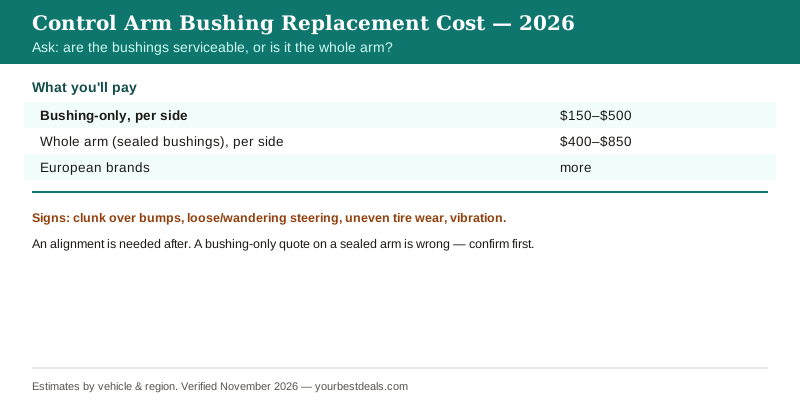
A control arm bushing replacement runs about $150 to $500 per side when the bushing can be pressed in on its own, with labor usually the bigger share. But here’s the catch: many modern control arms come with the bushings sealed in and not serviceable separately, so you replace the whole arm, which runs about $400 to $850 per side (European brands cost more). Signs of worn bushings include clunking or knocking over bumps, a wandering or loose steering feel, uneven tire wear, and vibration. A wheel alignment is needed afterward. The key question to ask your shop: are the bushings serviceable separately, or only as part of the arm? – because a bushing-only quote on a car with sealed bushings is wrong, and the price difference is large.
This repair’s price hinges almost entirely on whether your car’s bushings come out on their own or force a whole-arm replacement. Let me cover the cost, the sealed-arm question, and the clunk that signals wear.
What you’ll actually pay
Here’s the price picture. These are estimated ranges that vary by vehicle and shop.
| Scenario | Cost | Notes |
|---|---|---|
| Bushing-only, per side | $150–$500 | If serviceable |
| Whole arm (sealed bushings), per side | $400–$850 | Common on modern cars |
| European brands | more | Pricier parts |
Pressing bushings in and out requires a press and can be labor-intensive, which is partly why replacing the whole arm is often the practical choice. An alignment follows. Our full control arm cost guide and alignment guide cover the related work.
Shop Talk
The first thing to pin down is whether your control arm’s bushings can be replaced by themselves or whether you’re buying the whole arm. On some cars the bushing is a separate rubber part that a shop presses out and a new one in – that’s the cheaper route. On many modern vehicles the bushings are integrated into the control arm assembly and not sold separately, so a worn bushing means a new arm. If a shop quotes you a bushing-only price on a car that only comes as a complete arm, something’s off – and the reverse, being sold a whole arm when the bushing is serviceable, can be an overpay. That said, pressing bushings is labor-intensive and requires a press, so even when the bushing is technically serviceable, replacing the whole arm is sometimes the better value once you add up the labor – and a new arm comes with fresh ball joints and bushings all at once. The telltale symptom is a clunk or knock over bumps and a loose, wandering steering feel, plus possibly uneven tire wear. And whatever route you take, budget for a wheel alignment afterward, because disturbing the control arm changes the suspension geometry and skipping the alignment chews up tires.
Where Drivers Overpay
The overpay can go both ways, so the sealed-vs-serviceable question is everything. Being sold a whole arm when the bushing is really serviceable separately is one overpay; but equally, a bushing-only quote on a car whose bushings only come as part of the arm is simply wrong and will change once the shop finds out. Asking which your car uses up front sets the right expectation.
There’s also the labor reality: pressing bushings is time-consuming, so even when serviceable, a whole-arm replacement (which includes fresh ball joints) is sometimes the better total value – worth comparing. And the alignment afterward isn’t optional; skipping it ruins tires. The pattern: confirm sealed vs. serviceable, compare bushing-only labor against a whole-arm price, and always budget the alignment.
The Real Number
A control arm bushing is $150 to $500 per side if serviceable on its own, or $400 to $850 if your car’s bushings are sealed into the arm and you replace the whole arm. Ask which yours uses – that’s the whole price story. Because pressing bushings is labor-heavy, a whole arm (with fresh ball joints) is sometimes the better value even when the bushing is serviceable. The telltale sign is a clunk over bumps; budget a wheel alignment afterward.
Frequently Asked Questions
How much does it cost to replace a control arm bushing?
About $150 to $500 per side when the bushing can be pressed in on its own, with labor usually the bigger share. If your car’s bushings are sealed into the control arm and not serviceable separately, you replace the whole arm, which runs about $400 to $850 per side, and European brands cost more. These are estimates that vary by vehicle and shop. The key variable is whether the bushing is a separate part or integrated into the arm. Pressing bushings is labor-intensive, so sometimes replacing the whole arm is the better value even when the bushing is technically serviceable. An alignment afterward adds to the total.
Can control arm bushings be replaced separately?
Sometimes, depending on the vehicle. On some cars the bushing is a separate rubber-and-metal part that a shop can press out of the control arm and replace with a new one, keeping the original arm. On many modern vehicles, though, the bushings are integrated into the control arm assembly and aren’t sold separately, so a worn bushing means replacing the whole arm. That’s the single biggest factor in the cost. Even where the bushing is serviceable, pressing it in and out takes labor and a shop press, so replacing the whole arm (which includes fresh ball joints and bushings) can be the more practical choice. Ask your shop which applies to your car.
What are the signs of worn control arm bushings?
The classic sign is a clunking or knocking noise over bumps, railroad tracks, or when braking, as the worn bushing allows the control arm to move more than it should. You may also notice a loose, vague, or wandering steering feel, a vibration (especially as speed changes), and uneven or accelerated tire wear from the shifted suspension geometry. In bad cases the car’s handling feels imprecise. Because these symptoms overlap with other worn suspension parts (ball joints, sway bar links, struts), a proper inspection confirms the bushings are the cause. Catching worn bushings reasonably early prevents the uneven tire wear and sloppy handling from getting worse.
Do I need an alignment after replacing control arm bushings?
Yes. The control arm is a key part of the suspension geometry, and replacing the bushings (or the whole arm) disturbs the camber and often the caster and toe settings. Without a wheel alignment afterward, the car can pull, handle imprecisely, and – most costly – wear the tires unevenly and quickly. So an alignment should be budgeted as part of this job, typically adding to the total. It’s the same principle as other suspension work: any repair that moves the control arm or changes ride geometry needs the alignment restored to spec. Skipping it to save a little is a false economy that can ruin a set of tires worth more than the alignment.
Is it safe to drive with worn control arm bushings?
Mildly worn bushings cause clunks and sloppy handling but aren’t usually an immediate danger; however, they shouldn’t be ignored, because they worsen over time and affect handling precision and tire wear. Severely worn or failed bushings can let the control arm move excessively, degrading steering and stability and stressing other suspension parts, which becomes a safety concern. If you have a clunk and vague steering, it’s worth having the suspension inspected and the bushings addressed before they deteriorate further. So you can usually drive in the short term with early wear, but worsening clunks, poor handling, or uneven tire wear mean it should be repaired rather than left indefinitely.
What causes control arm bushings to wear out?
The rubber (or polyurethane) in the bushings degrades over time from constant flexing, heat, road salt, oil contamination, and age – eventually cracking, softening, or tearing so the control arm can move more than designed. Rough roads, potholes, hard impacts, and heavy loads accelerate the wear. High mileage is the usual backdrop. Oil or fluid leaks that drip onto a bushing can also deteriorate the rubber faster. There’s no scheduled replacement; bushings are replaced when they wear out and cause symptoms. Because they’re a normal wear item exposed to the elements, higher-mileage and older vehicles – especially in harsh climates – are the common candidates for bushing replacement.
Should I replace both sides at once?
Not automatically, but it’s worth considering on a high-mileage car. If only one side’s bushings are worn and the other side is fine, replacing just the affected side is reasonable. However, because the bushings on both sides are the same age and exposed to the same conditions, if one side has worn out the other may not be far behind – so some owners do both to avoid a second visit and keep handling balanced, especially if the whole arm is being replaced. Your shop can inspect both sides and advise. There’s no firm rule requiring both, so base the decision on the actual condition of each side and your mileage.
Sources
Price ranges verified against 2026 suspension repair pricing in November 2026. Dollar amounts are estimates that vary by vehicle and shop.
- RepairPal – control arm/bushing estimates
- J.D. Power – control arm replacement cost
- ASE – National Institute for Automotive Service Excellence
Related Guides
- Control Arm Replacement Cost
- Wheel Alignment Cost
- Ball Joint Replacement Cost
- Suspension and Steering Guide
- Car Repair Cost Estimator

Diane Holcomb spent seven years as a service advisor at multi-brand dealerships in Charlotte, NC, where the first question on a clunking-suspension write-up was whether the bushings even came separately – on half the cars they didn’t. She drives a 2019 Honda CR-V and a hand-me-down 2007 Toyota Camry, and takes no referral fees or advertising money from any shop or chain.