
Last updated: November 6, 2026 – By Diane Holcomb
November 2026 update: reconfirmed per-wheel pricing and the tire-removal-and-prep point.
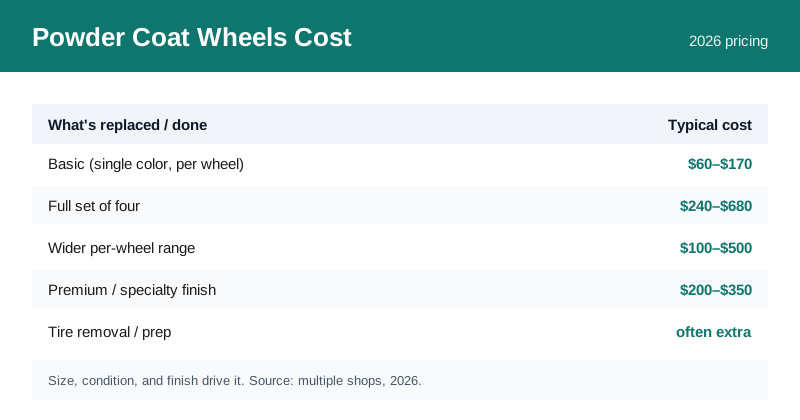
Powder coating wheels runs about $60 to $170 per wheel for a standard single-color gloss finish – roughly $240 to $680 for a set of four. The wider market range is $100 to $500 per wheel depending on the shop, and premium or specialty finishes (matte, textured, custom/candy colors) run $200 to $350 per wheel. Wheel size, the wheels’ condition (curb rash, corrosion), the finish, and whether tire removal and prep are included drive the price. Powder coating applies a durable, baked-on dry finish to wheels or rims – tougher and longer-lasting than regular paint – to restore curb-rash-damaged or corroded wheels, or to change their color. The process is involved: the tire is dismounted, the old finish is stripped, the wheel is prepped and media-blasted, then the powder is applied electrostatically and cured in an oven. Tire mounting and balancing is usually a separate charge, so factor that in.
This is a cosmetic/refinishing job, not a repair, and the prep and tire work are where the “extra” cost hides. Let me break it down.
What you’ll actually pay
Here’s the picture. These are estimates that vary by shop and wheel.
| Item | Cost | Notes |
|---|---|---|
| Basic (single color, per wheel) | $60–$170 | Gloss |
| Full set of four | $240–$680 | Standard |
| Wider per-wheel range | $100–$500 | By shop/size |
| Premium / specialty finish | $200–$350 | Matte, custom |
This is wheel refinishing; our rims guide, tire mount and balance guide, and car scratch guide cover related cosmetic work.
Shop Talk
The quoted per-wheel price usually covers the coating itself, but the full job has extras worth asking about. To powder coat a wheel properly, the tire has to come off (dismount), the old finish is stripped (chemically or by blasting), the wheel is media-blasted and prepped, then the powder is applied and baked in an oven – and afterward the tire is remounted and balanced. Tire dismounting/mounting and balancing are often billed separately from the coating price, as are TPMS sensor service and new valve stems, so ask for an all-in quote. What drives the price up: wheel size (big wheels take more powder and time), condition (curb rash, gouges, or corrosion need more prep and possibly straightening/welding first – a bent or cracked wheel may not be worth coating), and finish (a standard gloss single color is cheapest; matte, textured, two-tone, candy, or chrome-look finishes cost more, sometimes needing multiple coats or a clear). A couple of practical notes: powder coat is truly durable and resists chipping and corrosion better than paint, which is why people choose it for refinishing curbed wheels or changing color. But a severely bent or structurally cracked wheel should be repaired or replaced, not just coated – coating is cosmetic. And check whether the shop does the tire work in-house or you’ll be driving bare wheels somewhere; coordinating tire-off and tire-on matters.
Where Drivers Overpay
The “surprise” here is budgeting only the coating price and forgetting the extras – tire dismount/remount, balancing, TPMS service, valve stems – which are often billed separately. Asking for an all-in quote avoids the shock.
The other is coating a wheel that shouldn’t be: a severely bent or cracked wheel is a structural problem that needs repair or replacement, not a cosmetic coat. The pattern: get an all-in quote including tire and TPMS work, confirm the wheels are structurally sound (not bent/cracked) before coating, and match the finish (standard gloss vs premium) to your budget.
The Real Number
Powder coating wheels is $60 to $170 per wheel for a standard gloss ($240 to $680 for four), with premium/specialty finishes $200 to $350 each. The quoted price usually covers the coating – tire dismount/remount, balancing, and TPMS service are often extra, so get an all-in quote. Size, condition, and finish drive the cost, and a bent or cracked wheel needs repair or replacement, not just a cosmetic coat.
Frequently Asked Questions
How much does it cost to powder coat wheels?
About $60 to $170 per wheel for a standard single-color gloss finish, or roughly $240 to $680 for a set of four. The wider market range is $100 to $500 per wheel depending on the shop and wheel size, and premium or specialty finishes (matte, textured, custom/candy colors) run $200 to $350 per wheel. These are estimates that vary by shop and wheel. The quoted price usually covers the coating itself; tire dismounting/mounting, balancing, TPMS service, and new valve stems are often billed separately, so ask for an all-in price. Cost drivers are wheel size (bigger wheels cost more), the wheels’ condition (heavy curb rash or corrosion needs more prep), and the finish chosen. So budget for the coating plus the tire and TPMS work, and get a full quote rather than just the per-wheel coating number.
What is powder coating and why choose it for wheels?
Powder coating is a finishing process that applies a dry powder (pigment and resin) to the wheel electrostatically, then bakes it in an oven, where it melts and cures into a hard, durable, even coating. Unlike liquid paint, it uses no solvents and forms a thicker, tougher finish. People choose it for wheels because it’s more durable than regular paint – it resists chipping, scratching, fading, corrosion, and brake dust better, and holds up to the harsh environment wheels live in. It’s used to refinish wheels damaged by curb rash or corrosion (restoring them to look new) or to change their color/finish for appearance. The result is a long-lasting, factory-quality-or-better finish available in many colors and textures. So powder coating is popular for both restoration (making curbed or corroded wheels look new again) and customization (changing color), chosen specifically for its durability advantage over paint on a part that takes a lot of abuse.
Does the price include tire removal and remounting?
Often not – the per-wheel coating price frequently covers just the coating, with tire work billed separately, so this is a key thing to confirm. To powder coat a wheel, the tire must be dismounted from it (you can’t coat a wheel with the tire on), and afterward the tire is remounted and the wheel rebalanced. Those tire services – dismounting, mounting, balancing – plus TPMS sensor service and new valve stems are commonly additional charges on top of the coating, either by the coating shop or a tire shop you coordinate with. So when you get a powder-coating quote, ask whether it’s just the coating or an all-in price including the tire off-and-on and balancing. If the shop doesn’t do tires, you may need to take the wheels (tires off) to them and handle mounting elsewhere, which adds coordination and cost. Factoring in the tire work gives you the true total, which is meaningfully more than the coating price alone, especially across four wheels.
What makes powder coating wheels cost more?
Three main factors. First, wheel size: larger-diameter wheels (and wide wheels) have more surface area, so they take more powder, more prep, and more oven time, raising the cost – a set of 22-inch truck wheels costs more than small car wheels. Second, condition: wheels with heavy curb rash, deep gouges, or corrosion need extra prep work (more blasting, filling, sanding), and badly damaged wheels may need repair or straightening first, all adding labor. Third, the finish: a standard single-color gloss is the cheapest; matte, satin, textured, two-tone, metallic, candy, or chrome-look finishes are pricier because they may require special powders, multiple coats, or a clear coat, and more careful application. Add to those whether tire dismount/mount, balancing, and TPMS service are included. So the base per-wheel price assumes a standard-size wheel in reasonable shape with a basic finish; bigger wheels, rough condition, or fancy finishes push it toward (or past) the top of the range. Get a quote based on your specific wheels and desired finish.
Is powder coating better than painting wheels?
For durability, generally yes – which is why it’s the popular choice for wheels. Powder coating creates a thicker, harder, more uniform finish than typical liquid paint, and it resists chipping, scratching, fading, corrosion, chemicals, and brake dust better. Wheels take a lot of abuse (road debris, brake heat, salt, curbs), so the extra toughness of powder coat holds up longer than paint, meaning fewer touch-ups and better long-term appearance. Paint can be cheaper upfront and allows certain custom effects, and a quality paint job can look great, but it typically isn’t as durable on wheels. The trade-offs for powder coat: it requires the specialized process (stripping, blasting, oven curing) so it’s a shop job, not a quick DIY, and changing or repairing it later means re-doing the process. For most people refinishing or recoloring wheels and wanting a lasting result, powder coating is the better value despite being a bit more involved. For a cheap, quick change you might not keep long, paint could suffice – but powder coat wins on longevity.
Can a bent or cracked wheel be powder coated?
Powder coating is cosmetic, so it won’t fix structural damage – a bent or cracked wheel needs repair or replacement, not just a coat. If a wheel is bent (causing vibration or a slow leak) or cracked (which can leak air or fail), that’s a safety and function issue that must be addressed separately: a bent wheel may be straightened by a wheel-repair specialist, and a cracked wheel may sometimes be welded by a qualified shop (or may need replacing if the crack is severe or in a critical spot). Only after it’s structurally sound should it be refinished. Coating a bent or cracked wheel without fixing the damage just makes a compromised wheel look nice – the underlying problem remains. So if your wheels have curb rash or corrosion (cosmetic), powder coating restores them beautifully; but if they’re bent or cracked (structural), handle the repair/replacement first. A good shop will inspect the wheels and tell you whether they’re sound enough to simply coat or need structural work first. Don’t coat over a safety problem.
How long does powder coating on wheels last?
A quality powder-coat finish on wheels is durable and can last many years – often 5 to 10 years or more – holding up well to the wheels’ harsh environment, which is a big part of its appeal over paint. Its longevity depends on the quality of the prep and application (proper stripping, blasting, and curing are key – a rushed job won’t last as well), the finish type, and how the wheels are used and maintained. Normal road use, brake dust, and weather are what it’s built to resist, so it holds its look far longer than paint. What shortens it: fresh curb rash or impacts that chip through the coating (exposing metal to corrosion), harsh wheel cleaners, and poor initial prep. To maximize life, avoid curbing the wheels, clean them with mild wheel-safe products, and address any chips before corrosion spreads. So you can expect a good powder-coat job to look great for years with basic care – a durable, long-lasting finish that justifies the cost, provided the shop did the prep and curing properly. Choosing a reputable coater matters for getting that longevity.
Sources
Price ranges verified against 2026 wheel powder-coating pricing in November 2026. Dollar amounts are estimates that vary by shop and wheel.
- Gilroy Blackout – powder coating cost guide
- thePricer – auto service cost guides
- ASE – National Institute for Automotive Service Excellence
Related Guides
- Rims Replacement Cost
- Tire Mount and Balance Cost
- Car Scratch Repair Cost
- New Tires Cost
- Car Repair Cost Estimator

Diane Holcomb spent seven years as a service advisor at multi-brand dealerships in Charlotte, NC, where she’d remind customers that a wheel powder-coat quote rarely included the tire-off, tire-on, and balancing – so get the all-in number, and don’t coat a bent wheel. She drives a 2019 Honda CR-V and a hand-me-down 2007 Toyota Camry, and takes no referral fees or advertising money from any shop or chain.